Digital Proof or Physical Vial Label Sample? Approve Only What the Evidence Covers
Imagine the artwork approval arriving before lunch. The product code is correct, the lot field is in the right place, and the buyer wants to release the order. The remaining question is whether that label will sit properly on a replacement vial nobody has yet received.
Clicking approval will not answer it. Holding the entire artwork discussion open may not help either. The practical decision is to separate what can be approved now from the physical question still waiting for evidence.
I would ask the supplier to name exactly what the proposed proof or sample represents. “We sent a sample” is too broad when one person means a material swatch and another means the final printed construction applied to the actual container.
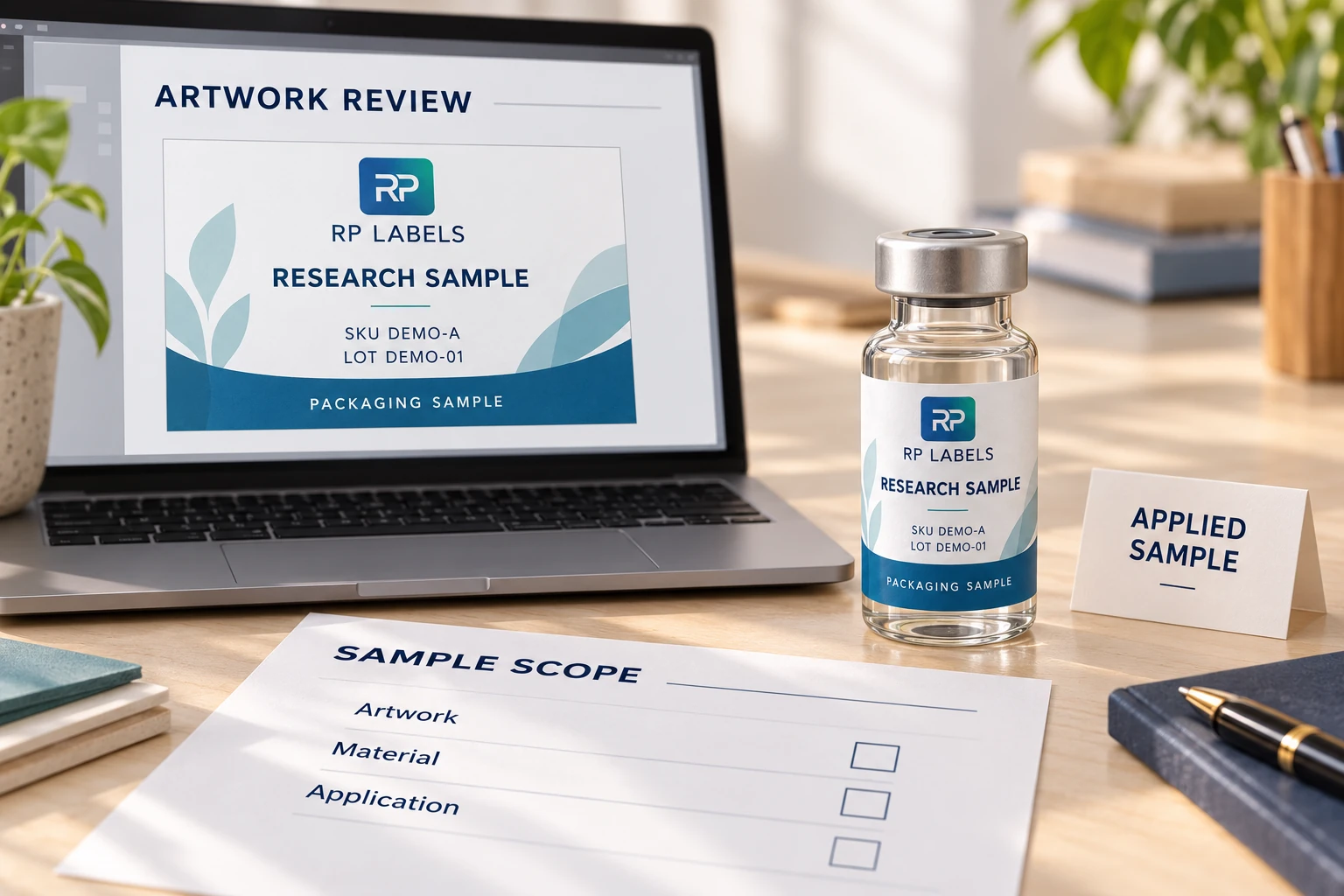
AI-generated packaging illustration. The screen and vial demonstrate different approval objects, not color agreement, physical testing or production release.
Let the PDF finish its own job
A digital proof can show the proposed artwork revision, finished dimensions, cut outline, text, variable-field positions and intended color references. The buyer can compare these with the brief and consolidate corrections before printing.
Be precise about the word “size.” A proof can record the intended finished width and height. It cannot establish that those dimensions fit a container identified only by nominal capacity. The vial measurement guide addresses the container-to-drawing decision; the proof should use the resulting agreed dimensions.
Check the actual approved text, including units and punctuation, rather than judging the overall impression at a large zoom. Confirm which file revision the supplier will use and which variable fields are examples. A realistic-looking DEMO lot does not become production data when someone approves the surrounding artwork.
An ordinary electronic proof also has a color limit. Avery's artwork guidance explains that screen colors vary and are not an exact match to printed products. Its specifications describe its own process; they are not universal RP file requirements. The general buying lesson is to agree the required evidence for critical printed appearance instead of asking a screen to settle it.
Use a 3D mockup to approve the intended view
A bottle rendering can help the artwork owner agree which panel faces the buyer, how two labels align visually or where a logo should sit relative to a cap. Ask which container model and artwork revision were used. If the model is generic, keep its size and curve open in the approval record. RP's sample policy describes a requested 3D bottle mockup as a visual reference and a digital proof as part of the pre-production review.
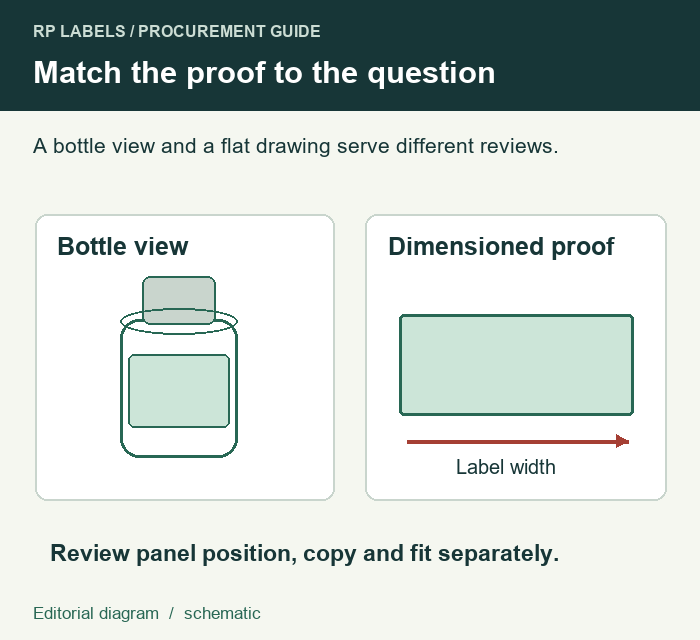
For a layout-only question, sign off the view and use the dimensioned proof to check the final copy and dieline. For a question about whether the label will cover a seam, reach a curved shoulder or maintain contrast on real glass, check a full-size wrap or an identified physical sample on the actual container as appropriate. To approve color or an optical finish, agree on the representative printed material and viewing conditions. Keep each approval attached to its own evidence.
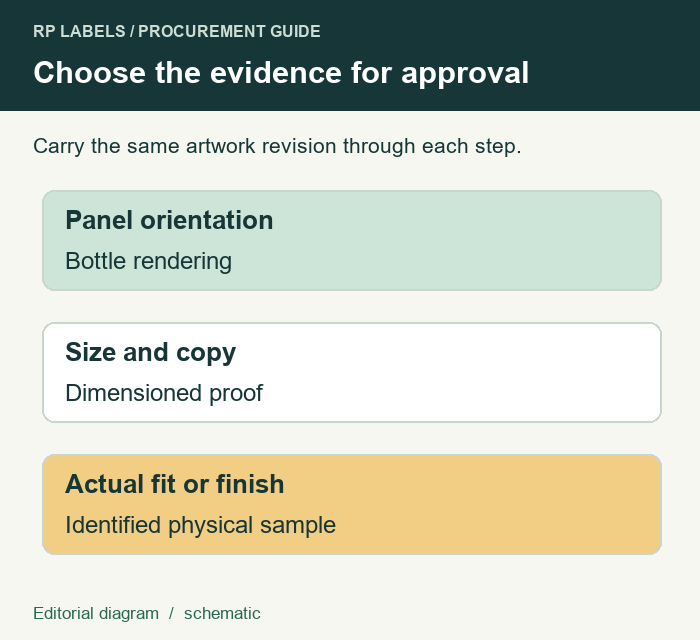
If a rendering shows an approved logo position but the dimensioned proof shows a different version or a changed edge, send both references to the artwork owner before approving production. If a printed sample is needed, ask what it includes and which materials and production steps it represents. Prepare the RP inquiry with the actual container, current art revision, the question to be answered and the person who will approve it.
There is more than one physical sample
A stock material swatch can help the buyer compare feel or a proposed surface. A cut sample may help investigate dimensions. A printed sample can show an identified combination of artwork, material and finish. An applied sample adds the container and application conditions.
Those useful objects do not necessarily establish the same things. A paper outline around a vial is a geometry aid, not an adhesive trial. A generic film swatch does not establish final white-ink coverage or a code's performance on a curved printed label. A sample on one container does not automatically establish behavior on another.
Ask whether the proposed sample uses the intended construction and production route, and document any differences. Some differences may be irrelevant to the particular question; others leave it open. The buyer and supplier need to agree that boundary, rather than assuming every physical object is a complete production trial.
Avery describes an order sample as showing final color, material and finish. That is an example of a supplier defining sample purpose. It does not establish RP sample availability, price, quantity or timing; confirm those for the actual job.
A sample for a close-up photograph has a different job
Suppose a brand needs a few labeled vials for a product shoot while the bulk order is still being specified. The photographer wants a clean close-up. The packaging buyer wants to know whether the sample represents the material that will eventually ship. Ordering the smallest available quantity does not resolve that difference.
State the intended use before asking for the sample price. A display sample may answer whether the proposed lettering and finish work in the planned photograph. It cannot establish adhesive durability, barcode performance or a complete production specification simply because it looks convincing. If those questions also need answers, identify the additional evidence rather than quietly assigning every job to the same object.
For a photography request, send the actual container reference, artwork revision and finished dimensions, together with the intended views. Identify the areas where reflection, transparency, white printing or a seam could alter the image. Ask the supplier which construction and print route the offered sample represents and what differs from the proposed bulk order. Sample availability, quantity, charges and timing require confirmation for the particular project.
Approve the photograph and the manufacturing question separately
In a conditional example, the front view may be enough to review a logo composition, while a side view reveals a seam or curved text that the front concealed. Record both views and their lighting limits. If the purpose is to represent the proposed finish, a screen rendering alone will not provide a physical reference. If the purpose is only an internal layout rehearsal, a paper wrap or an available local print may be sufficient and faster. That cheaper alternative deserves to win when it answers the actual question.
Keep a sample identity with the image: container, artwork, construction, view and anything deliberately substituted. Do not use an attractive display sample to imply that a different production finish has been approved. A revised coating, a replacement vial or a changed code area should reopen the affected manufacturing question even if the marketing team can still use the photograph.
Use the worked photography-scope brief and blank version alongside the existing approval-coverage record. The examples propose observations; they do not record a completed shoot or tested labels. Send RP Labels the artwork, vial, required appearance, intended use, quantity and date, and ask which sample scope is available. Keep any fit, adhesion or scanning decisions open until the agreed evidence exists.
Read the record-filling instructions before entering project observations. Keep sample identity and unapproved assumptions visible.
Two repeat orders can deserve different approvals
Consider a conditional repeat: the buyer has a controlled vial specification, accepted label construction and relevant application evidence. Only a product-reference line changes, well away from critical fields. Reviewing the revised artwork against the approved master may be the efficient next step. Review whether the particular text change affects any physical or readability question before deciding that existing evidence still applies.
Now consider the same artwork moving to a different vial with clear film and a revised code area. A clean PDF cannot resolve the new curve, background and applied scan conditions. The useful sample request identifies those changes and the evidence required to address them.
The second buyer is not necessarily being slow, and the first buyer is not necessarily cutting corners. They have different unresolved questions. A supplier who asks for the actual bottle reference and sample purpose may offer a better approval route than one who simply promises the fastest proof.
Use a coverage record, not one large approval box
The worked approval-coverage record, blank version and field guide separate the question, proposed evidence and decision owner.
The example has three requests: approve fixed copy from the identified digital proof, investigate fit on a replacement vial, and evaluate a revised code on the actual printed curve. It records the proposed evidence for each. Every observation and approval remains pending because the example contains no actual sample results.
Use it to ask who supplies the container, what construction the sample will use and which differences need agreement. A physical sample's scope should include the relevant artwork or print zone where that matters. Define the intended handling and observation with the application owner; obtain material-specific guidance where needed. Do not invent a universal test duration or pass threshold to complete the form.
When the evidence arrives, enter its reference and what was actually observed. The buyer's named approver can then release the covered item, reject it or request more evidence. An unresolved row should stay visible. It is a production hold point only to the extent agreed by the responsible parties, not something an editor can authorize.
Compare sample charges only after matching the sample scope
A free stock swatch and a charged custom printed sample answer different questions. Before choosing the cheaper offer, ask what will actually arrive: material reference, artwork revision, cut format, quantity and any difference from the proposed production construction. Compare charges only after deciding whether each sample can answer the open approval question.
For a fictional buyer checking only a proposed label outline, an actual-size paper wrap may be enough to discuss layout and available space. For the same buyer checking adhesive behavior after the intended cold-handling cycle, that paper wrap is the wrong evidence. A higher sample charge can be reasonable if the offered construction and agreed observation cover the second task. Neither price proves that the sample will pass.
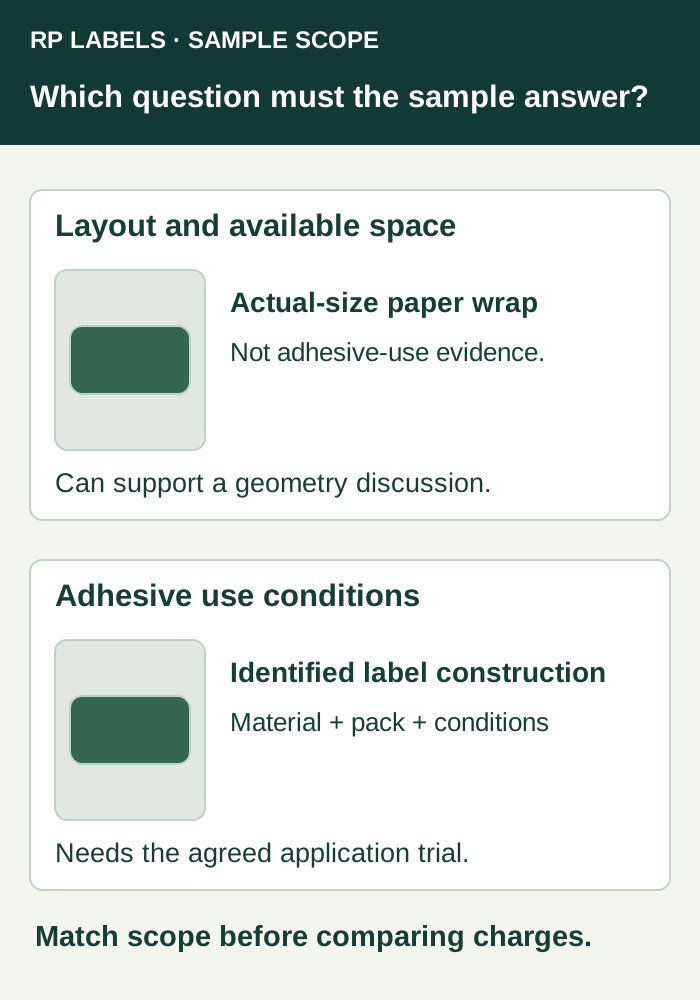
Ask the supplier to identify preparation or tooling, sample manufacture, any agreed inspection record, packing and courier charges separately or to confirm which are included in the sample total. Record the currency, delivered destination and unresolved import charges. Mark an unknown charge as awaiting confirmation; a blank cell does not mean free. The delivered-scope quote comparison explains the wider order-cost check.
A possible sample credit is a future condition
If a supplier offers to credit sample charges against a later order, ask for the eligible charge, order conditions, validity period and actual credit amount. Keep courier and other exclusions visible. A credit request is not an accepted promise, and it does not reduce the cash needed to obtain the sample today.
In a fictional arithmetic example, sample manufacture is USD 60 and courier is USD 25, so the buyer pays USD 85 now. If the supplier separately accepts a USD 60 credit on a qualifying future production invoice, that later invoice can be reduced by USD 60 when the agreed conditions are met. The courier still remains USD 25 of sample-related spend. Without an accepted credit, the buyer must not subtract USD 60 from its budget. These amounts are invented, not RP prices or credit terms.
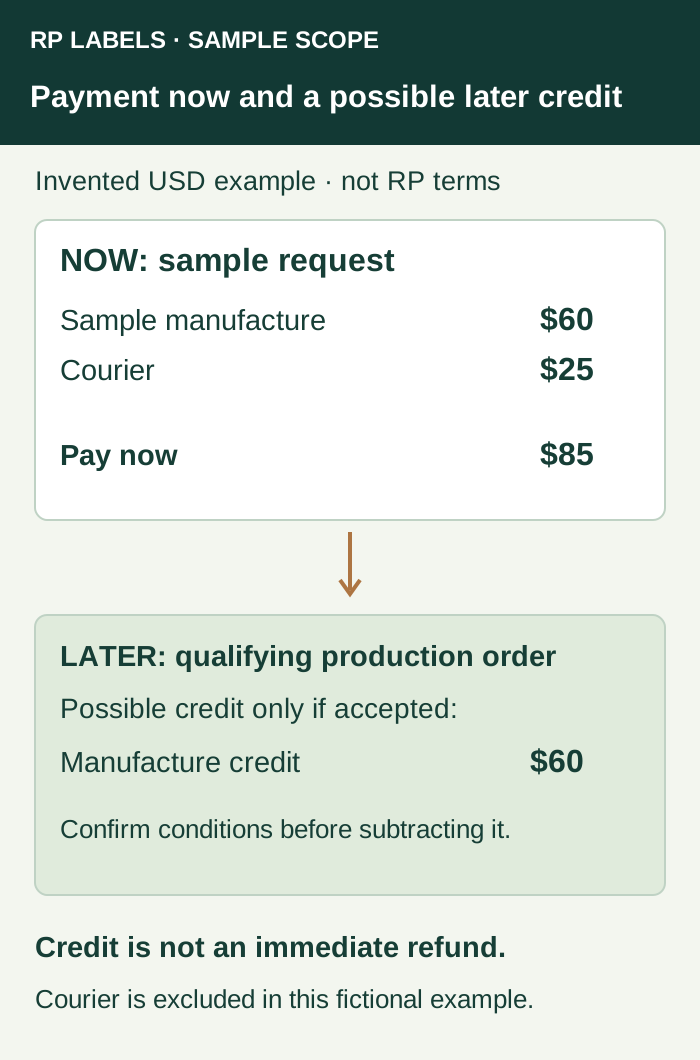
Use this compact request with the approval-coverage record: “Please identify the sample construction and the question it represents, state the sample quantity and total delivered scope, and list any differences from production. If a later credit is offered, confirm its amount and conditions separately. Please state what changes or additional charges would follow a revised artwork or a second sample.” RP's sample policy keeps sample cost and timing project-specific. Send the actual pack, artwork and open approval question when requesting that confirmation.
Give the next person the same starting point
Save the approved artwork, container reference, construction, sample evidence and remaining exceptions together. If a later revision changes one of those inputs, review which approval remains applicable. A previous acceptance is useful when the next team knows what it covered.
For an RP Labels quotation, send the coverage record, current artwork, exact vial reference, quantity and application conditions. Ask what sample and printing scope can be supplied against each open question. The best approval is the one both sides can explain after the email saying “approved” has left the inbox.
Sources and scope
Demand layer: competitor and process pages linked here, including Avery, HERMA or OnlineLabels where cited, illustrate buyer language and process topics only. They do not supply RP minimum quantities, lead times, prices, certifications or materials. Authority layer: an RP number is backed only by a factory datasheet, a signed quote or proforma, confirmed product data, or a fact kept on the About page. The March 2026 proforma there is one production-run example, not a standing offer. RP shipping and planning pages describe what to confirm on a quote. Worked figures on this page are fictional unless an authority source is named for them.