A small vial gives a brand very little display area. The tempting move is a full, opaque wrap. Then the buyer realizes the user still wants to see the fill level, powder cake or general contents through the glass. I would settle that conflict before choosing a film, because a "clear label" and a deliberate viewing window are not the same specification.
A clear film can carry opaque ink over most of its area. A white label can leave a die-cut gap or be shorter than the circumference. Either approach may preserve a view, but the resulting seam, printed identity and application tolerance will be different. Ask what has to be visible, from which direction, and under what ordinary lighting. The label supplier cannot infer an inspection requirement from a product photo.
Mark the window on a physical vial
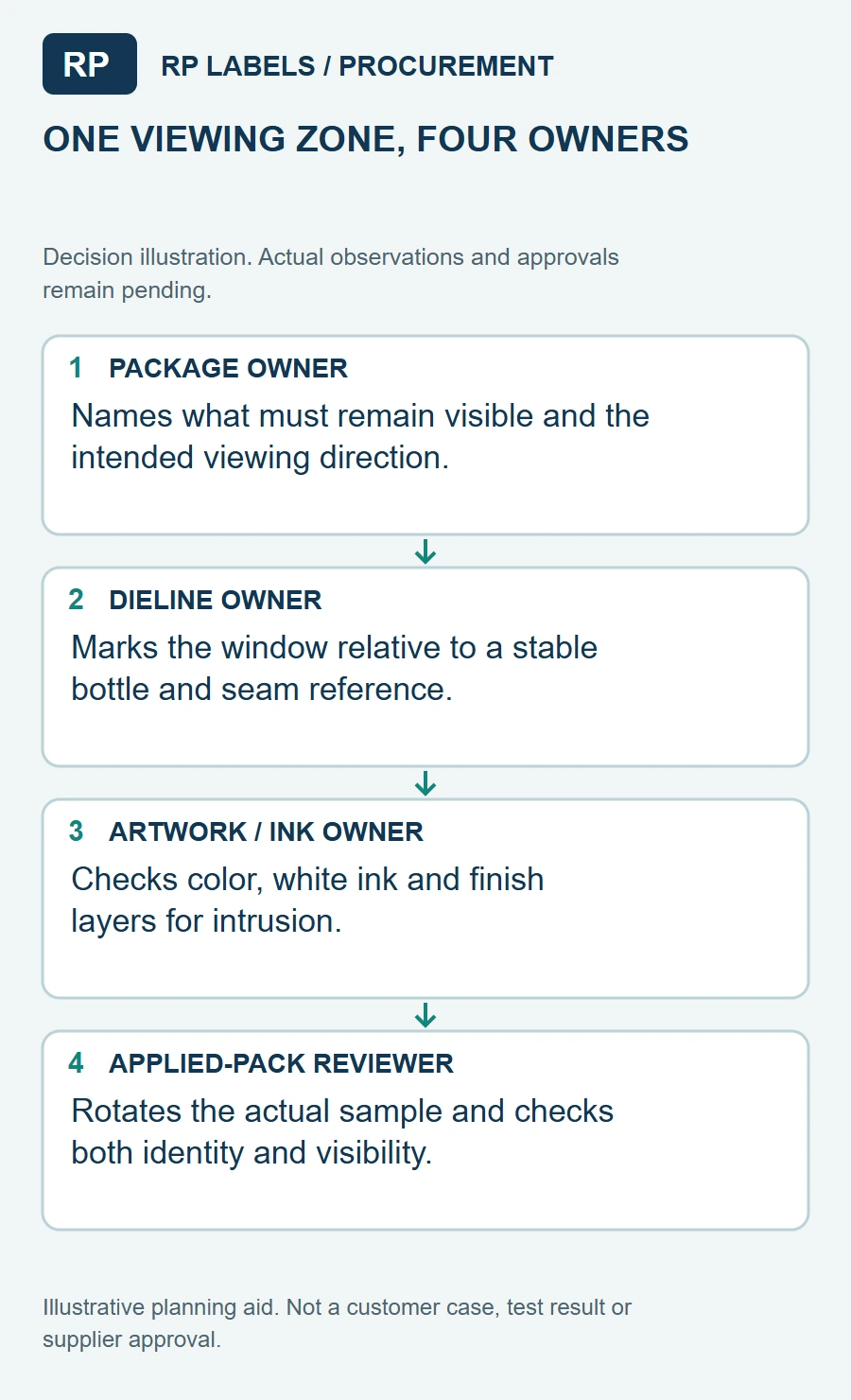
Take the actual container with its closure and place a temporary paper strip around the straight glass wall. Draw the desired viewing zone while the vial is held as it will be used. Note the shoulder, base curve and any cap overhang. Then decide where the product identity, lot field and code can remain readable without crossing that zone.
HERMA's vial-labeling guide notes that some vial labels include fill-level scale markings and require precise placement. The lesson is not that every peptide vial needs a scale; it is that label position changes what the user can see. HERMA also describes label cut-outs that deliberately expose bottle contents in another application. That is a useful construction analogy, not proof of fitness for a specific research material.
Decide between a gap and a transparent band
A physical gap uses no face film over the viewing area, but it shortens the wrap and can bring two label edges close to the grip zone. A transparent band retains a continuous label footprint, but adhesive, film and bottle reflections may still obscure details. Print inks, an opaque underlayer or heavy decoration can make a supposedly clear area functionally opaque. Ask to see both a flat sample and an applied vial.
Avery Dennison's discussion of clear vial films illustrates the broader trade-off between protection and visibility. It does not establish optical clarity, chemical suitability or UV performance for the RP Research artwork shown here. A brand with a protective-packaging requirement should have its own material specialist define and test it separately.
Prove the worst viewing position
Apply a full-size label on several real vials by the intended hand or machine method. Rotate each vial: can the user see the contents through the window without hiding the critical text? Compare a clean empty bottle, a representative filled bottle and the actual storage or transport condition. A window that works in a bright studio photo can be much less useful under a dark cap shadow or against a colored powder.
What I would include in the RFQ
Send vial dimensions and SKU, target window width and position, cap reference, label material candidates, required print fields, intended code location, application method and quantity per artwork. Request a physical applied proof viewed from both the branding side and the window side. Ask the supplier to mark the wrap seam and acceptable placement range on the drawing.
A clear zone is worth paying attention to only if it makes inspection possible without sacrificing identity. I would approve the vial in hand, not a zoomed-out render with a promising empty rectangle.
Sources and scope
Reviewed October 6, 2026. The primary references linked below support the identified technical points. Buying scenarios and inspection checklists are editorial guidance, not RP production records, certification, legal approval or universal acceptance standards. Demand layer: competitor and process pages linked here, including Avery, HERMA or OnlineLabels where cited, illustrate buyer language and process topics only. They do not supply RP minimum quantities, lead times, prices, certifications or materials. Authority layer: an RP number is backed only by a factory datasheet, a signed quote or proforma, confirmed product data, or a fact kept on the About page. The March 2026 proforma there is one production-run example, not a standing offer. RP shipping and planning pages describe what to confirm on a quote. Worked figures on this page are fictional unless an authority source is named for them.