Vial Labels on Rolls or Sheets? Time the Work Before Choosing the Format
We supply labels on rolls for automatic applicators and in sheets or individual pieces when that format is a better fit. Roll direction, core size, liner, and spacing are specified to the machine information you provide.
Suppose a research-packaging team applies labels by hand and switches among several SKUs during a short run. Sheets make the designs easy to lay out separately. A second team applies the same design repeatedly with a bench dispenser and wants fewer interruptions. A roll may suit that work better.
These are hypothetical teams, not a speed study. Their order quantities alone do not settle the choice. Both formats can support hand application, and either can become inconvenient when the packing routine has been left out of the quote.
I would compare one complete work cycle: prepare the correct design, peel and apply, check the vial, finish the count, then change to the next SKU. The time spent reaching for a label is only part of that cycle.
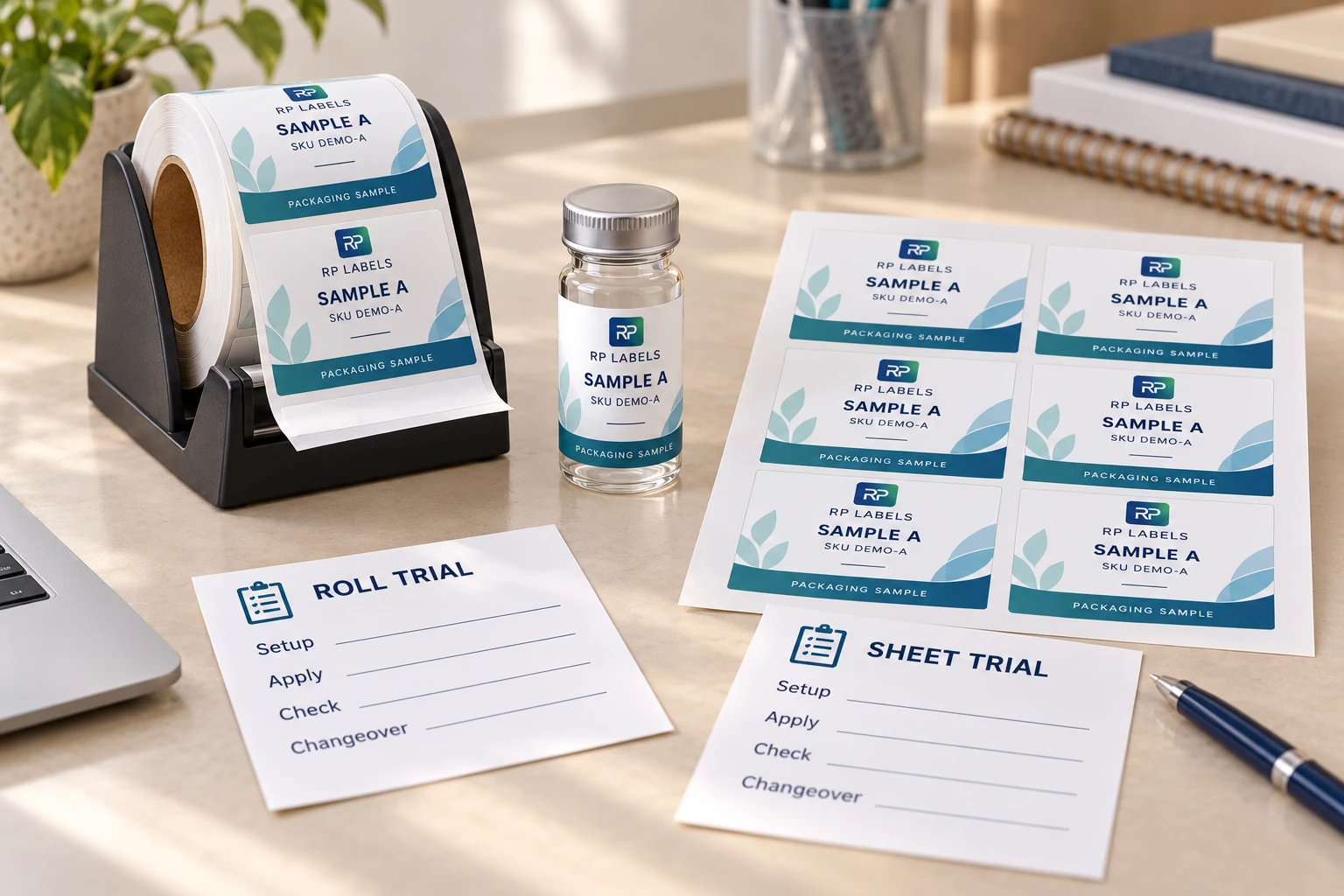
AI-generated packaging illustration. The two trial cards contain no speed results. Dispenser compatibility, actual dimensions and workflow performance need confirmation.
Sheets deserve more than a small-order stereotype
A flat sheet can make a short manual job easy to organize. The operator can keep one identified stack at the work area, see the remaining positions and remove the stack when the SKU changes. It can also be convenient for a review meeting where several designs need to be compared together.
That convenience depends on the layout. Ask whether one sheet contains one artwork or an agreed mixture, how many labels appear on it and how stacks are identified. A mixed sheet is not automatically a good idea simply because the total order contains many SKUs.
Include the final partly used sheet in the handling plan. Decide how the remaining labels will be counted and identified after the run. An unmarked stack of similar designs defeats the visibility that made sheets attractive in the first place.
Sheets are a sensible winner when that controlled manual workflow fits the job. They need not lose merely because a roll looks more industrial in the quotation photograph.
Rolls can support hand work as well as equipment
A roll keeps a repeated sequence together and can work with an appropriate hand dispenser. HERMA's manual dispenser overview illustrates that roll dispensing can be a manual operation. It does not establish compatibility with every roll, dispenser or vial-label size.
For a manual trial, check that the intended operator can present and peel the actual label without awkward handling. Identify where the roll sits, how the backing is managed and how the team finds the correct SKU. Do not turn a larger roll into an unmanageable bench object simply to reduce the number of roll changes.
The roll must also be identified after opening its outer carton. Ask what information will remain with the roll when the box is elsewhere. The artwork changeover guide covers old-versus-new revision control; the format decision should preserve that control in either presentation.
Equipment turns preferences into constraints
If labels must feed through a printer, dispenser or applicator, obtain the actual equipment requirements before selecting a supply format. A roll-fed process needs a compatible roll. Confirm relevant core, outer diameter, web width, pitch, leading edge and unwind requirements with the equipment owner.
Do not copy a working roll's appearance without identifying its specification. A photograph can start the discussion, but the roll-direction guide is the place to document how the label feeds and arrives at the container.
Also separate later printing from dispensing. A roll that fits a dispenser may not be suitable stock for the buyer's printer. If variable data will be added locally, the preprint-versus-on-demand guide addresses that separate workflow decision.
Roll or sheet presentation does not by itself establish water resistance, adhesion or storage suitability. Keep the proposed material, ink and finish comparable when asking for two format options; record differences when they cannot be held the same.
Compare the entire run, including the last SKU
Use the worked format-trial plan, blank observation sheet and field guide. The worked plan proposes two runs using the same three fictional designs and the same application objective. It leaves all measured times, waste and release decisions blank.
Ask the actual packing team to define a representative trial with identified containers and candidate labels. Record setup, application, checks, interruptions, changeover and cleanup separately. Record how many acceptable applied vials result, rather than assuming every label removed from the backing is a finished unit.
Use the same agreed counting boundary for both formats. If one trial starts after setup and the other includes retrieving artwork and clearing a bench, the comparison will answer a different question. Record operator familiarity too. A first attempt with an unfamiliar dispenser should not be disguised as steady-state production performance.
No universal trial quantity or time saving is supplied here. The purpose is to expose where work moves. A faster peel may be cancelled by longer SKU checks; a slower setup may become acceptable during a stable repeated run. Have the packing owner interpret the observations in the intended production context.
Put the results beside the quotation
Compare supplier quotations for the same dimensions, construction, artwork counts, quantities and destination. Identify setup and packing differences rather than attributing every price difference to format. Ask what is included in roll identification or sheet-stack separation where the workflow depends on it.
Then consider the observed operator work, equipment constraints and repeat schedule. A small manual multi-SKU job may reasonably choose sheets. A stable run with a compatible dispenser may reasonably choose rolls. If the first order is intended to qualify later equipment use, include that transition explicitly instead of assuming the first format will serve every stage.
For an RP Labels inquiry, send the format-trial plan, quantity per design, actual label and vial references, application method and any equipment requirements. Request comparable roll and sheet scopes where both are feasible. Order the format that the team can receive, identify, apply and finish using—not merely the one with the lower number beside “each.”
Sources and scope
Demand layer: competitor and process pages linked here, including Avery, HERMA or OnlineLabels where cited, illustrate buyer language and process topics only. They do not supply RP minimum quantities, lead times, prices, certifications or materials. Authority layer: an RP number is backed only by a factory datasheet, a signed quote or proforma, confirmed product data, or a fact kept on the About page. The March 2026 proforma there is one production-run example, not a standing offer. RP shipping and planning pages describe what to confirm on a quote. Worked figures on this page are fictional unless an authority source is named for them.