A buyer sends a neat flat vial-label PDF with a barcode tucked beside the product name. In the proof, all bars are sharp. On a real small glass cylinder, the left and right ends curve away from the reader. The label can be printed perfectly and still be awkward to scan. That is a packaging decision, not a reason to keep changing the ink density.
I would start by putting the intended code on the actual vial, then bringing the intended scanner to it. The useful question is not whether a code can be read once while someone rotates the bottle carefully. It is whether the normal receiving or packing workflow reads it repeatably, without turning a routine hand movement into a hunt for the code.
The diameter changes what the scanner sees
A linear barcode spans physical width. On a tight cylindrical surface, its outer bars face away from a scanner looking at the center. GS1's General Specifications discuss curved-surface placement and orientation for GS1 symbols. Their guidance is a starting point, not a substitute for checking the exact symbol, print size, glass diameter and scanning environment in this project.
Ask for the usable straight-wall diameter, not only the vial's nominal volume. Two vials called the same size can have different shoulders and wall profiles. A label that reaches into the shoulder, overlaps its own barcode, or puts the quiet area near a wrap seam creates a second problem before the scanner is even considered. Measure the real container and inspect a wrapped sample from front and side.
Compare the two orientations on applied labels
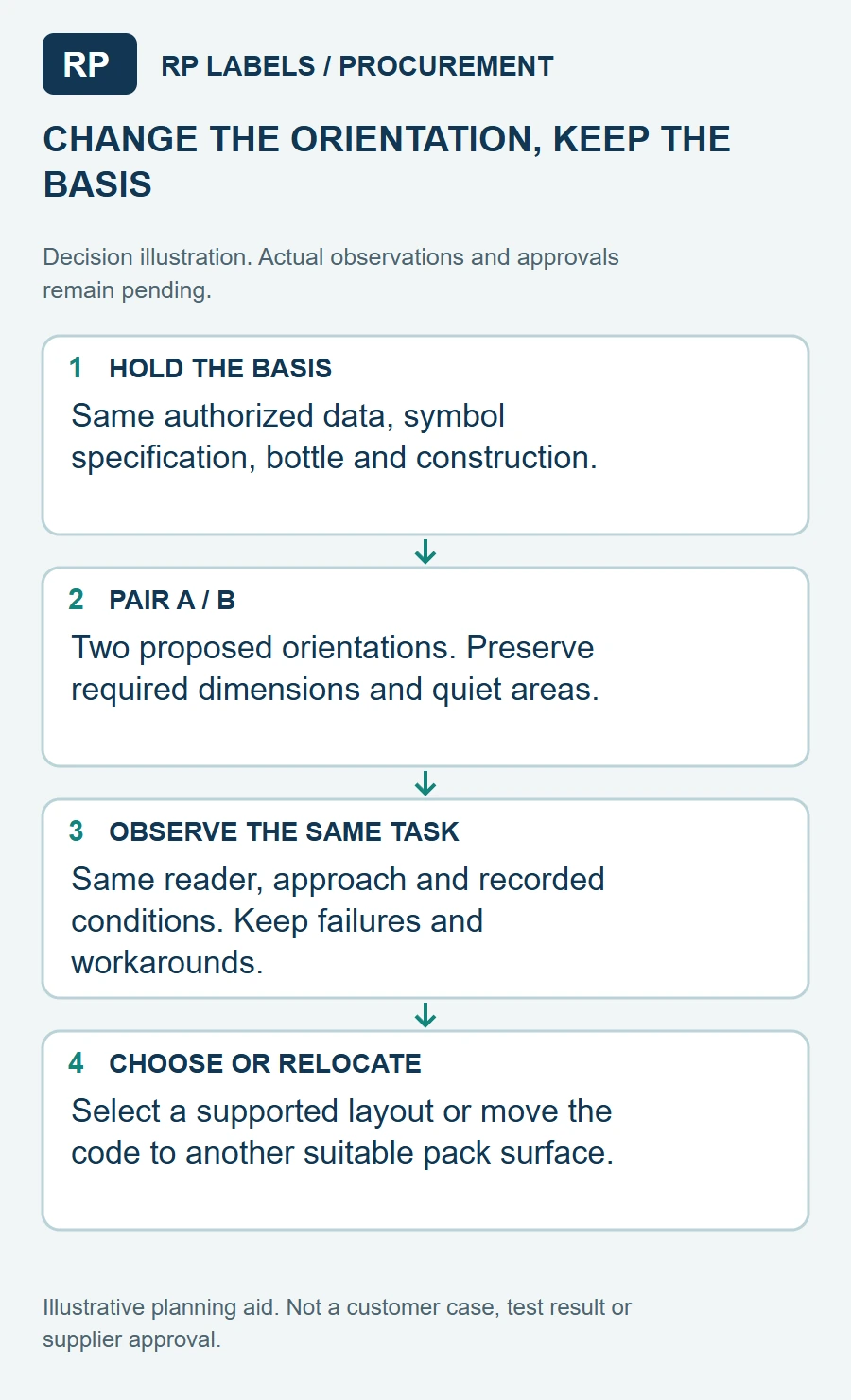
Buyers often call the options horizontal and vertical. GS1 documentation calls the arrangements picket-fence and ladder orientation. Neither word is a pass/fail result. For a particular small vial, one layout may keep the symbol in the visible arc while the other may preserve more label space for the product name. If a horizontal symbol wraps too far around the cylinder, changing orientation or moving the symbol to a wider carton panel may be more sensible than shrinking bars until the graphic merely fits.
Have the artwork team prepare two versions at the same intended print process and substrate. Keep the code data identical and mark both as proofs. Apply each to several vials by the actual hand or machine method. Then scan with the device used at goods receipt, packing and any downstream point that matters. If the buyer cannot provide that device, specify the scanner model and reading distance before approving a layout. A phone camera result alone does not prove performance with a dedicated 1D scanner.
Protect space around the symbol
A dark band, holographic highlight or busy pattern behind the bars can look attractive on screen but make a scan trial harder to interpret. Keep a deliberate light field and the required quiet areas for the chosen symbology; do not let the dieline trim them away. Avoid moving a barcode onto a label overlap simply to save front-panel space. The overlapping edge can sit slightly higher, and its position can vary during application.
GS1's barcode placement update also treats tightly curved surfaces and symbol truncation as special cases. That is not permission to truncate an arbitrary symbol. If there is no defensible footprint on the glass, an outer carton or a different data carrier may be the correct location. That decision depends on what is being identified and who must scan it.
Separate artwork approval from code approval
I would use two sign-offs. The brand approves visible copy, product identity and hierarchy. The code owner approves the encoded value, symbol specification and where the scan leads in the workflow. Finally, someone scans a production-representative applied sample. A press PDF proves geometry and text placement; it does not prove an applied code survives curvature, reflections and ordinary handling.
For a custom-label request, send the actual vial or precise glass drawing, label dieline, symbology, encoded-data owner, scan device, application method and expected roll direction. Ask the supplier for a flat proof and an applied sample plan. If the barcode belongs on an outer box, say so before investing in multiple vial-label revisions. The cheaper decision is the one made while the layout is still movable.
Sources and scope
Reviewed October 2, 2026. The primary references linked below support the identified technical points. Buying scenarios and inspection checklists are editorial guidance, not RP production records, certification, legal approval or universal acceptance standards. Demand layer: competitor and process pages linked here, including Avery, HERMA or OnlineLabels where cited, illustrate buyer language and process topics only. They do not supply RP minimum quantities, lead times, prices, certifications or materials. Authority layer: an RP number is backed only by a factory datasheet, a signed quote or proforma, confirmed product data, or a fact kept on the About page. The March 2026 proforma there is one production-run example, not a standing offer. RP shipping and planning pages describe what to confirm on a quote. Worked figures on this page are fictional unless an authority source is named for them.