Supplement Barcode Verification: Ask What the Report Actually Covers
The phone scans the barcode on the first bottle. The label looks clean. Purchasing is ready to approve the roll, but the retailer has asked for a verification report and nobody can say which printed sample it will describe.
That is a hypothetical handoff, but the decision is real: a quick scan, an identifier check and a print-quality verification answer different questions. Before releasing a supplement label for print, agree who supplies each piece of evidence and which finished version it covers.
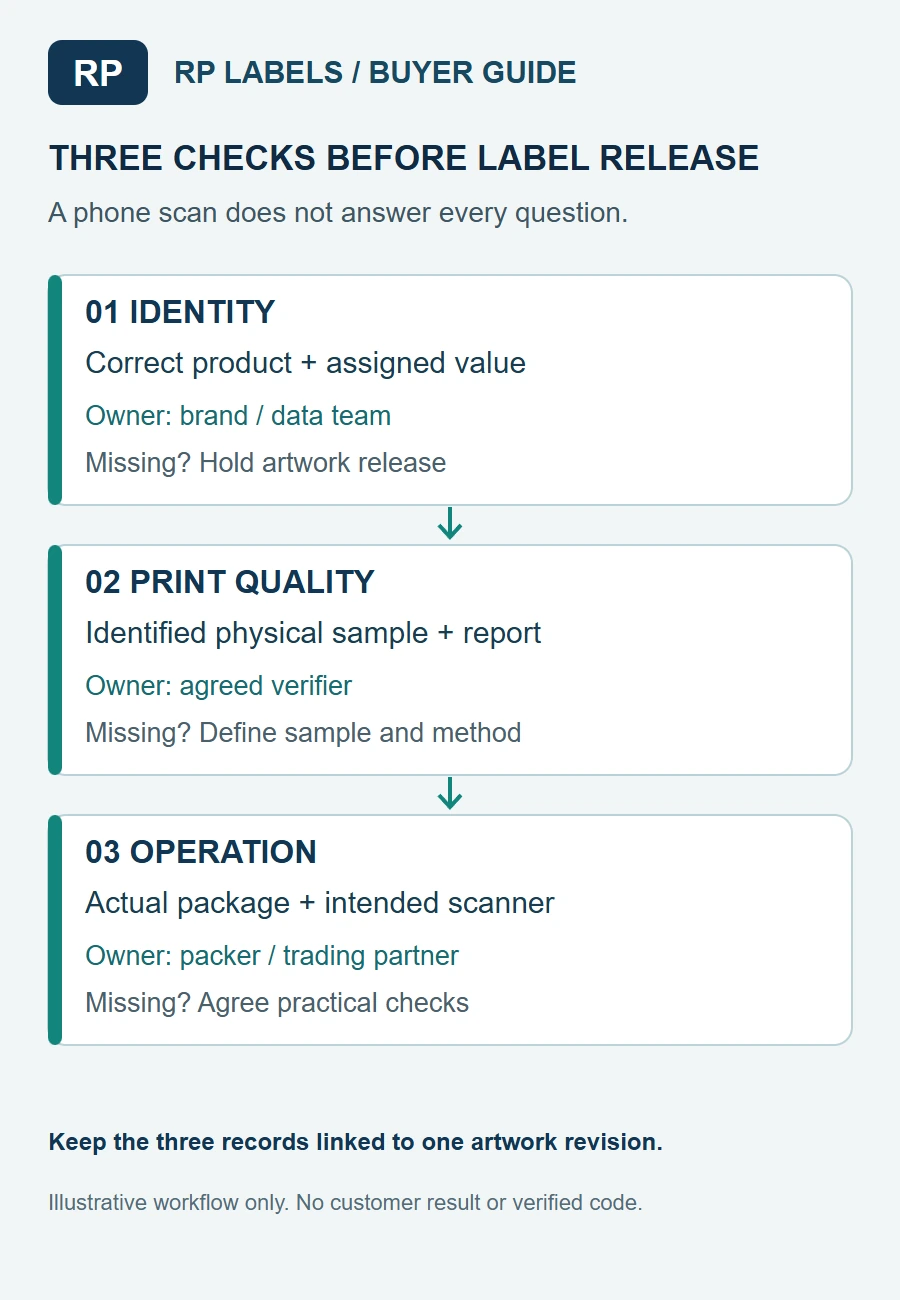
Procurement workflow illustration. Example references are fictional; no actual identifier, verification grade or approval is shown.
A scan can help without settling the purchase
An ordinary scan is useful for catching an obvious unreadable symbol or an unexpected decoded value. It is quick enough to perform during an artwork discussion. If that is all the buyer needs for a private internal process, agreeing a more extensive report may add cost without answering another question.
Retail distribution often adds requirements from a customer or trading partner. Ask that party what symbol, application, print-quality criteria and evidence it actually requires. Do not insert a generic grade from an unrelated barcode guide into the purchase order.
GS1 US describes verification as a way to assess printed barcode quality using verification equipment. Its barcode placement guidance also notes that the printed symbol and its placement matter. Neither source makes a successful phone scan a verification certificate for your packaging.
Start with the right product and the right code
The brand owner or other authorized party supplies the assigned identifier and confirms which saleable product it represents. The artwork owner then checks the encoded value, the human-readable text where applicable, and the exact artwork revision carrying it.
Suppose a hypothetical berry bottle and a citrus bottle have separate approved identifiers. A well-printed berry label carrying the citrus identifier can still fail the identity decision. Reprinting a sharper symbol would not repair that mismatch. Resolve the product-data record first.
Conversely, the correct value in a spreadsheet does not demonstrate that the actual printed symbol will meet an agreed quality requirement. Keep the identifier approval alongside, rather than inside, the print-quality request. The flavor and count guide covers the separate variant-to-identifier decision.
Make the verification request traceable to the sample
Ask the verifier or supplier what report can be produced and on which sample. Identify the label SKU, artwork revision, encoded value, symbol type, material, print method and any finish. If the bottle's curvature, gloss or seam affects the eventual check, tell the verifier how the applied pack will be used and ask what sample arrangement is appropriate.
The sample may be a proof, a production label or an applied package. Those are not interchangeable automatically. A digital proof can confirm a value or layout for review; it cannot by itself represent print quality on a finished physical label. If the verifier receives a flat label while the trading partner requires an applied-pack assessment, clarify the difference before treating the report as the final release evidence.
The worked report-scope record follows two fictional samples. One has the artwork revision but no physical verification report. The other has an unlinked report reference. Neither row contains a fabricated grade. The blank record and field guide give the buyer a place to identify the missing connection.
What should come back with the report?
Ask the verifier to identify the sample and the standard or method used, the reported result and the conditions needed to interpret it. Agree the applicable acceptance requirements with the trading partner. A report number without a sample reference may be difficult to connect to the approved design; a result without an agreed criterion leaves the buyer guessing what to do next.
If the report and the purchase specification disagree, hold the decision and send the exact discrepancy to the verifier, print supplier and responsible product owner. The remedy depends on the cause. It might involve a corrected data file, an artwork adjustment, a different print sample or a further review. Do not promise a pass simply because the label was printed again.
Keep variable-data printing in scope. A symbol added later by the packer may be produced with a different printer, ribbon or setting from the preprinted artwork. Decide which party owns that print process and whether its output needs separate evidence.
Check the working environment separately
A verified symbol still needs to be usable in the intended operation. The packer or trading partner should decide what practical scan checks are appropriate on the actual package and equipment. Record the device and context when the result is relevant. A checkout, warehouse scanner and phone may present different conditions; one convenient device is not a substitute for all of them.
For a QR code, verify the destination and ownership as a separate task. A symbol can encode the intended address and still lead to the wrong or unavailable content. The barcode and QR guide separates those uses. Avoid putting a QR destination decision into a print-quality grade.
Give the printer a question it can answer
For custom supplement labels, send RP Labels the product and barcode evidence brief: the approved artwork revision, authorized code source, bottle and finish, quantity per design, planned later printing and the trading partner's stated requirements. Ask what sample and documentation are available, and name any external verification service the buyer intends to use.
The practical release package joins three things: the right value for the right product, an identified physical print-quality record when required, and the application checks owned by the people who will use the pack. If one is missing, the other two do not fill the blank.