Private Label Supplement Packaging: Release the Bottle, Box and Seal Together
Consider a launch where the bottle label is approved at revision two, the carton is still at revision one, and both emails say approved. Printing either file accurately will not resolve the disagreement. The buyer needs one release record for the assembled packaging set, with the content owner deciding which combination is valid.
For a small brand, the owner may be the person forwarding every approval. The temptation is to send the latest attachment from each email and let the packer sort it out. I would assemble the bottle, box and seal on one desk first. It is a small act, but it forces the remaining disagreement into view while changing a file is still easier than sorting finished packaging.
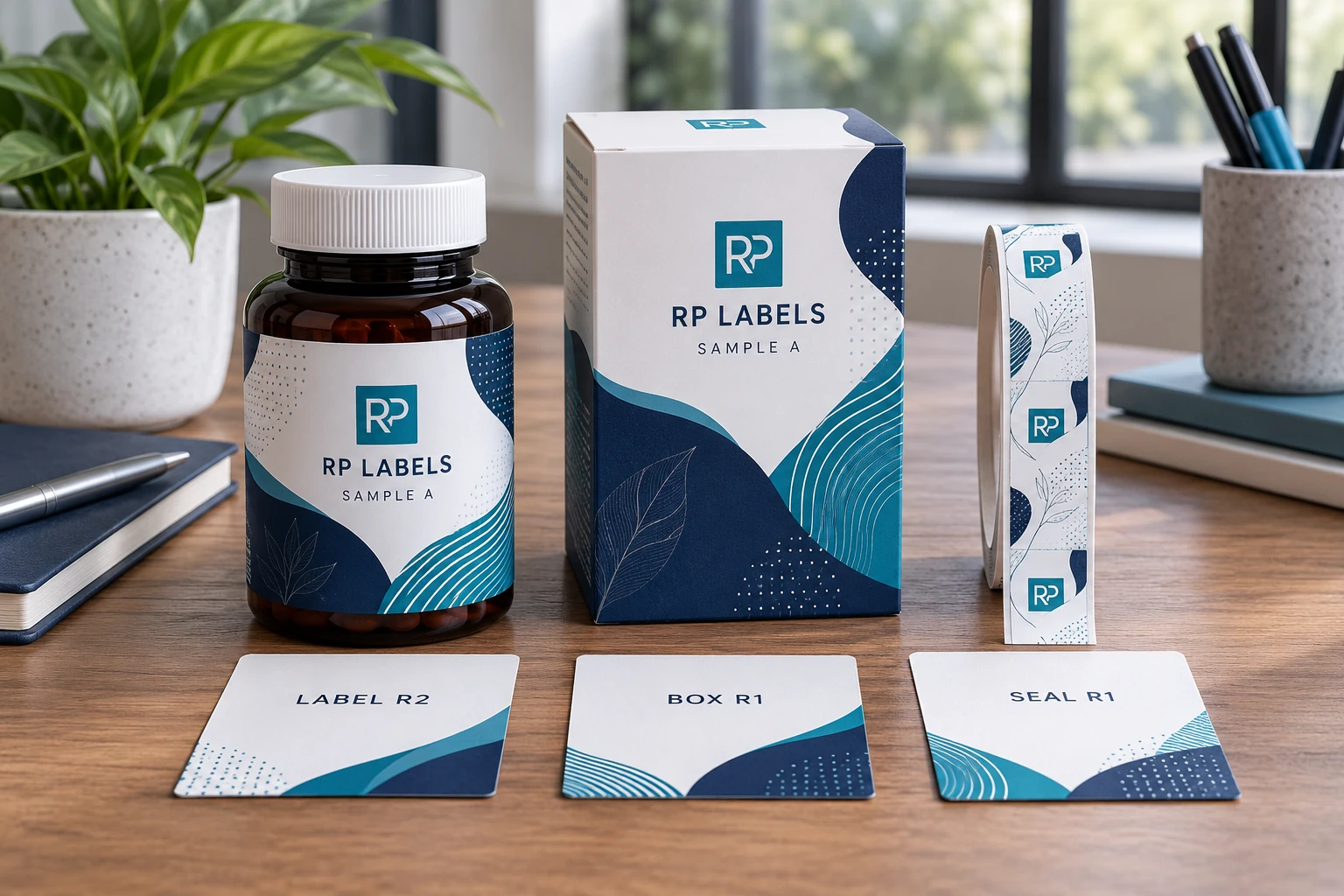
AI-generated packaging illustration. Fictional RP samples show the proposed decision; no physical test or customer order is documented.
Approve a combination of components
Assign a set reference before collecting component approvals. Under that reference, list the bottle label, carton, seal and any insert actually included in the job. Each row needs an artwork revision, a quantity, its approval owner and the component it must match. A shared color is not a reliable substitute for the product identifier.
The worked example deliberately contains LABEL R2 beside BOX R1. That is an unresolved combination, not evidence that all revision numbers must be identical. A label can change for a printing adjustment while the carton remains valid. The copy owner must state whether the change affects shared identity, approved statements, codes or packing instructions. If it does, the affected component returns for review. If it does not, record the reason the mixed revision set is allowed.
Then check the quantities as a set. Suppose, purely as an example, an assembly needs one bottle label and one carton per unit, but two seals. A carton quantity alone cannot establish the seal requirement. Include any agreed setup or spare allowance separately so it is not silently confused with finished-pack demand. Actual allowances belong to the packer and order agreement.
For a bottle sold without a carton, the simplest valid release may contain only the label and its actual closure component. Adding more paperwork than physical parts does not improve control. For a multi-component launch, however, one set reference makes a late change manageable: hold only the affected combination, record the replacement and tell the packer what is usable. Send RP Labels that component map with the print files, rather than forwarding a chain of approvals and asking production to infer the final answer.
Start with a packaging map
List every printed component: bottle label, lid or neck seal, carton, insert and shipping identifier. Give each component a file name, finished size, material, quantity and version owner. This simple map prevents the common mistake of approving the bottle artwork while an older carton file remains in production.
| Bottle label | Primary product identity, approved information panel, barcode or QR area and batch or date field. |
|---|---|
| Carton | More room for brand story, handling information and a clear hierarchy, subject to the buyer's approved copy. |
| Tamper seal | A small functional element that must bridge the actual opening and adhere to both package surfaces. |
| Master record | SKU name, revision date, color cue, barcode file, quantities and approval status for every component. |
Separate regulatory approval from print approval
The NIH Office of Dietary Supplements summarizes required categories of US label information, including product identity, net contents, nutrition labeling, ingredients and the responsible business name and location. Use its dietary-supplement label information as background and obtain qualified review of the exact product and destination. The summary is not an approval of this packaging set.
A printer's proof confirms dimensions, image placement, color layers, finishing notes and production setup. It is not legal approval. Mark the copy file as approved before sending it to prepress, and keep regulatory comments out of scattered chat messages that can be missed during revision.
Build one hierarchy across bottle and box
Product name, variant, count and brand should be recognized the same way on every component. The carton can carry more detail, but it should not look like a different SKU. Use a stable product-code system and a controlled accent color rather than redesigning the hierarchy for each flavor, ingredient or strength.
Send codes as production assets, not screenshots
Provide the correct barcode file and the final destination for each QR code. Do not rebuild a code from a screenshot or low-resolution preview. Keep a quiet zone around scannable elements, avoid placing them on a tight curve or reflective effect, and test them from a printed sample after the label is applied to the real bottle.
Make variant control visible
A SKU matrix should show product name, artwork filename, color cue, barcode, label quantity and carton quantity. The printed proof should display the SKU name and revision date outside the artwork area. Approve the whole family together so a copied barcode, outdated ingredient panel or mismatched box can be caught before production.
Worked component quantities: find the part that limits complete packs
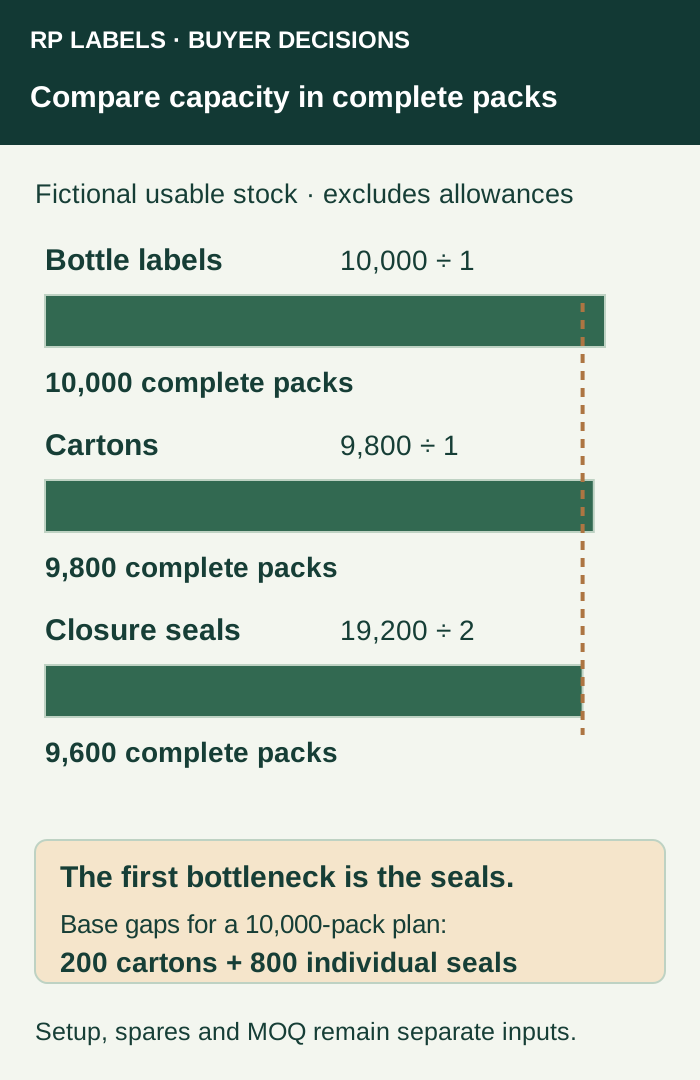
Approval of the packaging combination does not establish how many complete packs the stock can support. Count each component in its own units, then divide by the amount required per finished pack. Compare only usable stock at the accepted revision and location.
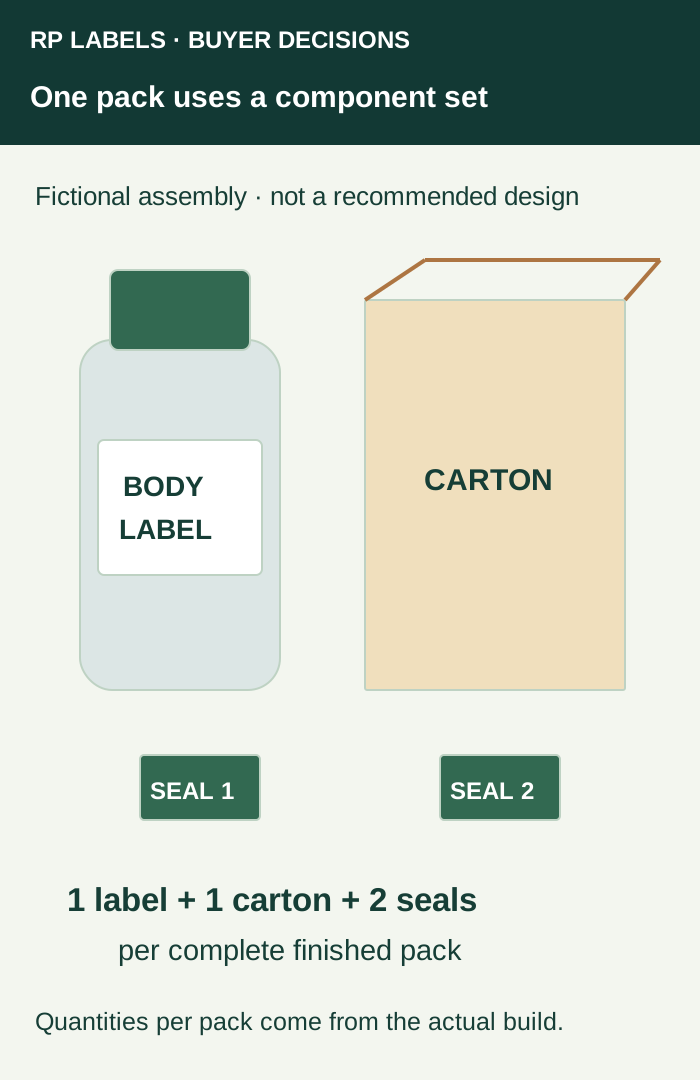
In this hypothetical case, the planned pack uses one bottle label, one carton and two closure seals. Available approved stock is 10,000 bottle labels, 9,800 cartons and 19,200 seals. The complete-pack limits are therefore 10,000, 9,800 and 9,600 respectively. The seals are the immediate bottleneck: 19,200 divided by two supports only 9,600 complete packs.
| Component | Per pack | Usable stock | Capacity in complete packs | Base gap for 10,000 packs |
|---|---|---|---|---|
| Bottle label | 1 | 10,000 | 10,000 | 0 |
| Carton | 1 | 9,800 | 9,800 | 200 cartons |
| Closure seal | 2 | 19,200 | 9,600 | 800 seals |
For a 10,000-pack plan, the base requirements are 10,000 labels, 10,000 cartons and 20,000 seals. The immediate base gaps are 200 cartons and 800 seals. Buying only the missing seals still leaves the carton gap. After assembling 9,600 packs with the starting stock, 400 labels and 200 cartons remain, but no complete two-seal sets do. Do not report those leftovers as another 400 complete packs.
Keep setup allowances and supplier quantities separate
This example excludes setup consumption, rejected application, testing and spares. Have the packer provide the actual allowance for each component; two seals per pack does not imply twice the same percentage loss. Then ask the relevant supplier what order quantity can be supplied. A calculated gap of 800 seals does not establish an 800-piece MOQ or an exact-delivery policy.
For each actual SKU, record the pack reference, accepted component revisions, units per pack, usable stock, dated inbound quantity and base gap. Keep stock awaiting a revision decision outside the usable total until the owner releases it. A confirmed incoming carton order may solve a future gap, but cannot support today’s packing run if it arrives later.
Send RP Labels the required label and seal quantities by design with this component map, and coordinate carton availability with the responsible packaging supplier. Use the inquiry draft to identify the desired packing quantity and date. The calculation makes the shortfall explicit; production feasibility, minimum quantities, allowances and delivery still need the actual order agreement.
Worked packaging component release record
The rows below are hypothetical planning examples. Empty observation or commercial fields must be completed from the actual project; no sample has been tested for this article. Use the worked CSV and blank worksheet with the field guide. Keep the example references separate from production records.
| set reference | component | artwork revision | units per pack | required packs | approved combination | owner | release state |
|---|---|---|---|---|---|---|---|
| DEMO-SET-A | Bottle label | R2 | 1 | Buyer to supply | Review against BOX R1 | Copy owner | HOLD |
| DEMO-SET-A | Carton | R1 | 1 | Buyer to supply | Confirm R2 change does not affect box | Packaging owner | HOLD |
| DEMO-SET-A | Seal | R1 | 2 in example only | Buyer to supply | Confirm actual pack construction | Packer | PENDING |
Bring this decision into the print inquiry
Contact RP Labels with the completed packaging component release record, the actual packaging reference, approved artwork and quantity per design. State which fields remain unresolved so the print specification and any relevant sample scope can be discussed against the same decision.
Related buying guidance: Custom supplement labels; Supplement Facts on small bottles; Barcode and QR placement; Custom label process.