Recycled Content or Recyclable? Check What the Label-Material Claim Covers
A recycled-content claim concerns what went into an identified material. A recyclability claim concerns what can happen to an identified product or package at end of life. One does not establish the other. Before approving a label proposal, name the component, the percentage basis, the market and the evidence behind the exact claim.
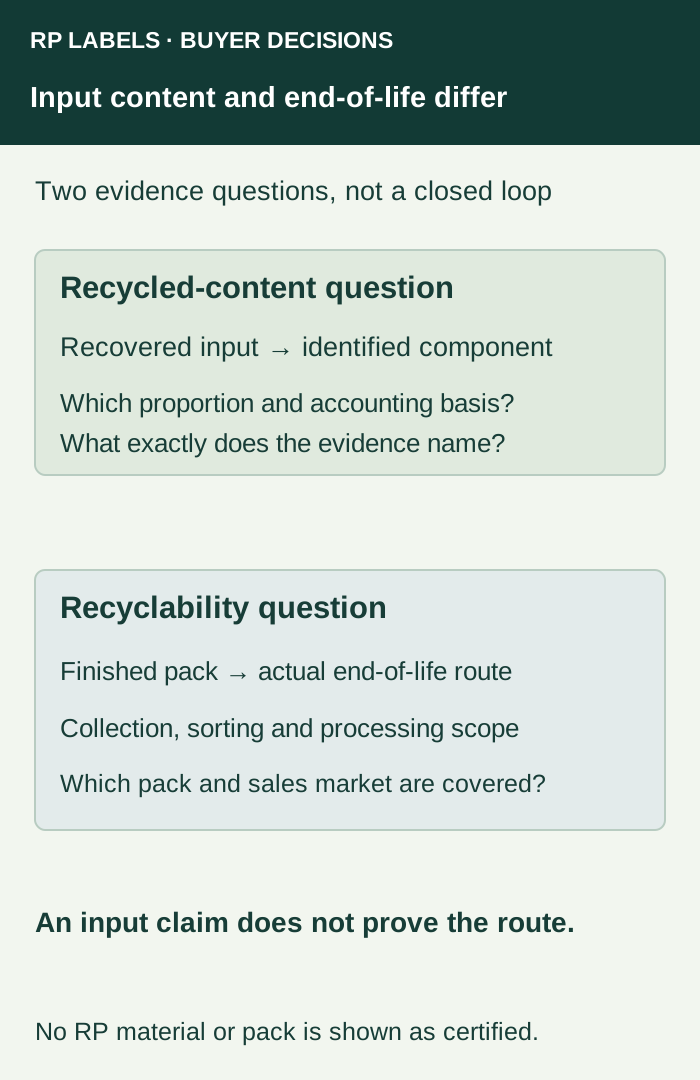
Start by locating the claim on the construction
Ask whether the statement concerns the face stock, a laminate, the release liner, the finished applied label or the complete bottle pack. Those boundaries can lead to different answers. A liner removed during application is not the same physical item as the label remaining on the consumer’s bottle.
For a proposed recycled-content percentage, request the identified material, issuer, relevant document or declaration, percentage basis and what input category or accounting approach it describes. If the evidence names one component, keep the component visible in the internal specification. Do not silently expand it to every layer.
For US-facing claims, the FTC’s Green Guides summary distinguishes recycled-content and recyclable claims and addresses qualification of partial-content claims. It also cautions against broad environmental-benefit statements. Have the responsible reviewer confirm the exact wording for the product and sales market; this procurement example is not approved marketing copy or a legal opinion.
A component percentage is not automatically a whole-label percentage
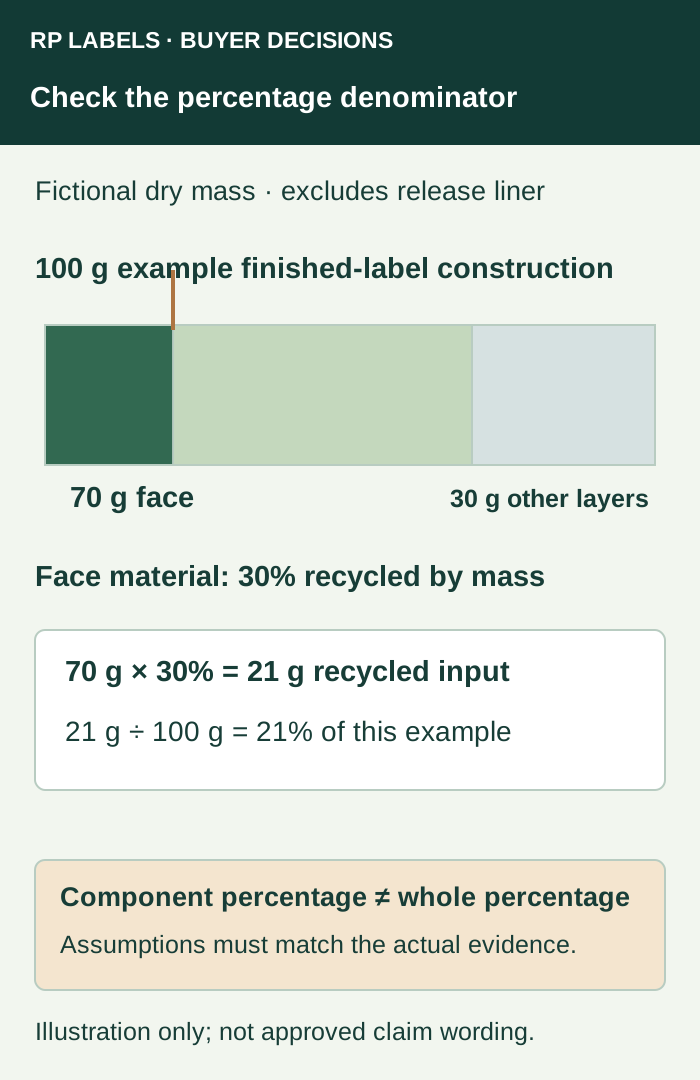
Suppose a fictional finished-label construction contains 70 g of face material and 30 g of other dry layers, for a total of 100 g excluding the release liner. Assume the face material contains 30% recycled material by mass, the other layers contain none, and all values have the stated physical basis. The recycled mass is 70 × 0.30 = 21 g. That is 21% of this example construction, not 30%.
The numbers are invented to expose the denominator, not to establish a label formulation or recommend a claim. Real evidence may use a different component boundary or accounting basis. Obtain and reconcile that basis before using the calculation. A percentage supported by an allocation method should not be silently described as a measured physical fraction if the evidence does not establish that.
If the supplier only has a face-stock declaration, it may still be useful for selecting that face stock. It does not settle a finished-label or bottle-pack claim. The buyer can retain the component requirement while withholding broader wording from the artwork.
Review recyclability as a separate question
A material can contain recycled input without establishing that the finished bottle will be collected, sorted and processed through the intended route. Conversely, a proposed pack’s end-of-life evidence does not establish a recycled-content percentage. Keep those requests in separate rows.
The PET bottle recycling-evidence guide covers bottle-specific construction, coverage, adhesive and route. Use it when that is the decision. Do not substitute a recycled face-stock brochure for the evaluated package scope.
| Statement received | Evidence boundary to resolve |
|---|---|
| The paper contains recycled input | Which paper reference, proportion and supported input basis? |
| The label is recyclable | Which supplied or applied item, market and end-of-life route are being described? |
| The bottle pack is recyclable | Does the evidence cover the bottle, label, decoration and other relevant components as proposed? |
| The liner enters a recovery program | Which local collection and acceptance arrangements actually apply at the packing site? |
Do not let an environmental phrase replace the functional brief
The proposed construction still needs to meet the label’s application, information, appearance and handling requirements. If choosing another face stock or finish changes the accepted construction, route that change through the material-substitution review. A certificate logo does not approve adhesion or the later-print surface.
Where an FSC paper claim is requested, the FSC supply-document guide addresses that distinct chain and invoice question. Do not treat the name of a certification program as a substitute for identifying which product and claim are actually covered.
Ask for the narrow supported proposal
For supplement labels, prepare an RP inquiry with the bottle reference, artwork, quantities, actual use requirements, target market and precise environmental objective. Ask which identified construction and supporting evidence can be proposed. Availability, the claim boundary and the final artwork wording all need their own confirmation. A narrower supported component statement is more useful than an unsupported green claim over the whole pack.