Label Liner Recycling at the Packer: Confirm the Collection Route
Confirm an accepted collection route at the packing site before choosing a label liner on the expectation that it will be recycled. Identify the actual paper or PET liner, keep the waste stream within the collector's rules, and agree who records collection and receipt. A material description alone leaves the operational route open.
This decision belongs with the brand's label buyer and contract packer. The liner leaves the label during application, so the packer needs room, handling instructions and an accepted destination for it. The consumer's bottle follows a separate route after use.
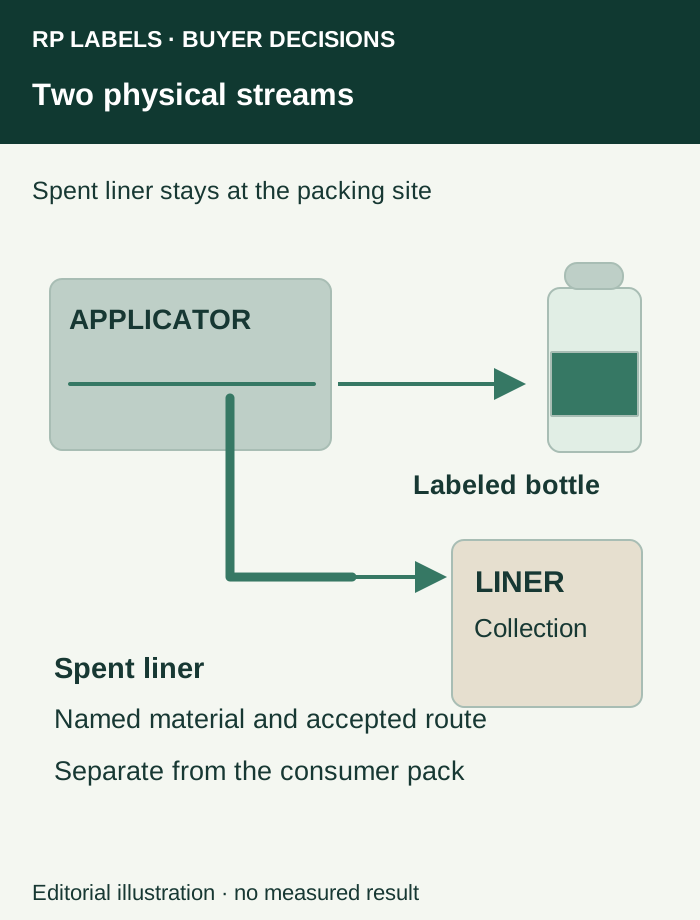
Ask the local program to identify its scope
Request acceptance for the identified liner from the actual packing location. Ask whether the program accepts the proposed supplier and material, how it separates paper and PET, what contamination it excludes, and what form of storage or collection unit it requires. Obtain the current quantity, pickup, transport and charge conditions directly from that program.
UPM's RafCycle service describes paper and PET release-liner collection and offers local support in select markets. It illustrates a managed collection route. Obtain the actual local terms before assuming eligibility, free collection or any particular pickup threshold at your packer. UPM RafCycle service.
If the site already has a route for one approved liner, ask whether a proposed substitute remains eligible before ordering it. If neither option has an accepted destination, record that gap in the comparison. A functional improvement may still justify a purchase, but expected recovery should stay outside the confirmed benefits until a route exists.
Map where each waste item goes
Trace a normal label change at the applicator. Locate the spent liner, any rejected labels, cores, outer wrap and other packing waste. Ask the collector which items may enter its liner stream. Operators should receive a simple site-specific instruction at the collection point.
The instruction should name accepted material and exclusions, show the correct collection unit, identify the responsible person and explain where uncertain material goes for review. It should also cover a roll change from one liner type to another. A bin labeled only “label waste” can leave too many different components in the same stream.
The paper-versus-PET liner guide covers dispensing and machine-change approval. Keep that line qualification alongside the collection review. Choosing an eligible waste material does not establish that the finished roll will run on the applicator.
Compare the full handling obligation
Ask the packer to describe how the proposed collection fits its actual work. Record storage capacity, movement of collection units, pickup coordination and responsibility when a load is rejected. Include accepted quantities and documented charges in the commercial comparison.
| Situation | Practical direction | Evidence to obtain |
|---|---|---|
| Current liner has an established accepted route | Preserve that identity while reviewing any proposed change | Current acceptance and collection record |
| A new local route accepts the proposed liner | Agree a site instruction and collection arrangement | Written scope, exclusions and actual terms |
| The route needs more accumulated material than the site can manage | Review storage or another authorized route before assuming collection | Site capacity and program confirmation |
| The load contains uncertain material | Keep it identifiable for review under the site's procedure | Collector's disposition and corrective instruction |
Keep operational costs separate from expected environmental outcomes. A lower unit price for labels can be outweighed by handling or collection obligations in one site and still be useful at another. Use actual terms and site estimates with their assumptions recorded. Avoid assigning a generic saving to every kilogram of liner.
Close the collection record after it happens
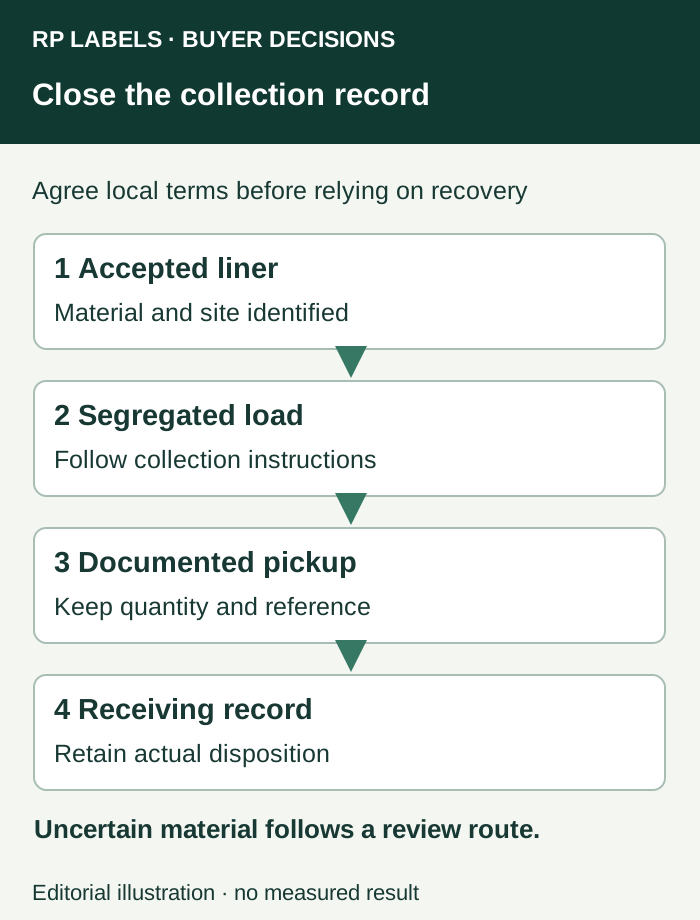
An accepted program proposal establishes a route to use. A pickup record establishes that a load left the site. The evidence supporting its later treatment depends on the program's receipt and reporting documents. Keep those stages distinct in the internal log.
Record the site, material identity, collection period, measured quantity and its basis, pickup reference, receiving organization and relevant receipt or treatment record. If a quantity is estimated rather than weighed, identify it as an estimate. Keep uncertain or rejected loads out of a confirmed recycled total until the supporting disposition is available.
The environmental-claim guide addresses component boundaries and supported wording. Liner recovery at a packer cannot by itself establish recycled content in a printed label or recyclability of the complete supplement bottle. Any external statement needs evidence for its own exact scope.
Bring the packer's requirement into the label inquiry
For an RP supplement or vial label inquiry, provide the packer location, required liner identity or accepted-material conditions, line specification and quantity per design. Ask which construction can be proposed against those requirements. The packer or brand owner should separately confirm its collection arrangement with the program operator.
Retain the named liner in the approved order specification. If a substitution is proposed, reopen the affected machine and collection checks together. That gives procurement a practical recovery requirement to buy against and operations a route it can actually follow.