Choosing the Print Side for Clear Vial and Bottle Labels
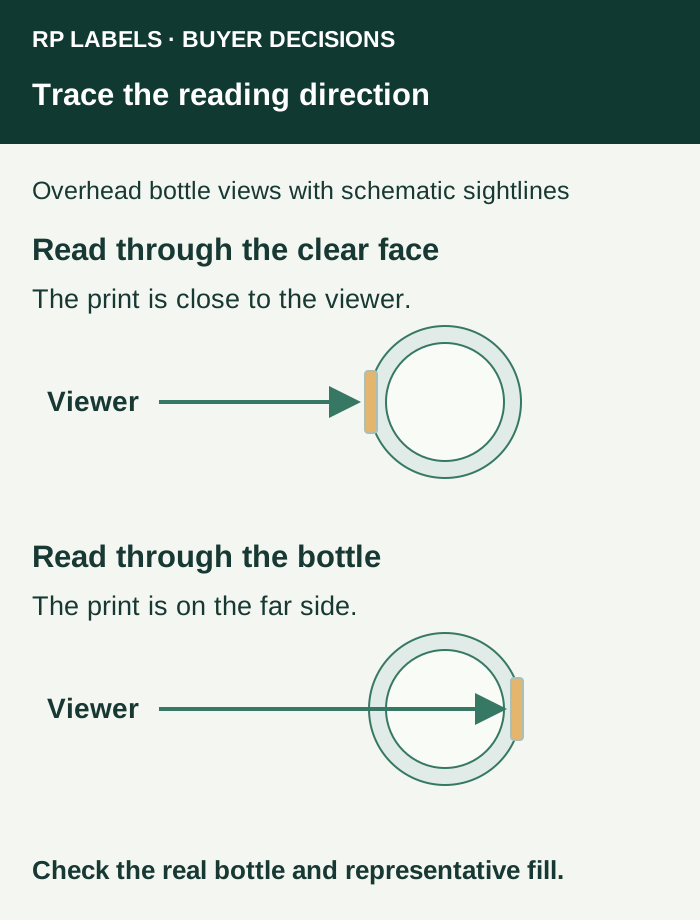
Choose the print side by tracing the viewer’s line of sight through the label. For an outside bottle label that puts fixed graphics behind a clear film, ask about printing on the film’s container-facing surface and reading through the film from outside. For a later lot code or a visible surface effect, specify which exposed layer must accept that operation before approving the construction.
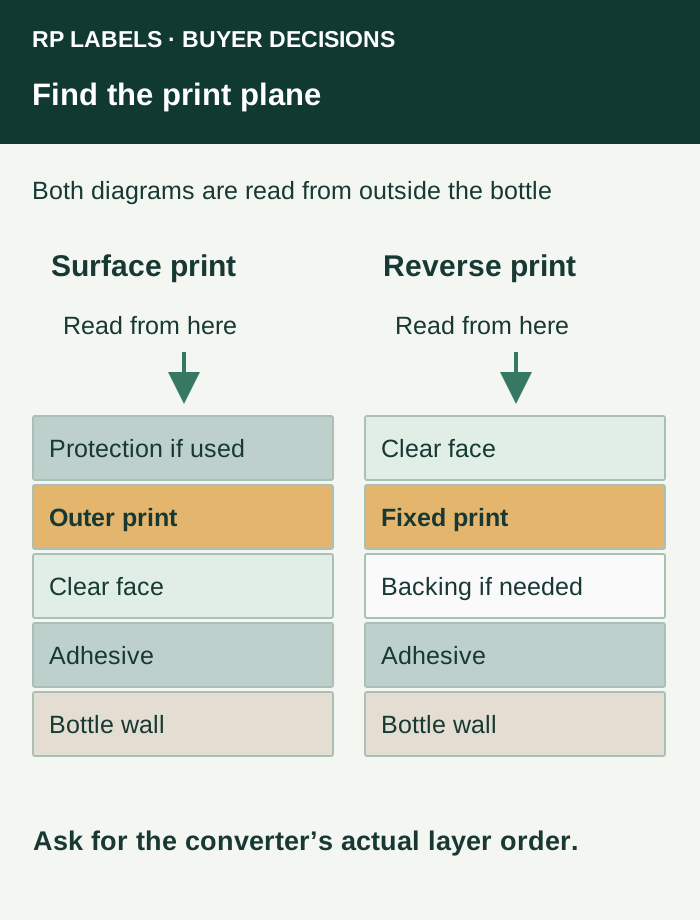
Agree on which surface carries each element
Surface printing puts the graphics on the outer side of the face film. A converter may add a compatible protective layer above those graphics. In a reverse-printed construction, the fixed graphic can sit behind the clear face so the viewer reads it through that face. Ask the converter for its actual stack because the ordering of print, white, protective layers and adhesive depends on its proposed process. Film label patent application, Figures 2 and 4.
For a bottle or vial viewed from outside, mark the desired reading side and the container side on the artwork handoff. Let prepress handle orientation for the selected route. Request the reading view and a clearly labeled production view when the two differ. The buyer approves the intended readable result and the placement of each print layer. The converter confirms how to produce that result.
Separate protected graphics from through-bottle artwork
Some label briefs use “reverse-side printing” to describe a second message read through a clear container. That proposal needs the bottle and contents included in the sightline. For protected outside graphics, the main reader looks through the clear face from the label side of the bottle. Mark the intended path before comparing either quote. Converter’s double-sided label example.
| Buyer’s requirement | What to identify in the construction | What the sample should show |
|---|---|---|
| Fixed image behind the clear face | Reading side, print plane, selective white areas and any layers between print and adhesive | Readable fixed graphics and the intended clarity on the real bottle |
| Fixed graphics with later lot or date printing | Exact exposed printable area, printer and consumable | The fixed artwork plus a legible, durable later mark under the agreed handling conditions |
| Separate artwork read through a clear bottle | Both reading directions, bottle color and intended contents or representative fill | Which message appears from each side on the assembled pack |
Keep the reading view and the white-opacity result together
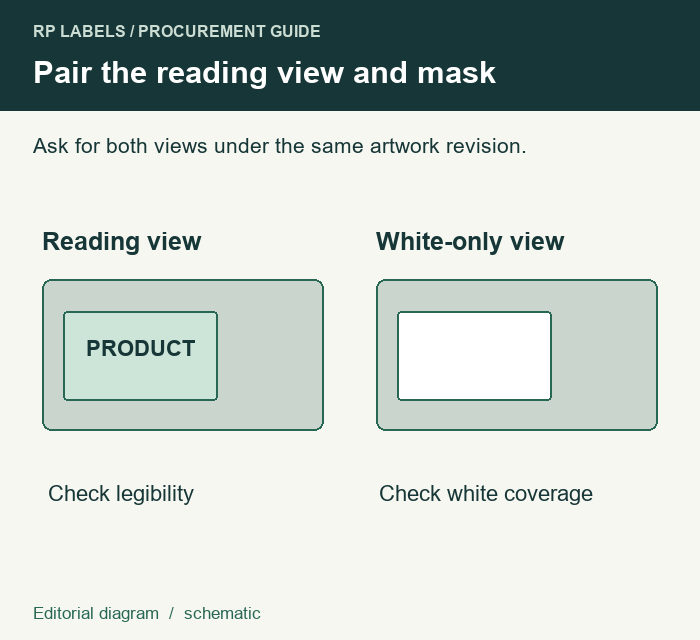
A white-only view helps confirm which regions are printed white. It leaves the buyer to verify that the intended message reads correctly through the final layers and on the actual bottle. Ask for a reading-side view and the matching production separations under the same artwork revision. If the brief calls for a second message through the bottle, check that view separately with the intended container and representative contents.
If suppliers report visual opacity, ask them to identify the printed white specimen and its substrate. ISO 23498 describes a measurement method for printed white ink on transparent and on white or colored opaque substrates. Confirm the method used and the specimen construction before comparing values. Two readings can answer different questions if one represents the proposed clear film and the other is for white ink printed on another substrate.
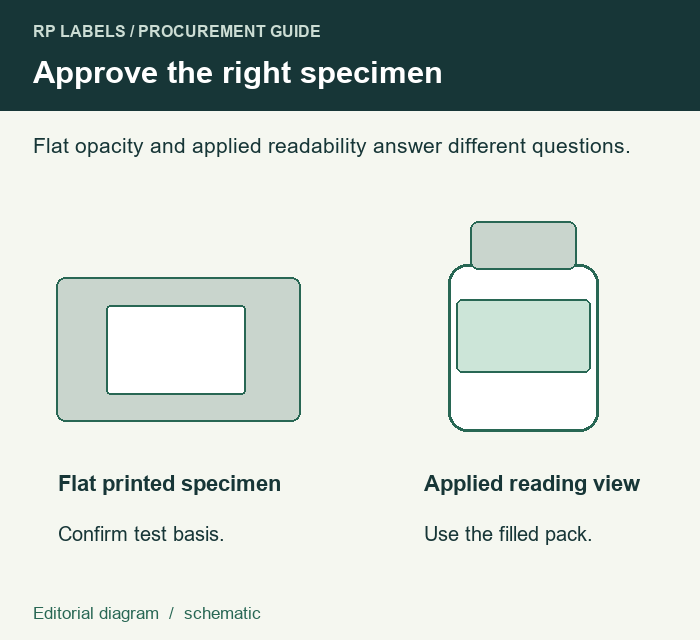
For a label where the white mask only backs the outside artwork, review its coverage and check the applied outside reading view. For a construction with messages from two sides, review both against the approved references and look for unwanted show-through. When an identified flat specimen meets the agreed opacity criterion but small copy still disappears on a filled bottle, keep the applied approval open. Review the background, position, registration and curvature with the converter. If a change to white coverage is proposed, have prepress preserve any intentional clear window and issue a new paired proof. Ask for code verification separately when the layout includes a code.
Approve the finished construction on the bottle
Check the smallest type, unprinted clear areas and the intended opaque fields in an applied sample. View the pack against its expected background. If print protection is the reason for the purchase, ask the converter to describe the sample construction and agree the real rub or wipe exposure with the buyer. Observe the exposed film, fixed print, applied edge and any later mark separately. Moving fixed print behind a film can change its direct exposure while the outer face and edges still need their own evaluation.
When you compare quotes, ask which sides are printed, which layers are included, and who prepares the orientation and white separation. Compare the finished dimensions, costs by design and sample scope on the same basis. Keep the white ink decision with the viewing requirements and the surface finish comparison with the handling requirements.
For custom vial labels or supplement labels, prepare an RP inquiry with the reading-side sketch, bottle reference, artwork, quantities and any later printing. Ask which layer arrangement and applied sample can be quoted. Include a photo from each requested reading side so the converter can resolve the intended construction before proofing.