When to Use a Split-Back Liner for Hand-Applied Bottle Labels
Consider a split-back liner when the operator needs to expose only part of a hand-applied label before locating it on the bottle. Keep a plain backing when a short label can be peeled and placed reliably in one motion. Ask for the finished label and liner arrangement in the quote, then compare both on the actual pack before choosing.
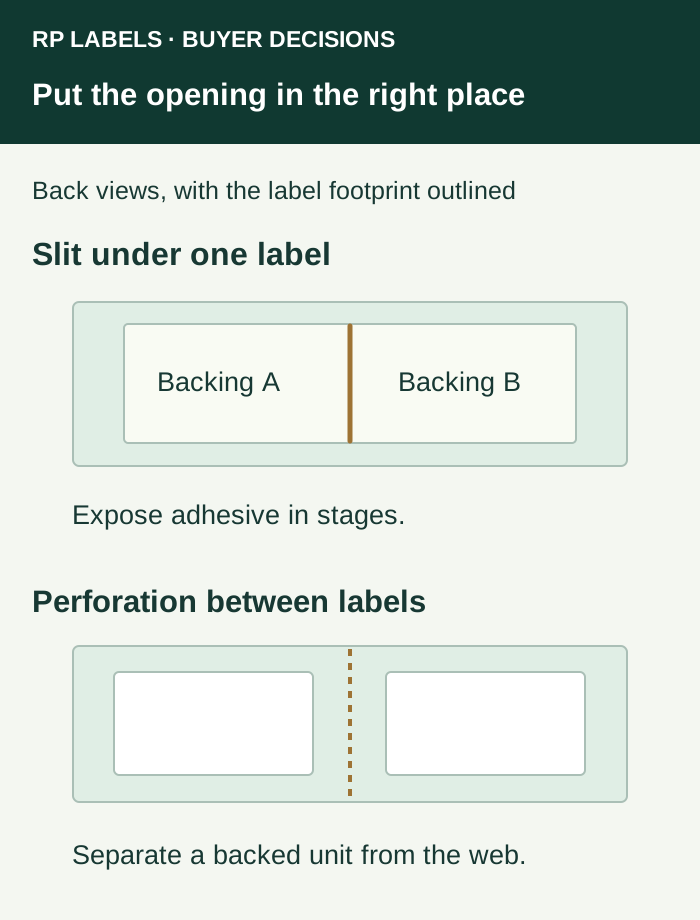
Mark the slit under the label
A split back places a slit in the liner beneath an individual label so the operator can remove the backing in sections. A between-label perforation gives the operator a way to separate a backed label or group from the web. The two features belong in different locations on the finishing drawing. Keep the printed face continuous where the task is staged peeling. Labelservice glossary.
Ask the converter to show where the proposed split falls relative to the leading edge, front artwork and wrap seam. Some stock has a prepositioned slit. Check that the slit actually falls under the delivered label. If the converter offers a registered slit, ask which stock and delivery format support it. The roll perforation guide explains how to specify a between-label tear when the packing station needs separately backed units.
Choose the hand movement that needs support
On a long supplement-bottle wrap, the operator may need to align an edge while keeping most of the adhesive covered. A split can let the operator expose one zone, place it against the agreed reference and remove the remaining backing while applying the rest. Identify that reference on the bottle, such as an approved alignment mark or fixture. Request a position that leaves a usable section to hold. Avery’s guidance for applying labels with a slit liner.
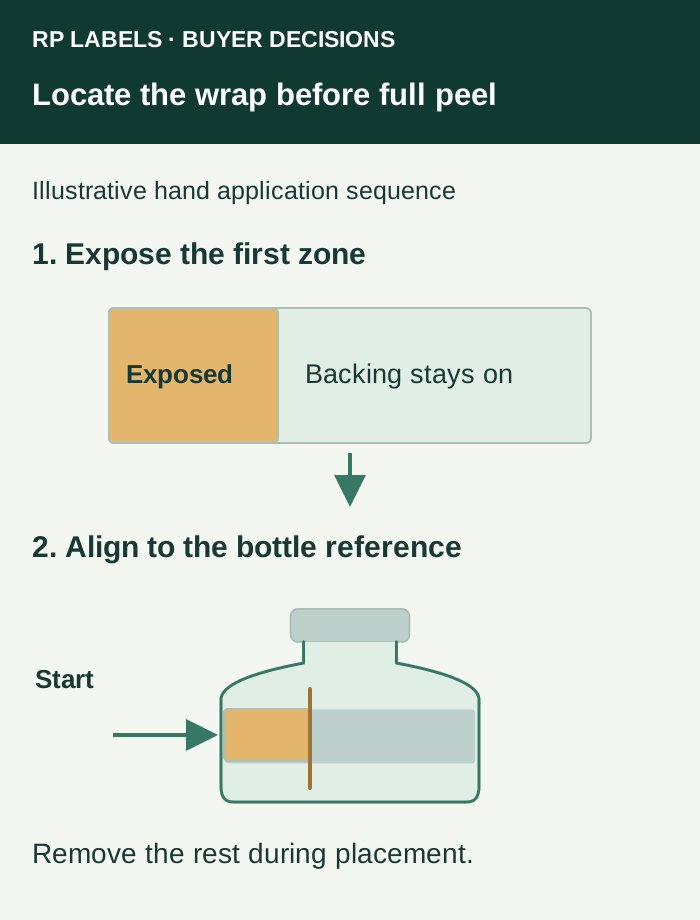
| Pack and application | Compare on the sample | Decision |
|---|---|---|
| Short label already peels cleanly and meets placement needs | Plain backing and the current bench method | Keep the simpler format if the result remains acceptable |
| Long wrap shifts while fully exposed | Plain backing and staged peeling with the same bottle and printed shape | Use the proposed split if the intended operator can place the wrap more consistently |
| The backed unit must be separated before it reaches the station | A between-label tear location and the required unit count | Specify the group boundary separately from any under-label slit |
| The same design will also run through an applicator | The proposed machine roll and a separate manual format | Obtain the packer’s approval before using a slit carrier on equipment |
Test the finished piece, including the backing
Give the intended operator the normal gloves, fixture and work surface. Observe whether the first section releases easily, the remaining backing stays in place until needed and the printed face remains intact. Compare applied skew, seam position, wrinkles and handling against the existing format. For a small label, check whether the additional backing piece is easy to handle and remove. If either piece tears or the exposed adhesive cannot be controlled, return the marked sample to the converter before approving a larger order.
Ask how the approved geometry will be supplied, including sheets or individual pieces, backing layout and any separate machine rolls. The kiss-cut and through-cut guide covers the outer cut and delivered format. Confirm the split location independently when it affects application.
For custom supplement labels, prepare an RP inquiry with the bottle, label footprint, artwork, quantities by design and a sketch showing where the operator starts the peel. Ask which hand-applied format and sample can be quoted, including the proposed slit and any effect on material or finishing cost.