Perforated Label Rolls: Put the Tear Line in the Right Layer
If a packing team wants to tear individual labels from a roll while leaving each label on its backing, ask for a proposed tear line in the carrier between labels. If the buyer wants a seal to break when a carton opens, the proposed perforation belongs to a different part of the construction. “Perforated labels” does not distinguish those requests.
Mark the intended tear location and identify the layers it crosses before accepting the quote. Then ask the person who will handle or feed the web to review the finished proposal. A convenient hand-tear feature can be an unwanted weakness in a continuous machine-fed carrier.
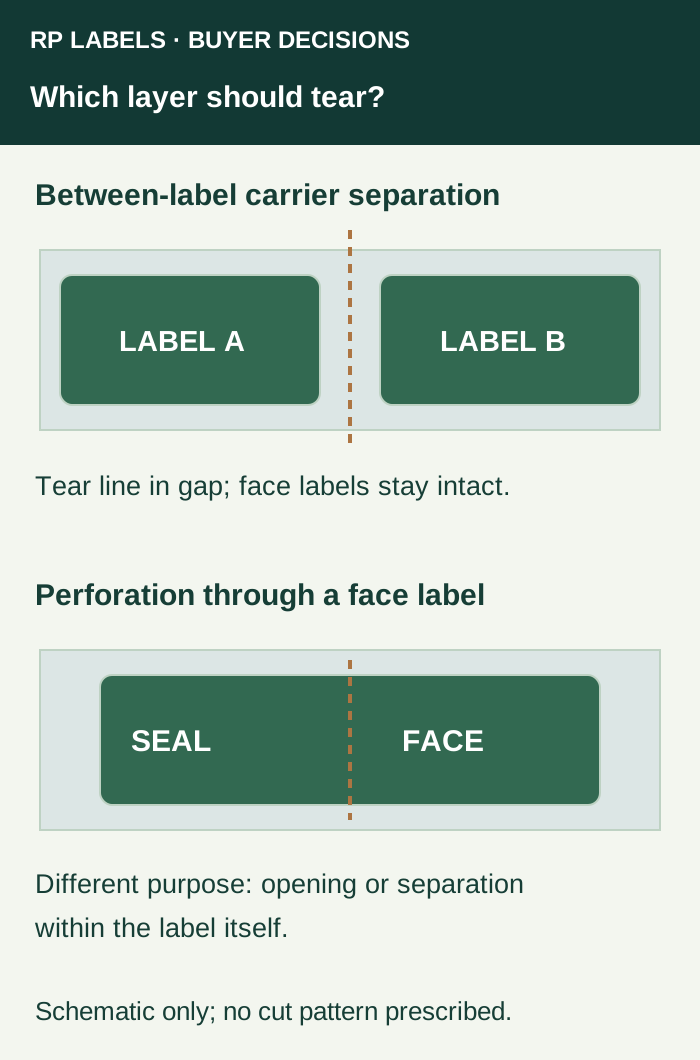
First decide what should remain attached
For a manual job, the operator may want to separate one backed label, a small strip or a fixed group of labels. Record which unit is useful at the bench. The adhesive label should remain on its protective backing until application if that is the intended workflow.
For a tamper-evident closure, the buyer instead wants a specified response after the label is applied across an opening. A line between neighboring labels on the liner does not establish that response. The carton-seal tear-path guide addresses that separate purchase.
For a detachable record tab, the requested separation can cross part of the face label itself. That needs its own identity and transfer requirements in the record-tab guide. Do not let an illustration of one perforation approve all three functions.
The liner and finishing process determine what can be offered
Avery's WePrint guidance describes a between-label perforation available with its paper liner and excludes its PET-lined film products from that particular laser-finishing option. This is a supplier-specific production rule. It is not evidence that every PET liner is impossible to perforate or that RP offers the same service.
Ask the converter to confirm the proposed carrier, finishing method and available tear arrangement for your job. A request that works on one stock may require a different construction or may not be available on another. Do not accept a liner substitution without checking the machine and application conditions that depend on it.
Keep the liner qualification separate from the tear feature. If the original carrier was selected for sensing, strength or release behavior, changing it solely to obtain a perforation can reopen those decisions.
For hand work, test the complete separation and peel sequence
Ask the intended operator to separate the proposed unit, identify its design, peel the label and apply it to the actual container. Include the gloves, handling space and counting routine used at the packing bench where relevant.
A useful result answers whether the tear reaches the intended boundary, whether the label stays protected until peeling and whether the separated piece remains identifiable. It does not merely show that someone can break the web with enough force. Let the operator and converter define an appropriate trial; this guide supplies no universal tear-force threshold.
In a fictional mixed-vial kit, the team wants three backed labels kept together until it reaches a particular kit station. A tear line after every label may create more loose pieces to control. A proposed group separation could be more useful if the converter can supply it. The application task decides the requested unit.
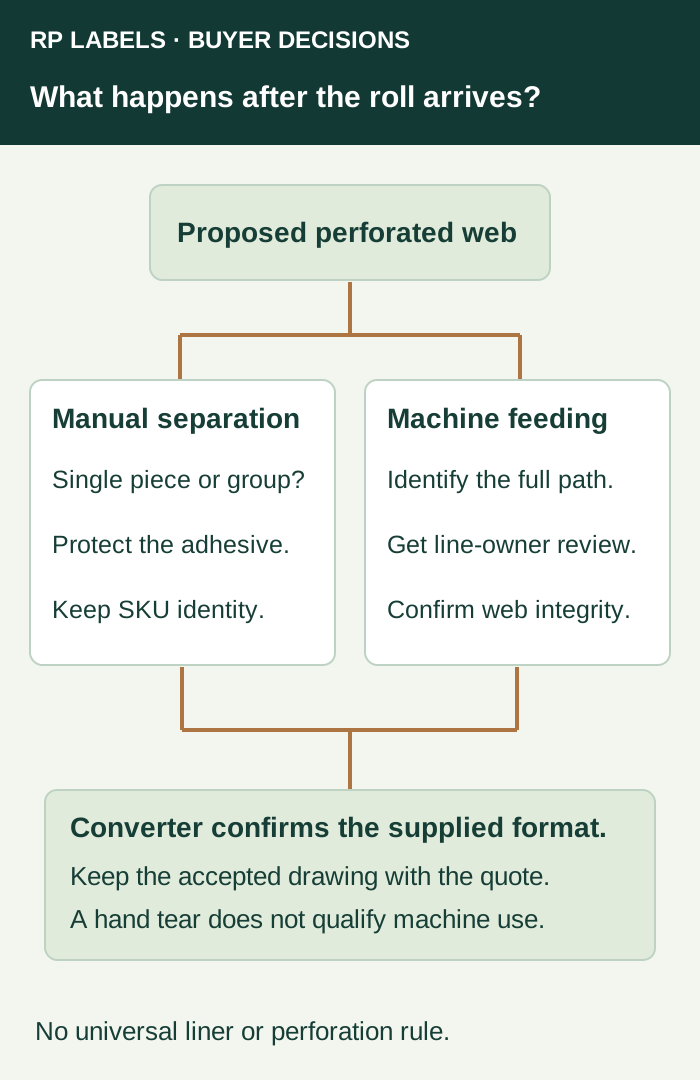
For machine feeding, let the line owner approve the carrier
Identify whether the web must travel through a printer, peel plate, applicator or liner rewinder. Ask the equipment owner whether the proposed perforation and its location are acceptable for that complete path. A roll that tears neatly by hand may not behave as required under the line's tension and start-stop routine.
The converter needs the accepted web drawing, including width, pitch, gap, liner and any tear positions. The machine-roll brief holds those requirements. Do not strengthen or weaken a proposed tear line by improvised cuts at the packing station and then treat the altered web as the supplier's approved format.
Make the quote name the finished result
For a hypothetical request, write: “Propose a tear line between backed label groups as marked on FORMAT-R1, leaving the face labels intact. Please confirm the carrier, availability, dimensions to agree and any price or schedule effect. Manual separation is intended; any later machine use remains unapproved.” An actual machine-fed request needs the line owner's acceptance instead.
For vial labels, supplement labels or hologram seals, prepare an RP inquiry with the separation unit, annotated layer/position drawing, quantity per design and application method. Ask what finished format can be supplied, then retain the agreed drawing with the order.