Label Rolls for Multiple Packers: Allocate the Shipment Before Finishing
The label order contains the right total quantity. Packer A needs part of it now; Packer B uses a different applicator and receives the rest later. Purchasing asks the printer to divide the cartons after the rolls have already been finished.
That hypothetical request can be more complicated than adding a second address. The destinations may need different roll formats, quantities, artwork versions or receiving references. Set the allocation before the converter confirms finishing and shipment, then ask which supply arrangement it can actually support.
This guide concerns finished product-label rolls for supplement or research-vial packaging. It is not a guide to printing carrier shipping labels. The buying decision is how an accepted label order becomes the correct usable delivery for each packing site.
Amazon FBA warehouses
We can split a shipment to multiple Amazon FBA warehouses when you provide the warehouse addresses and any required carton or label instructions. Each destination is packed and documented separately as agreed on the order. Amazon receiving rules are the buyer's to provide; we follow the written instructions on the order.
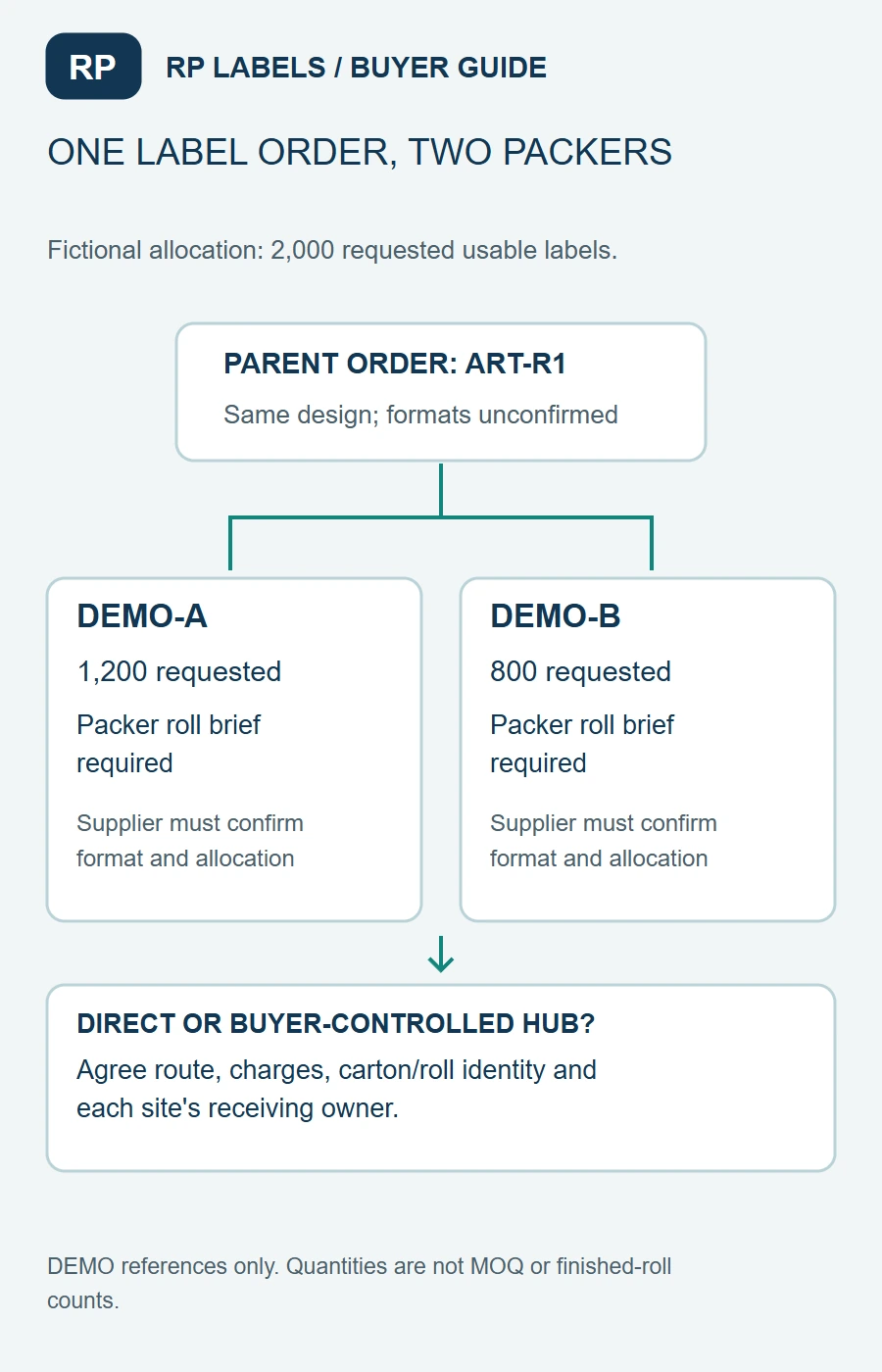
Illustrative allocation map. DEMO sites, quantities and formats are planning references, not customer locations, confirmed shipments or RP service commitments.
Separate the artwork from the destination requirement
Start with the approved label identity: SKU, artwork revision, construction and finished dimensions. Then attach the requirements of each receiving site. The same printed design does not prove that one finished-roll format will fit every applicator.
Ask each packer for its actual unwind interpretation, core, permitted roll diameter, web and other relevant restrictions. Use the automatic-roll specification guide to collect those inputs. Do not average two incompatible requirements or assume the packers can modify the rolls themselves.
If one shared format fits both sites, it may simplify production and inventory. If it does not, separate finishing may be the practical proposal. Ask the converter about feasibility and quoted consequences before treating the split as part of the accepted order.
Allocate quantity on a stated basis
Give each destination its required usable quantity by design and revision, plus any separately agreed trial or reserve stock. Identify whether the request is an exact quantity, a minimum or another accepted range. Commercial count conditions belong in the supplier's written agreement.
The fictional worked example allocates 1,200 labels to DEMO-A and 800 to DEMO-B, totaling 2,000. It does not establish RP minimums, roll sizes or tolerances. Actual labels per roll, finished-roll counts and any rounding remain for supplier confirmation.
If the converter cannot achieve the requested allocation without changing the finished format or commercial quantity, ask for an explicit alternative. An overall excess does not automatically make up for a shortage at one site. Conversely, unused stock at the first packer may remain available only if the buyer has agreed how it can be transferred and identified.
Use the usable-quantity guide for the separate total-order commitment. This allocation tells the supplier where the accepted quantity needs to go, rather than redefining that commercial agreement.
Decide where the physical split happens
One arrangement sends separately identified deliveries from the converter to each packer. Another sends a consolidated order to a buyer-controlled hub that performs the later split. Neither is automatically faster or cheaper.
Direct deliveries can reduce an intermediate handling step when the supplier accepts the arrangement and each destination's requirements are complete. A hub can offer flexibility where allocations may change or the supplier quotes only one delivery. It also introduces an owner for counting, identifying, storing and forwarding the rolls.
Ask who is responsible for freight, destination information, shipping documents and any other requirements applicable to the agreed route. RP's shipping-information page leaves method and cost to confirmation for the actual order. Do not assume multiple-address dispatch or later storage is included in a general shipping statement.
Make carton and roll references survive receipt
Connect the destination allocation to the actual finished roll references and the cartons containing them. Receiving should be able to identify the intended site, SKU, artwork revision and quantity basis without opening and unrolling every item.
Where trading partners require formal logistics identification, use their applicable requirements with the responsible logistics owner. The GS1 Logistic Label Guideline addresses identifying logistic units within its scope. It does not mean every small label shipment needs an SSCC or that this article's DEMO references are valid GS1 identifiers.
Keep the carrier tracking reference separate from the content record. Tracking can show the movement of a package; it does not establish that the carton contains the correct artwork or roll format. Match the packing information to the allocation at receipt.
Change an allocation without losing the old decision
If Packer A postpones its run, purchasing may want to divert its rolls to Packer B. Check whether the artwork and physical roll specifications are still suitable before changing the destination. Record who authorizes the revision and whether the supplier has already packed or dispatched that portion.
A revised spreadsheet is not proof that a supplier received and accepted the change. Obtain acknowledgement identifying the affected allocation and keep the former version as history. If the physical format is incompatible, the next question may be an agreed rework proposal rather than an address edit.
The worked allocation, blank allocation and field guide join destination, artwork, quantity, roll requirement, dispatch owner and receiving disposition. Actual formats and outcomes remain pending in the example.
For custom supplement labels or vial labels, send RP Labels the per-site allocation brief before accepting finishing. Include quantities, artwork revisions, each packer's roll requirements and desired receipt dates. Ask what arrangement and charges the supplier can confirm. The order is ready for distribution when every destination has an identified share it can actually use.