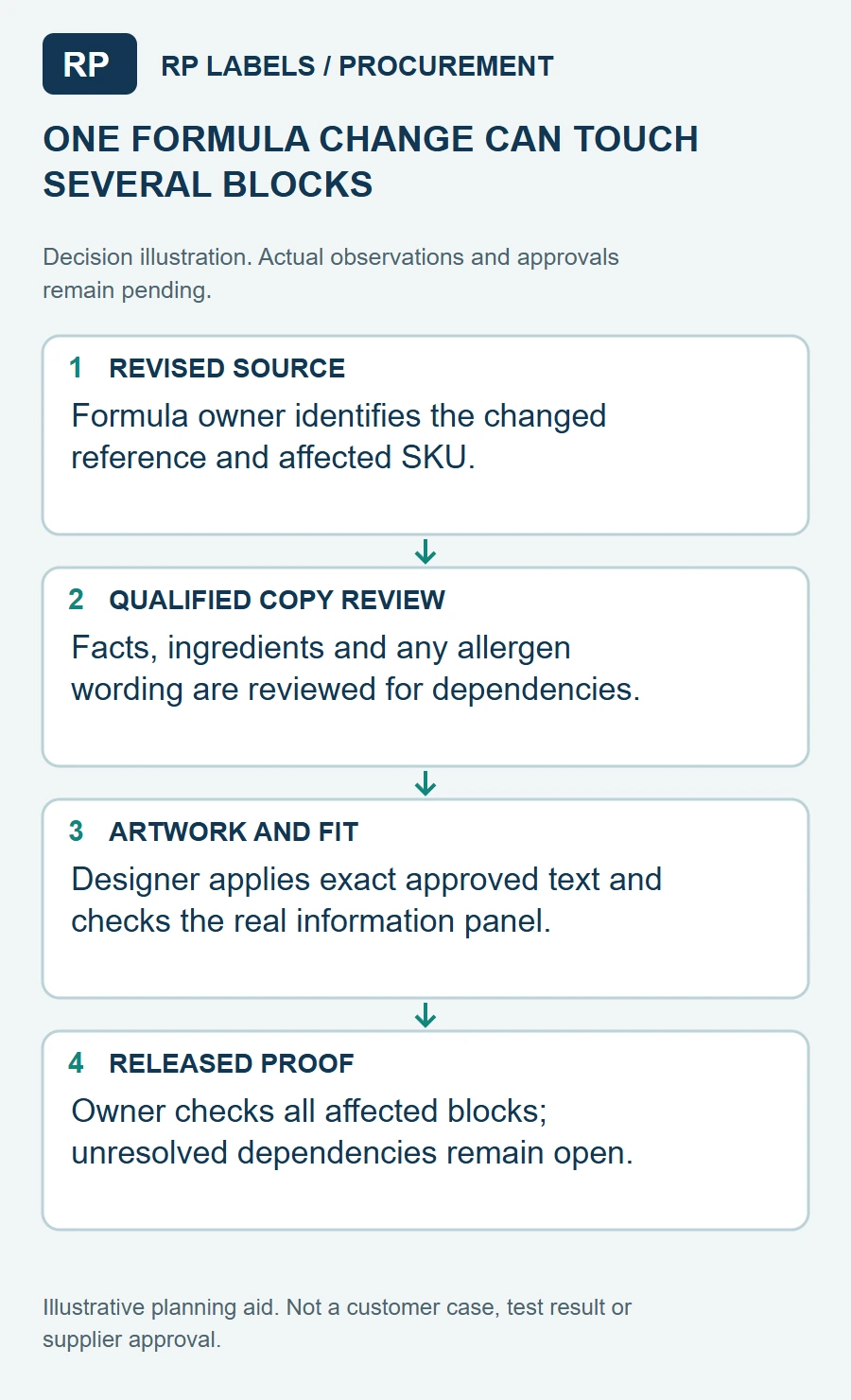
A supplement bottle can have a beautiful front panel and still need a complete redesign when the formula owner sends the final ingredient list. The trouble is rarely that the designer forgot the side panel entirely. More often, the side panel was sized around a temporary two-line placeholder, then treated as finished artwork.
I would reserve the information area before polishing finishes or decorative claims. The product owner should supply approved formula, ingredient names and any required allergen wording. A custom-label printer can reproduce that copy and test whether it fits; it should not guess the ingredients or decide legal wording for a brand.
Separate the facts panel from the ingredient statement
The FDA's dietary supplement labeling guide identifies the statements generally required on a U.S. dietary supplement label and explains the front and information-panel arrangement. Its ingredient-labeling chapter distinguishes ingredients declared in Supplement Facts from the ingredient statement. When some ingredients are identified as sources inside the nutrition panel, the separate statement is headed "Other Ingredients". The guide also describes where that statement belongs when it is required.
For a buyer ordering a wrap label, this means the dieline must be planned around both the finished facts panel and the actual statement below or adjacent to it, not around the number of characters in a draft. A change from one capsule shell, flavor or sweetener to another can alter copy length. It may also change which version of the label can be used for a given SKU. Treat that as an artwork-control issue, not a last-minute font-size issue.
Keep allergen review with the brand
Allergen declarations are not generic lines that can be copied from another product photo. FDA's food-allergen labeling Q&A discusses dietary-supplement cases as well as the relationship between ingredient statements and "Contains" statements. The applicable wording depends on the actual formulation and market. I would ask the brand's qualified regulatory reviewer to approve the final ingredient and allergen text before the label supplier releases files to print. An empty review field on an internal proof is better than a convincing-looking but unapproved claim on finished labels.
For multi-SKU orders, create a copy table with one row per flavor, count and formula revision. Name the exact artwork file for each row. The product owner signs off the formula-linked wording, while the printer checks that the correct file and quantity are attached to the correct roll or carton. A shared visual system is useful, but it must not hide a copy difference between variants.
Test the wrap, not just the flat page
Print a proof at finished size and wrap it on the exact bottle. Can the information panel be read when the bottle is held normally? Does the seam or overlap interrupt the ingredient statement? Is the cap, tamper band or shoulder covering the top of the panel? Does the barcode or lot-code area eat into the space the copy needs? These are simple physical questions that a large artboard cannot answer.
Do not respond to a crowded panel by reducing every line until the text technically fits. Change the panel allocation, bottle size, label height or product-copy hierarchy first. For some projects a different packaging format may be the cleaner answer. The final decision should be made with the actual brand copy and its legal reviewer, not with a printer's fictional example layout.
What belongs in the order brief
Send the bottle or accurate drawing, finished label dimensions, approved Supplement Facts file, ingredient statement, any brand-approved allergen copy, market, barcode, date/lot plan and quantity per variant. Request a digital proof that shows the entire wrap and a physical applied sample before bulk printing. The aim is not to make the side panel impressive. It is to leave enough room for accurate copy to remain readable after the label is actually on the bottle.
Sources and scope
Reviewed October 2, 2026. The primary references linked below support the identified technical points. Buying scenarios and inspection checklists are editorial guidance, not RP production records, certification, legal approval or universal acceptance standards.