A wrap label can look wonderfully balanced while the designer is still working on the front. Then the final ingredient list arrives, the Supplement Facts panel grows, and the distributor address has to move. If the die-line was approved first, the only apparent options are smaller type, a cramped panel or a new label size. I would settle the information architecture before spending time on a foil accent.
This is especially important when a custom supplement brand sells several SKUs in similar bottles. The longest legitimate copy, not the prettiest first product, should inform the shared label footprint. The decision is both physical and regulatory. RP can help produce the label, but the brand and its qualified regulatory reviewer must approve the final claims, required statements and jurisdiction-specific artwork.
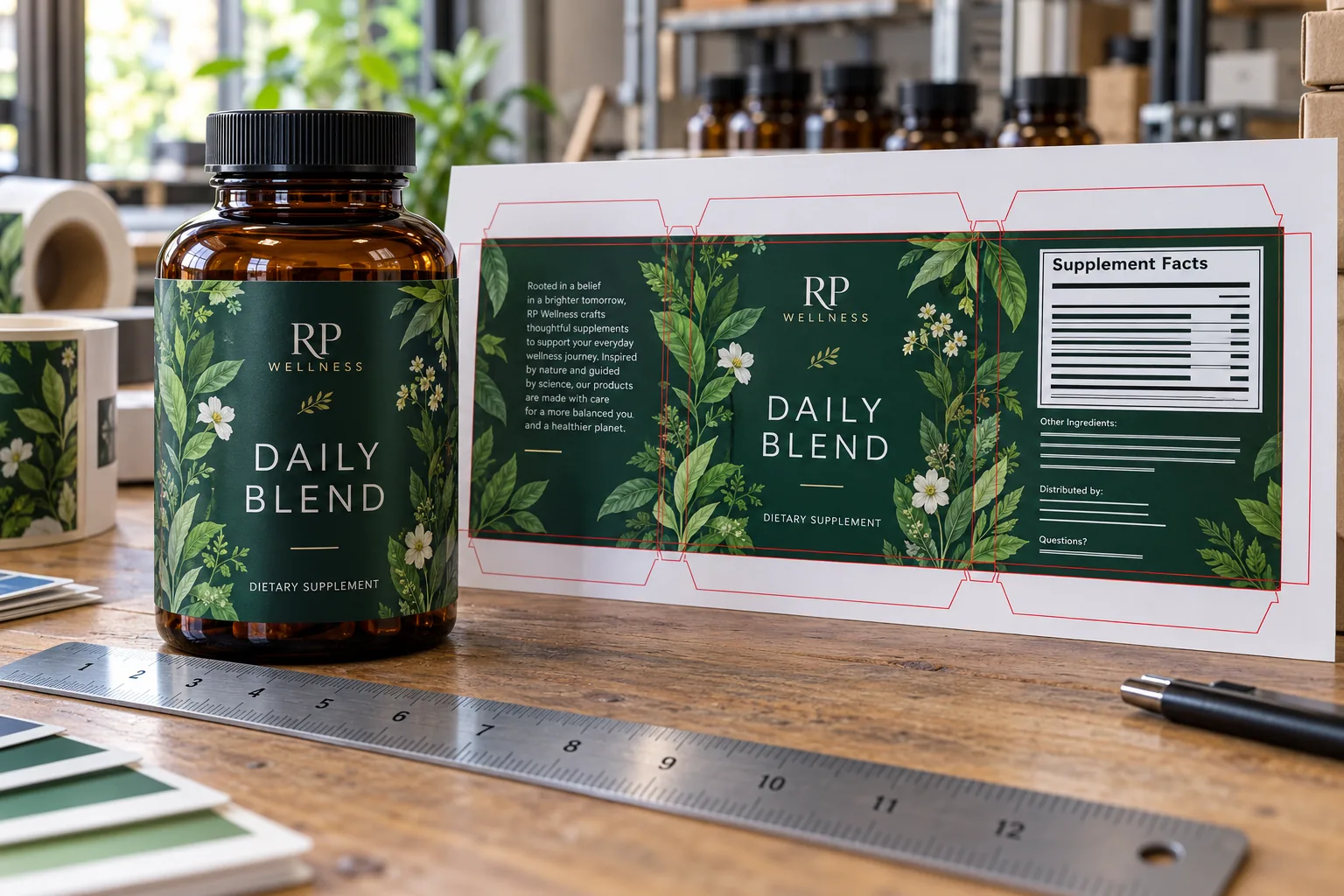
Reserve the information panel before the front panel expands
For a U.S. dietary supplement, the FDA's general dietary supplement labeling guide identifies the required statement groups and explains principal display panel versus information panel placement. The guide places Supplement Facts, ingredients and manufacturer, packer or distributor information on the information panel unless they already appear on the principal display panel, subject to stated exceptions. Decorative copy and QR codes cannot simply interrupt required information to make the wrap look symmetrical.
On the actual bottle, mark the portion a shopper can see from the front, then reserve the adjacent usable width for required copy. Check where the label seam lands and whether the cap or bottle curvature hides an edge. This is not a suggestion to invent a fixed universal back-panel width; the bottle, content and applicable rules determine the working area. If the brand is selling outside the United States, use the relevant market's requirements rather than transferring a U.S. example across borders.
Use real content, not a beautiful placeholder
Ask the regulatory owner for the approved ingredient list, serving information, required business identification, warnings and approved product identity before the final dieline lock. A generic “Supplement Facts here” rectangle is useful in early sketches only. Once the copy arrives, test it at the intended print size on a one-to-one physical proof. Read it under ordinary light, then wrap the proof on a bottle; a flat monitor view hides curvature and seam problems.
The FDA's Supplement Facts guidance discusses panel formatting, contrasting background, lettering and specific small-package provisions. Those exceptions are not an invitation to shrink all text until it fits. FDA also notes that parts of its older guide are being updated, so the brand's regulatory reviewer should check the current industry resources and current rules before approval.
Compare three real layout choices
First, a single continuous wrap may be efficient when the bottle has enough straight-wall area and the applicator can hold the seam away from critical text. Second, front and back labels can give cleaner merchandising space, but they introduce registration and gap tolerances. Third, an outer carton or another approved multi-panel format may be worth evaluating when copy truly cannot fit. None of these is automatically compliant or cheaper. Each needs a separate quote and a sample on the actual bottle.
My least favorite option is making the print smaller without changing anything else. If the panel cannot be read comfortably on the real container, a digital proof has not solved the problem. Move decoration, alter the bottle or revise the approved panel layout with the compliance team. Keep the barcode away from severe curvature and the seam; the front/back registration guide covers that production detail.
A practical artwork handoff
Send the bottle specification, a flat layout with exact dimensions, the longest SKU's approved copy, the market of sale and the desired finish. Identify which fields change by SKU so they cannot drift into the wrong panel. Ask for an actual-size print proof, not merely a screen PDF, before mass printing. The photograph above is an AI-generated planning illustration with placeholder lines; it is not approved Supplement Facts artwork.
For a quote, share the final copy and bottle dimensions through the custom supplement label inquiry. The best time to discover that the panel needs more room is before the cutting tool and print file are committed.
Sources and scope
Reviewed September 30, 2026. Primary FDA, GS1 and label-material references support the identified technical points. Buying scenarios and inspection checklists are editorial guidance, not RP production records, certification, legal approval or universal acceptance standards.