Printing an Amazon FNSKU on a Supplement Label: What to Approve First
A supplement brand is redesigning its bottle label and moving a product into Amazon fulfillment. The team sees an opportunity: put the Amazon barcode on the main label and avoid applying a second sticker. The designer has space. The printer has a PDF. But neither fact answers the purchasing question: is this the right barcode, on the right packaging layer, for the specific offer and shipment?
Start with the seller's current account and the actual fulfillment plan. If the Amazon barcode is required for the unit and the authorized code, packaging format and artwork are stable, ask the converter whether integrating the supplied code is feasible. If the same printed bottle needs to serve several channels or a code decision remains open, a separate label can preserve flexibility. Neither route is automatically approved for every product.
This is a planning guide for custom-label buyers, not an Amazon approval or a substitute for current Seller Central instructions. A public Reddit seller question raised the same printing decision during a label redesign. It is not an RP customer order or a reported production result.
Confirm which barcode the actual offer requires
There are several identifiers in an Amazon product workflow. An ASIN, a manufacturer barcode such as a UPC, and an Amazon barcode can all appear in a conversation about the same item. They are not interchangeable design decorations. The seller should check the current barcode and labeling instructions for the specific US offer, inventory and shipment in Seller Central before commissioning print-ready artwork.
Amazon's FBA barcode requirements identify manufacturer and Amazon barcodes as separate paths. Its publicly indexed guidance says barcode requirements changed on March 31, 2026; whether a particular offer may use a manufacturer barcode depends on the applicable seller and product conditions. The page may require JavaScript or account access to read in full. Confirm the live account instructions and eligibility with Amazon when the status is unclear. Do not assume every supplement, brand owner or reseller receives the same choice.
If the plan requires an Amazon barcode, obtain the actual authorized asset through the seller's account. Ask the seller which human-readable text and product identification need to accompany it for this offer and shipment. A number typed into a mockup or a screenshot of someone else's label is not an authorized print file. The brand or seller owns the account decision; the label supplier needs an approved source to reproduce.
Choose the physical label only after the pack is defined
A bottle-only unit, a bottle in a retail carton and a bottle wrapped for shipment create different visible surfaces. The location that looks clean on a bottle proof may be hidden once the unit is packed. Mark the exact unit as it will be presented to fulfillment, including any additional protective packaging, and ask the seller to verify the applicable placement rules.
Amazon's seller-education guidance on barcode preparation discusses matching labels to products, placing a readable barcode and handling other scannable codes. Apply its instructions only after checking the current US requirements for the actual shipment. In particular, do not blindly cover a UPC: identify which barcode the plan requires, whether another code must remain visible for a different channel, and what can lawfully be covered on the finished pack.
For a physical proof, reserve a readable area with the appropriate quiet margins and avoid cutting a code across a seam, corner or heavy glare. The code owner supplies the symbol and its requirements; the designer checks the layout; the packer checks the actual unit. A crisp code on a flat PDF is useful evidence of layout, not evidence that the assembled bottle or carton will pass every receiving scan.
Integrated printing can simplify a stable operation
When the seller has confirmed the code and the package has a suitable scan area, the main-label proof can include the authorized barcode asset. That can remove a separate label application step. It also binds the purchased label stock to that barcode and artwork version.
Consider a clearly fictional example: DEMO-A is one supplement variant, ART-R2 is its proposed bottle artwork, and the seller has supplied a controlled barcode-file reference. The printer can show the reference on the proof; the seller then compares the decoded value and accompanying content with the current offer and shipment instructions. The example contains no real FNSKU, no fulfilled order and no platform approval. If another flavor uses a different offer or code, it needs its own confirmed row rather than a copied artwork assumption.
Before release, ask the converter what file format and physical sample can be supplied, what portion of the code area the buyer must approve, and how the relevant artwork version will be identified on finished rolls or stacks. A digital proof can show that the correct approved asset was placed; an applied, representative print sample is needed to examine the physical result. Confirm any required verification method with the responsible trading partner. A phone scan alone is not a barcode quality report.
Separate labels can be the better purchase
A separate Amazon barcode sticker has an extra handling step. It can nevertheless be a sensible option when the brand uses the same primary bottle design for different sales channels, when the code decision is still pending, or when the packaging configuration may change. The team can maintain common primary-label inventory and decide which units need a channel-specific label after the seller confirms the plan.
That flexibility has a real operational cost: somebody must maintain the right sticker files, apply them to the right units and check the final packaged item. It also does not excuse covering product identity, Supplement Facts or other copy that the product's qualified reviewer has determined must remain visible. If a sticker would obscure essential information, revisit the label layout or packaging arrangement with the responsible owners.
Neither option eliminates version control. The difference is where the controlled change sits: in the printed bottle artwork or in a separate unit-label operation. Ask the packing team which error they can actually prevent, rather than choosing the option that produces the cleanest mockup.
Keep four approvals connected
Fictional worked handoff (CSV) · Blank handoff (CSV) · Field instructions
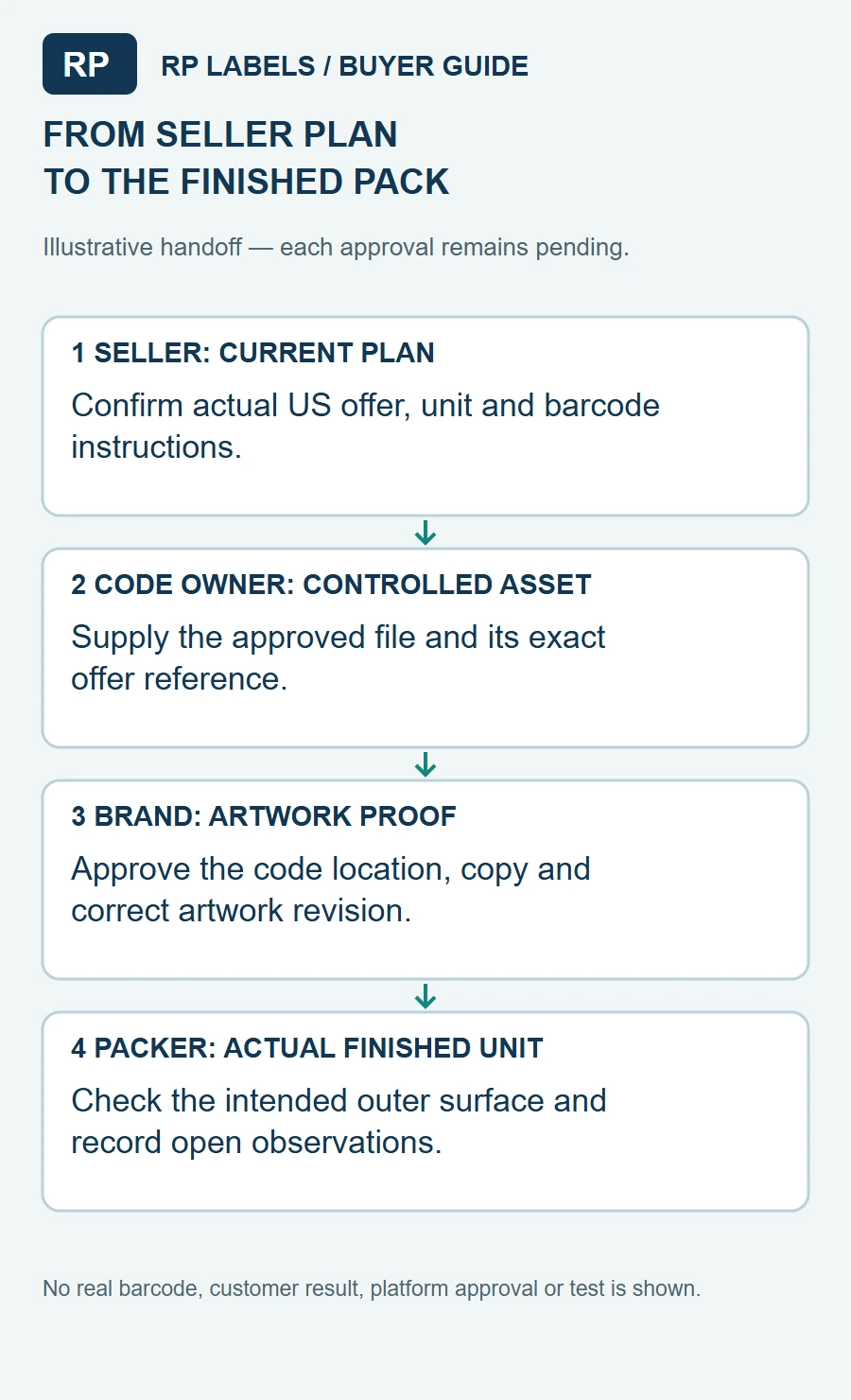
Use the decision record below to join four references without pretending that one owner approves everything:
- Seller and fulfillment plan: the account owner records the specific US offer, unit configuration and current barcode instruction, plus the source and date checked.
- Authorized code source: the seller supplies the exact asset and checks the relevant text or identifier against the offer. Keep the file version controlled.
- Printed artwork: the brand approves the exact label revision and confirms that the code, clear area and required product copy are placed on the intended surface.
- Physical pack: the packer or designated reviewer inspects the representative final package with the intended scanning workflow and records unresolved observations. Any additional verification or Amazon instruction stays with its actual owner.
The worked record uses DEMO references and leaves every approval pending. It is an example of a handoff, not an acceptance checklist issued by Amazon. If the code or offer changes, the seller should first verify what actually changed and whether any existing stock remains usable. A change does not automatically invalidate every printed label, and a printer should not make that account-level judgment.
For general code-purpose decisions, see supplement barcode and QR planning; for the separate question of report scope, see supplement barcode verification. This article focuses on the choice and approval path for an Amazon barcode on the physical label.
Prepare a useful print inquiry
Send RP Labels the actual bottle or carton reference, finished dimensions, approved product artwork, quantity per version, the seller-supplied code asset, intended barcode location and the application method. Explain whether the seller is considering an integrated print or a separate label and which platform or physical-pack questions are still open. Ask RP to confirm the available print and sample scope for that project.
The seller confirms platform eligibility; the appropriate product reviewer owns required supplement copy; the print supplier confirms what it can reproduce. When those responsibilities are written beside the proof, the buyer can make a practical decision without treating a shiny sample as an FBA guarantee.