UV-Printed Labels or Spot UV Finish? Ask What the Quote Includes
Ask whether “UV” describes the ink-curing process, an overprint coating or a selective decorative effect. UV-cured printing does not by itself specify a glossy patch over the logo, a raised surface or resistance to sunlight. Put the required layer and result into the quotation before approving the artwork.
UV DTF crystal (rub-on) transfers for glass cups are a different product. See UV DTF crystal transfers. This page does not rate wash, dishwasher, or outdoor durability for those transfers.
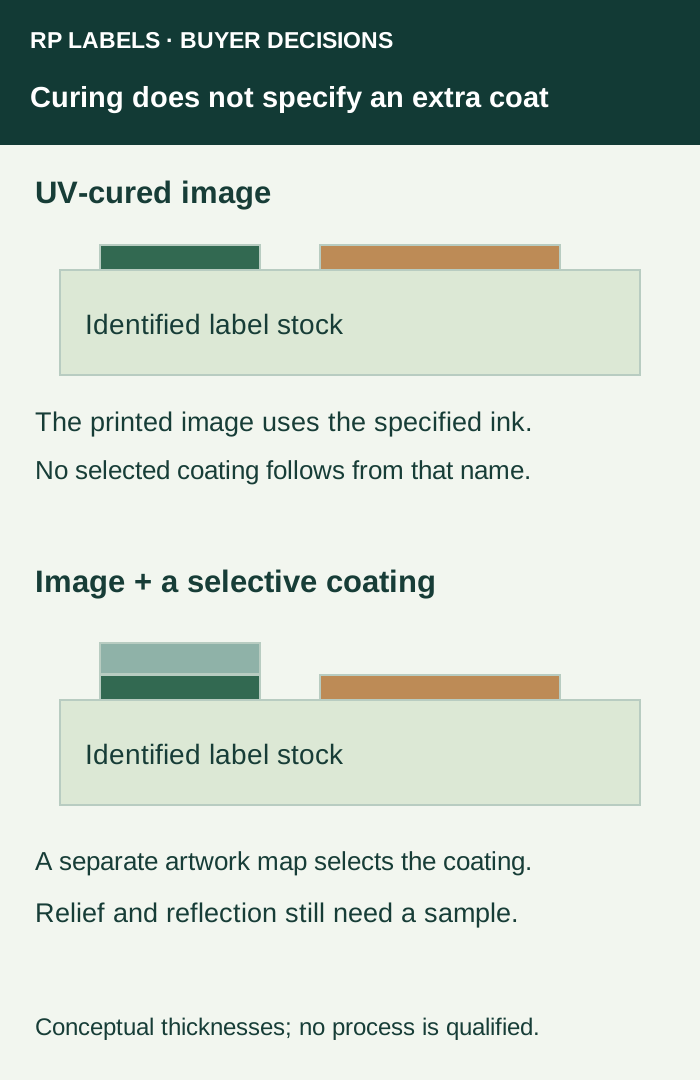
Name the operation hidden inside the shorthand
UV-curable ink is formulated for a curing process using ultraviolet energy. A quote for UV printing may therefore describe how the image is produced. It does not identify whether an additional coating will cover all, some or none of that image.
Siegwerk’s digital-printing overview distinguishes ink systems, primers and overprint varnishes for packaging. They are separate parts of a production proposal. Its descriptions are not a declaration that RP uses a named ink, owns a particular press or can supply every listed process.
A selective or spot coating covers defined artwork areas. For example, ACTEGA’s pressure-sensitive label sample combines a UV matte coating with a gloss spot finish. Its sample has an identified substrate, ink and coating configuration. That illustrates a distinct finishing scope, not an RP process or a coating recommendation for your supplement packaging.
Specify the visible effect separately from the curing route
If the brief is a glossy logo on a matte field, show the exact logo region and the intended contrast. If the buyer wants a raised or tactile effect, state that separately and ask whether the proposed construction can produce the desired result. A small bright highlight in a supplier photograph is not a measurement of relief.
Do not call every selected coating “raised UV,” or every UV-cured label “UV protected.” The light-exposure guide addresses the actual exposure and fading question. A curing term cannot answer it.
Return a finish map with the proof
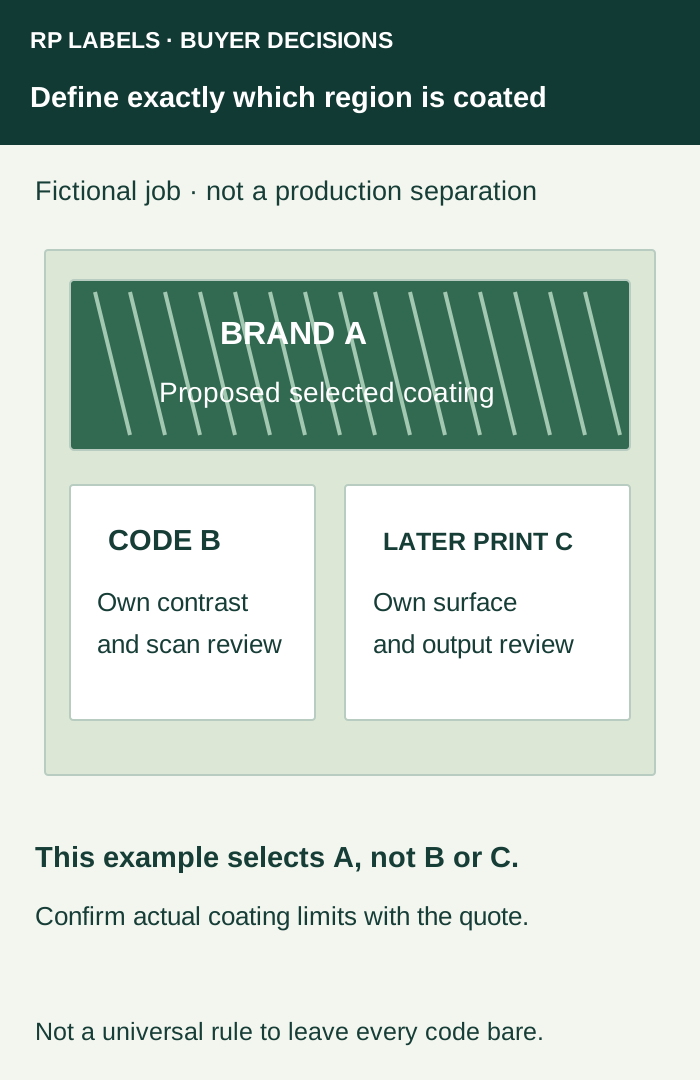
Provide a separate, clearly named map for the proposed coating. Keep the final label size, artwork revision, front-view orientation and boundaries identifiable. Ask the converter to return its interpretation with any relevant alignment or production limitation. There is no universal registration allowance in this guide.
Where coating meets fine type, foil or another decorative layer, identify which visual boundary matters. A code and its quiet area should keep their actual contrast and surface requirements. A later lot field should retain the confirmed printing surface. The correct treatment depends on the proposed construction; the sample map does not forbid coating every code on every job.
If the quoted scope changes from a selective coating to full coverage, treat it as a revised proposal. It can alter the intended matte/gloss contrast and the surfaces used later. The PDF separation guide helps review what the artwork contains; it cannot establish the finished physical effect.
Approve the finished sample, then compare the cost scope
A digital proof can establish the proposed location and artwork. A representative finished sample is needed when the purchasing decision depends on reflection, relief or touch. View it on the actual bottle with the remaining print and finish present. Keep what the sample does not represent explicit.
| Quote says | Question to close |
|---|---|
| UV printing | Does this describe the image-forming ink process only? |
| Spot UV | Which exact areas, coating reference and intended effect are included? |
| Raised finish | What physical reference and proposed process define the requested relief? |
| UV resistance | What exposure, material and evidence support this separate performance claim? |
Ask the quote to identify any separate setup, artwork-preparation, finishing and sample scope. Get the actual amounts rather than assuming that a UV term includes another operation or that the decorative route is always more expensive. A flat printed design may meet the brief without an added spot effect.
Send RP the layer you want to buy
For supplement or holographic labels, prepare an inquiry with the bottle or carton, artwork, quantity, selected-finish map, desired appearance or tactile reference and later-print needs. Ask which route can be proposed and what sample would establish the result. Keep market-specific use suitability and any performance claim within the evidence reviewed for that construction.