Label Lot Traceability: Connect the Material Batch to the Finished Rolls
If a label-material concern arises, a purchase-order number or artwork filename may not identify all the affected stock. Ask how the input material batch connects to converter jobs, finished rolls and deliveries. The useful record is the link between those identities, not a single code printed on every carton.
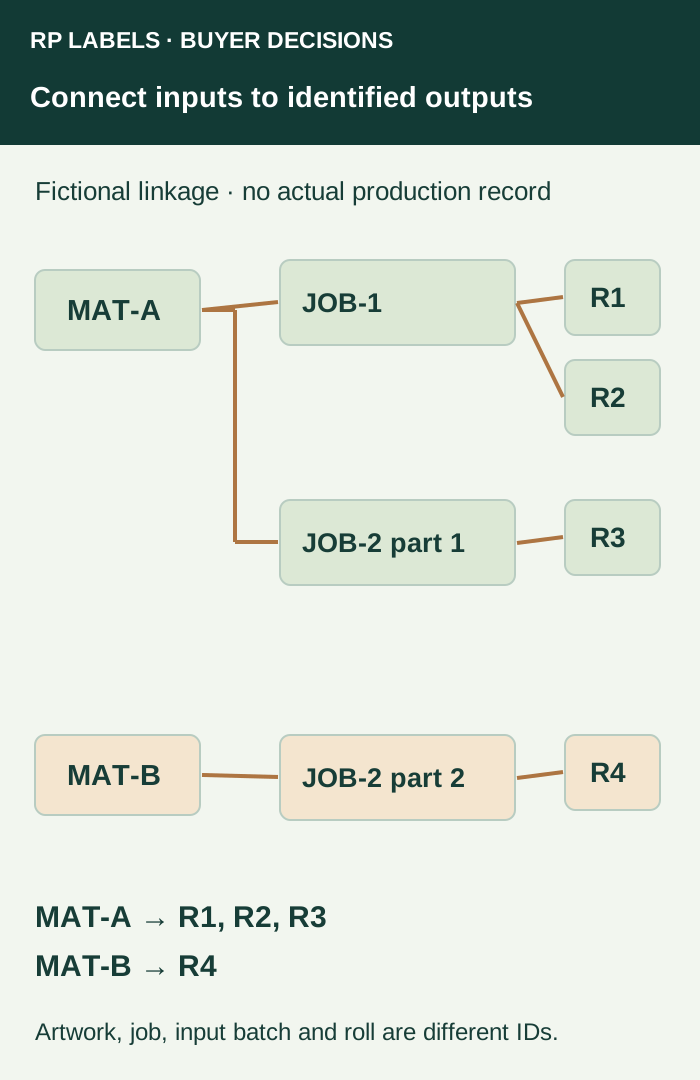
Separate four identities that answer different questions
The artwork revision identifies the printed design. The converter job identifies an operation or agreed production run. The material batch identifies the supplied input under the relevant supplier’s system. A finished-roll ID identifies an output that can be received, stored or loaded. None of these is automatically interchangeable with the others.
Two rolls can share artwork while using material from different batches. One input batch can also feed more than one job. An order split into several deliveries may retain the same artwork while requiring separate receiving references. Agree which records the buyer needs and what the supplier can supply before treating “batch traceable” as a completed requirement.
GS1’s Global Traceability Compliance Criteria Standard addresses managing links between inputs and outputs and exchanging relevant information across trading partners. That principle supports the record structure here. It does not require every small label purchase to adopt a particular barcode system, and this article does not certify RP against that standard.
Walk through a split input before approving the record
In the fictional map, MAT-A supplies JOB-1 and JOB-2. JOB-1 produces rolls R1 and R2. JOB-2 produces R3 from MAT-A, then R4 from MAT-B. A concern recorded on R3 can be connected backward to MAT-A and forward to the other recorded MAT-A outputs, R1 and R2. R4 is not connected to MAT-A in this example.
This mapping does not prove what caused the concern or which stock must be rejected. It identifies the evidence scope for the responsible quality owner to investigate. If the material transition was not recorded, do not invent a boundary between R3 and R4. Mark the uncertainty and let the responsible parties decide the appropriate hold and investigation scope.
For a printed construction with additional coating or laminate, ask which input identities are relevant to the requirement. A single base-stock batch may not describe every converted layer. Keep the scope proportionate to the actual concern and agreed purchase requirement rather than demanding that an unexplained code represent the entire supply chain.
Test whether a finished roll can lead back to the right record
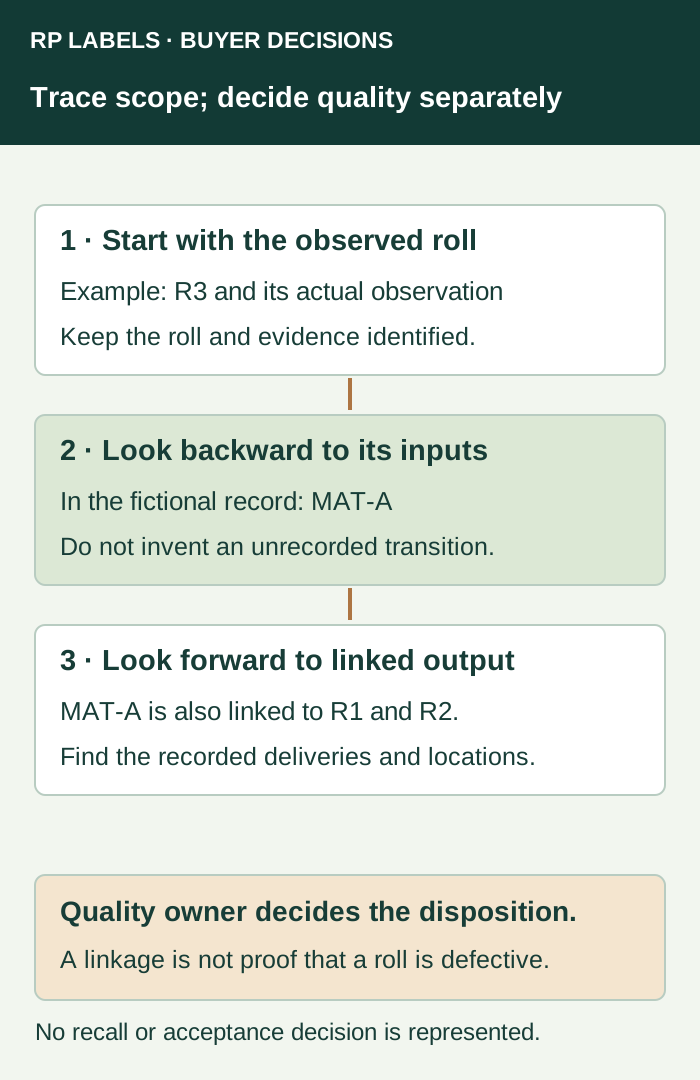
Choose a proposed example roll reference and ask what record the receiver would use to retrieve its job, accepted artwork, relevant material identities and shipment. Then ask the reverse question: if an input batch is identified, which output rolls and deliveries can be found?
Keep any gaps visible. A job summary that lists MAT-A and MAT-B without connecting them to output rolls may be useful, but it does not establish a precise material-transition boundary. A carton label that identifies only the product name may require another lookup. Ask what link survives after a carton is opened and its rolls move to separate workstations.
| Record | Question it should answer |
|---|---|
| Accepted job and construction | Which design revision and agreed material proposal were released? |
| Input-to-output link | Which identified input batches connect to which finished rolls or defined output range? |
| Shipment allocation | Where did those identified outputs go, and in which delivery? |
| Receiving and use record | Which roll arrived, where was it stored or used, and what observation is actually recorded? |
Keep material traceability separate from product serialization
A unique QR or serial on each finished seal addresses individual identifier control. A material-batch map addresses which inputs connect to the physical outputs. One can support the other, but printing serials does not create the material history. The serialized-label reconciliation guide owns the identifier-set task.
Likewise, a material reference does not prove conformity, adhesive performance or a passed inspection. Keep the applicable documents and agreed inspection scope connected without turning their existence into a blanket approval.
Put the required evidence in the inquiry
For vial or supplement label orders, prepare an RP inquiry identifying the construction, quantity by design, receiving sites and the material-to-roll evidence your quality owner needs. Ask which identification and reporting scope can be confirmed, how material changes are recorded and what record accompanies delivery. Any retention, access, cost or timing condition belongs in the actual agreement.
On receipt, preserve the supplied roll references with the job documents. If an observation later appears, begin with the identified roll and actual evidence. A traceability link makes the investigation more focused; it does not decide the outcome for the buyer.