A Tracking Number Is Not a Dispatch Confirmation for Your Label Order
If a label supplier sends a tracking number while the carrier shows only “Label Created,” record the number but keep physical handoff unconfirmed. Ask the sender whether the cartons have been collected and what record supports that statement. Plan the packing slot from the actual order and shipment evidence, not from the existence of a number.
A custom-label order has several milestones: approved production, finished goods ready, shipment information created, carrier possession and warehouse receipt. They can happen on different dates. A carrier event also does not establish that every required label design is in the parcel.
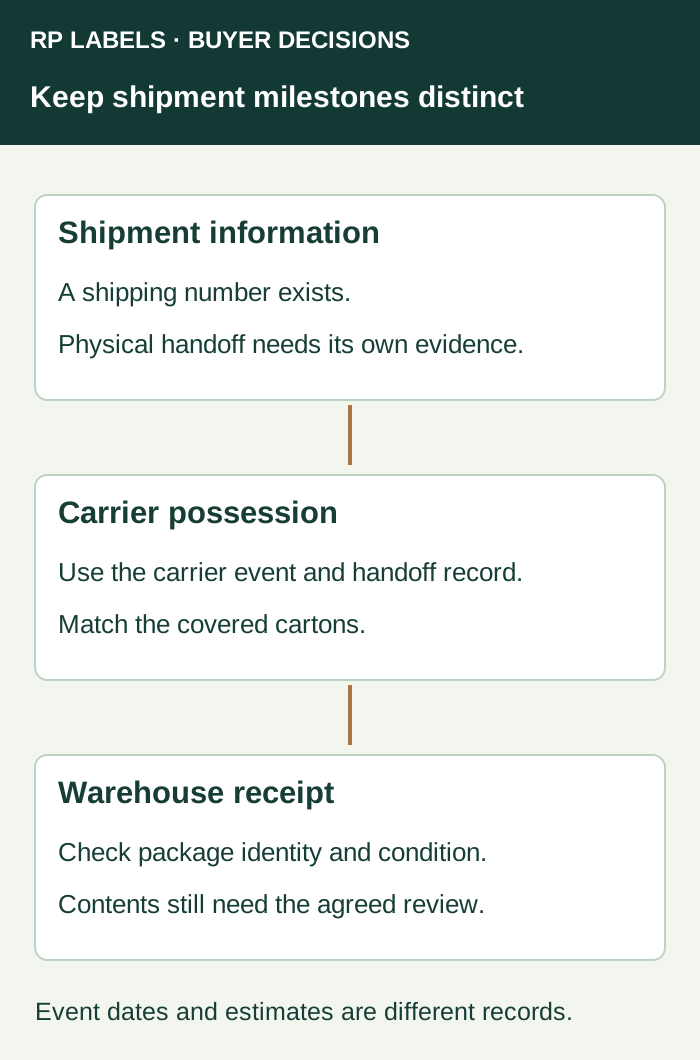
Read the carrier's event, not the supplier's shorthand
UPS's status explanation distinguishes receipt of shipment information from possession and movement in its network. FedEx's tracking guide likewise distinguishes label creation from entry into its network and later delivery stages. Use the definition for the actual carrier and service.
Keep the displayed event, timestamp and location together. An automated supplier email saying “shipped” can refer to a shipping-label workflow while the carrier has not yet recorded possession. That is a reason to request a precise handoff update, not an automatic allegation that the supplier has withheld the goods.
If the sender has a collection or handoff record and the tracking display differs, ask it to reconcile the records with the carrier. Do not discard one record merely to make the timeline tidy. The buyer needs the current supported status and the next owner of the discrepancy.
Connect the number to the correct cartons
Ask how many packages are in the shipment and which carton references correspond to the tracking information. Some services present a shipment-level reference with individual package details. Confirm what the number actually covers rather than assuming one displayed event applies to all cartons.
In a fictional order, Carton A contains the vial labels and Carton B contains the matching carton seals. A has a carrier-possession event; B still has shipment information only. The combined label order is not yet evidenced as completely handed over. If the packing process needs both components, the buyer should review that dependency before booking the line.
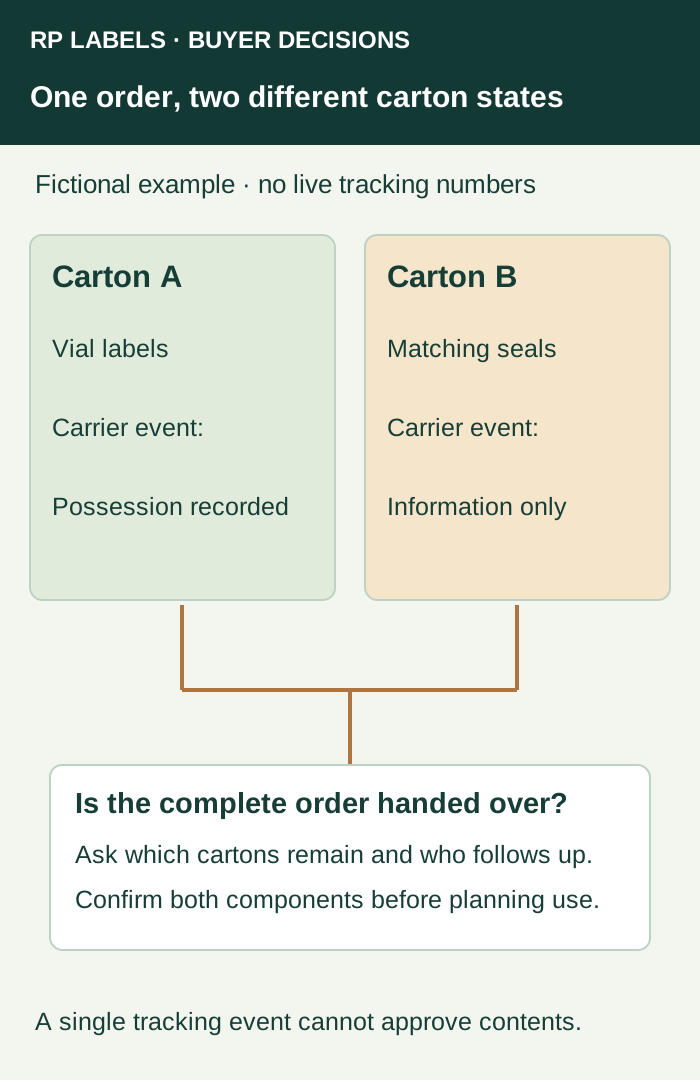
The allocation guide links cartons to designs and destinations. The shipping-document check connects those quantities to the invoice and packing list. Tracking provides movement information alongside those records; it does not replace them.
Keep estimates and confirmed events distinct
A scheduled collection is a plan. A recorded carrier handoff is an event. An estimated arrival date is not a receiving inspection. Put each on its own line with the relevant source and last update time, especially where the packer has a fixed slot.
When an event threatens the required arrival, ask the sender and carrier for the current next action and responsible party. The answer might concern a collection query, an address correction or information needed for clearance. Follow the actual carrier instructions through a verified channel; this guide supplies no universal delay threshold or replacement entitlement.
A gap between scans does not alone establish that a parcel is lost. Read the full event history and applicable service guidance before classifying it. Keep any revised estimate visible and have the packing owner decide what it changes in the production plan.
“Delivered” is the start of the warehouse check
Ask the intended receiver to confirm the package count and location, then match carton and roll identities to the accepted order. A delivery event can be useful transport evidence while the contents remain unopened. It does not verify the artwork revision, quantity or physical condition of the labels.
Use the receiving quantity guide and agreed condition checks before releasing the material to packing. Record missing or damaged cartons through the actual supplier and carrier process, retaining the packaging references needed for investigation.
Ask a dispatch question the supplier can answer
A useful request is: “Please confirm whether the identified cartons have physically left your custody, the applicable handoff record, the carrier/service and carton-to-tracking references. If any cartons remain, identify their contents and current plan separately.” Keep that reply with the order timeline.
For an RP supplement-label or vial-label project, prepare an inquiry with the required arrival date, destination, component list and packer's receiving needs. RP's shipping information keeps logistics order-specific. Agree the dispatch and receipt evidence as part of that plan.