When to Reorder Custom Labels: Count Usable Stock by SKU
Plan the next label order from the stock that can actually serve the next packing run, the expected label consumption and the time until replenishment becomes usable. A warehouse total that mixes old artwork, another SKU and held stock can give a reassuring number while the required label is nearly exhausted.
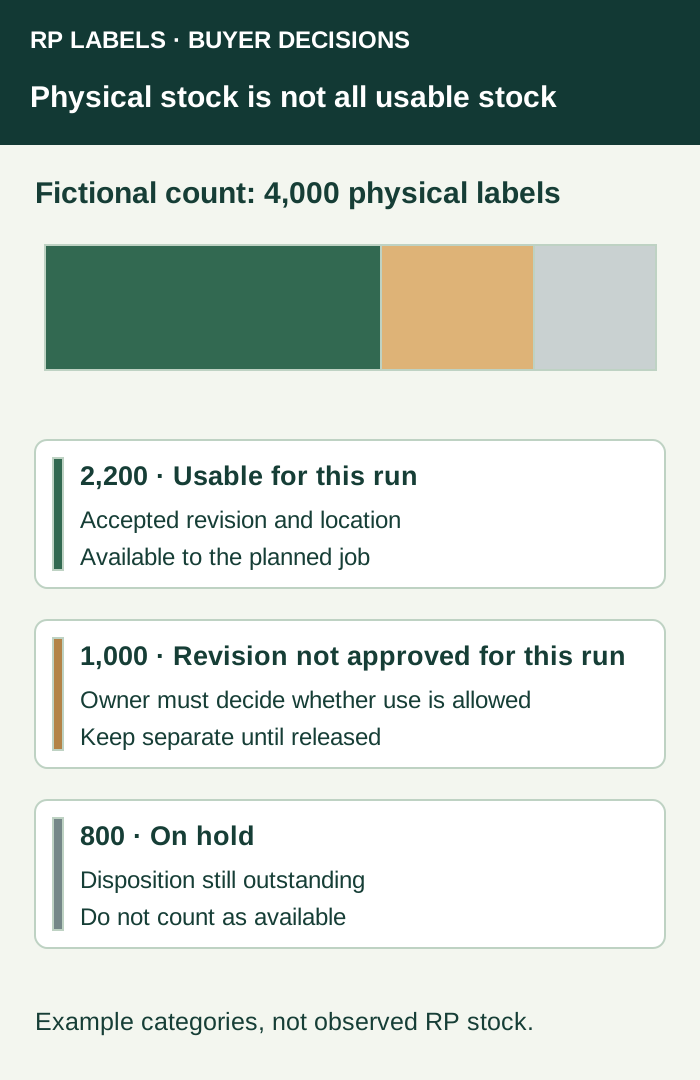
Make the count specific to the next run
Start with the exact SKU, artwork revision, label construction, packing location and application route. Separate usable stock from stock awaiting disposition. An older revision is not automatically unusable, but it cannot count toward this run until the responsible owner has approved that use. A roll reserved for a different run should not quietly appear available twice.
The drawing starts with 4,000 physically present labels: 2,200 usable for the planned run, 1,000 at a revision not approved for that run and 800 on hold. The planning input is 2,200, not 4,000. Resolve the other categories separately. The artwork changeover guide explains the revision handoff; the stored-roll release guide addresses stock condition.
Use label consumption rather than finished-product sales alone
One sold pack does not always consume one of every label. The pack may use a body label and two seals, or different components may be printed elsewhere. Use the actual bill of materials. Keep setup, rejected application and any planned spare allocation visible rather than assuming a universal waste percentage. Where the operation has records, compare labels issued with labels returned and usable packs completed.
For uneven production, a dated packing schedule is more informative than a daily average. A monthly average can hide a large run due next week. Check each component against the planned consumption date and location. A slow-moving SKU also needs review before purchasing a large quantity that may outlast the next artwork change.
A worked review trigger for stable consumption
For relatively steady use, a simple starting calculation is expected label consumption during replenishment plus a separately chosen buffer. Oracle NetSuite’s reorder-point explanation distinguishes this timing trigger from the quantity to buy. Its general model is not a label supplier’s lead-time promise.
Suppose a fictional operation consumes 200 labels per calendar day, plans on 12 calendar days until replenishment is usable, and has chosen an 800-label buffer. Its review trigger is (200 × 12) + 800 = 3,200 usable labels. Each input is invented for the example. Twelve days is not RP’s turnaround; 800 is not a recommended safety stock.
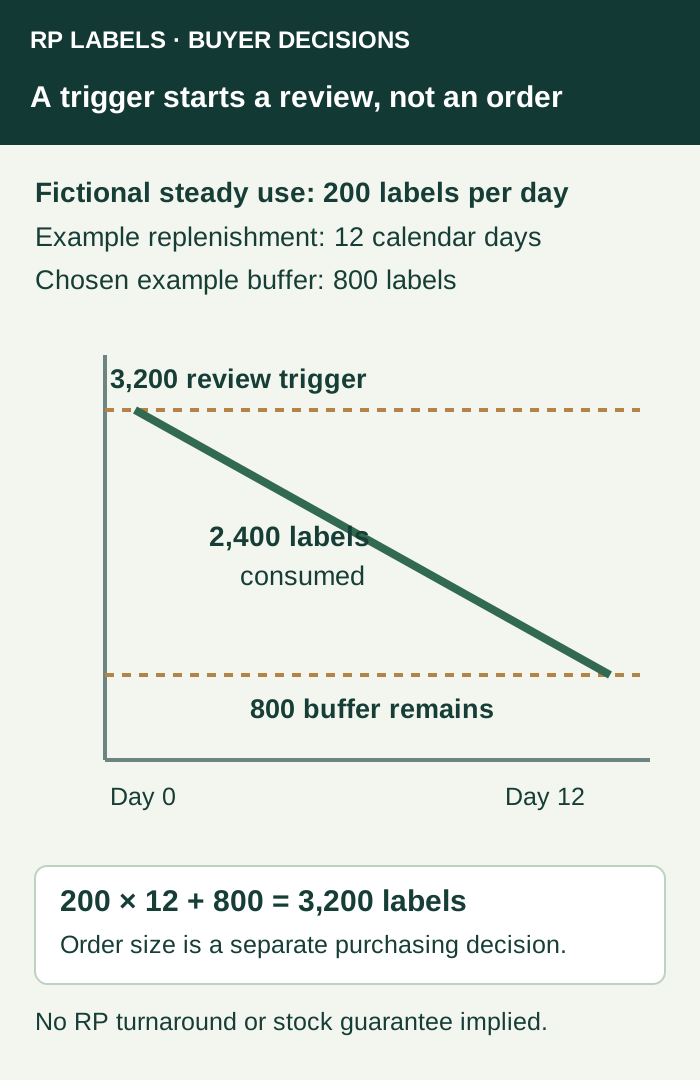
If the count is already 2,200, the buyer should review the gap now rather than waiting for an arbitrary low-stock alert. Whether a new order can arrive in time must be confirmed with the supplier and packer. If the assumed period becomes 18 days, the same arithmetic gives 4,400 labels. This sensitivity shows why a guessed replenishment period can defeat an otherwise correct calculation.
Define when replacement stock becomes usable
Separate quotation, artwork work, approval, production release, production, shipment and receiving checks. Use a consistent calendar when combining periods; do not multiply calendar-day use by a working-day lead time without conversion. Ask the supplier to confirm the current order schedule, especially after a material, quantity or artwork change. The production-timeline guide covers the release event.
Open purchase orders need their own dated record. A confirmed inbound quantity may cover a future need, but it is not on the shelf today. Show expected usable dates against scheduled withdrawals so that an order arriving after the packing run does not hide a near-term shortage. Avoid reordering twice merely because one team counted physical stock while another also counted the same inbound order.
Choose the next quantity in a separate decision
The trigger says when to review replenishment. It does not select the order quantity, establish the supplier’s MOQ or reserve capacity. Compare actual forecast use, current approved stock, confirmed incoming orders, artwork-change risk, storage conditions and the quantities RP can quote for each design. A lower unit price can still leave excess stock if the copy changes before use.
When usage is intermittent or launch-driven, replace the smooth example with a dated component plan and test different arrival dates. There is no historical average for a new SKU merely because a neighboring product sells well. Keep a forecast separate from observed consumption and revisit it after real runs.
Bring the next run into the reorder inquiry
For supplement, vial or hologram labels, prepare an RP Labels inquiry with the approved revision, usable stock by design, proposed quantities, packing destination and required usable date. Identify any pending copy or material change. Ask for the current feasible scope and schedule before turning the planning assumption into a purchase commitment.