Stored Vial Label Rolls: Decide Whether Opened Stock Can Return to Production
An opened roll comes back from the packing bench with plenty of labels left. Putting it straight onto the shelf is convenient. Using it later becomes harder if nobody can identify its revision, construction or storage exception. The next order decision should include a return-to-stock record, particularly when a larger print run will be consumed in stages.
The operator has labels left and does not want to waste them. Purchasing would also prefer to use what is already paid for. I would protect that value by keeping the roll's identity with it. A bag and a legible return record are useful only if the next person can tell whether the roll is available, awaiting review or no longer the right revision.
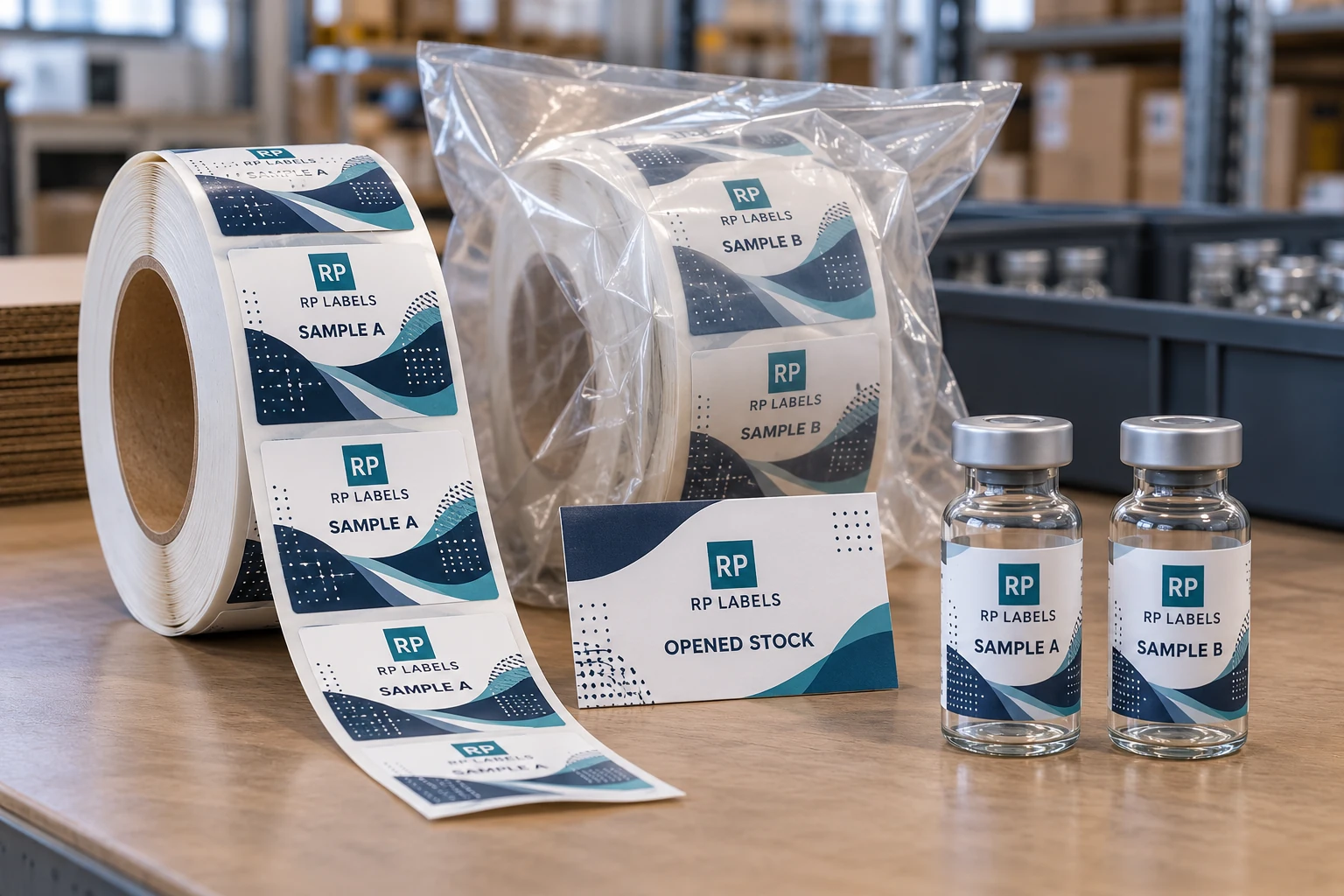
AI-generated packaging illustration. Fictional RP samples show the proposed decision; no physical test or customer order is documented.
Give the opened roll a second receiving check
The worked return record follows the physical roll, not just the purchase order. Record its roll ID, artwork revision, construction reference, remaining quantity basis and protective packaging. If the quantity is estimated, label it as an estimate; a handwritten number should not acquire the authority of a verified count simply because it is copied into another spreadsheet.
Have the operator record why the roll came back. A routine changeover is different from a web problem, suspected contamination or an unexplained storage excursion. Keep unresolved exceptions visible. The next person should not have to infer a hold from an informal note attached to the outer carton.
Before reuse, check that the artwork is still authorized and that the material guidance applies to this identified construction. Follow the supplier's storage and review instructions; this worksheet does not create an extension to a shelf-life statement. Where history is missing, ask the responsible reviewer what evidence is needed instead of inventing a replacement manufacture date.
The example deliberately separates two routes: known identity with a routine return, and missing construction reference with an unresolved exception. Neither receives an automatic release. The first may require only the agreed checks. The second may need supplier review, a relevant application trial or rejection under the buyer's procedure.
For a predictable repeat SKU, maintaining usable opened stock can be sensible. For an obsolete revision, good adhesive performance cannot make the label correct. Send RP Labels the roll identification, order reference and specific uncertainty if advice on the supplied construction is needed. That makes the conversation about a recoverable record, not an unsupported promise that old labels should still work.
A label roll has more than one clock
Track the material lot, conversion date, receipt date and approved artwork revision separately. A new invoice does not necessarily mean the adhesive was manufactured that week. Equally, an older roll is not automatically unusable because a calendar threshold has passed. Its construction, supplier instructions and actual condition matter.
There is also commercial expiry. A perfectly usable label carrying an obsolete product identifier is still the wrong label. Put artwork revision beside the material reference on the stock record so a warehouse colleague does not have to infer approval from the color of the box.
Avery Dennison's finished-label storage bulletin recommends approximately 22 degrees C and 50% relative humidity, protection from light and contamination, and keeping rolls in their protective packaging. It also explains that constructions age differently. These are supplier guidelines, not a blanket shelf-life promise for every RP order. Ask for the instructions covering your exact face material, adhesive, liner and finish. Read the supplier bulletin.
The cheap extra carton: a planning example
Suppose a buyer expects to use 800 labels a month. An order of 2,400 covers three months; 9,600 covers twelve. Those are illustration figures, not an RP minimum or a recommended stock horizon. The second quote may offer a better unit price, but it also ties the buyer to a year of one design and one storage arrangement.
For a settled, fast-moving SKU, fewer purchasing cycles may justify that commitment. For six research-vial designs still being revised, smaller releases can be worth the higher printing cost. I would compare total exposure: unused inventory, revision risk, storage capacity and replenishment lead time. The answer should survive a change in demand, not just look good on the purchase order.
Make the opened roll easy to identify
A useful stock record does not need a complicated dashboard. It needs information that follows the roll when somebody moves it. Give each opened roll a reference tied to the purchase order, artwork revision, material lot and remaining quantity. Record when it was opened and who returned it to stock.
Keep the original packaging details with it. Do not replace the supplier identification with a handwritten product nickname that means something to only one operator. When two visually similar blue label designs share a shelf, the wrong-roll risk deserves as much attention as adhesive age.
| Record | Why keep it? | Release question |
|---|---|---|
| Material and adhesive reference | Connects the roll to its instructions | Is this the approved construction? |
| Artwork ID and revision | Prevents old copy entering a new order | Is the revision still approved? |
| Receipt, opening and review dates | Supports stock rotation | Is a recheck due under the agreed policy? |
| Storage exception | Preserves what happened in transit or storage | Does the supplier need to review it? |
| Inspection decision and owner | Stops an unresolved roll returning to production | Released, held or rejected? |
When an older roll comes back to the line
My suggested receiving sequence starts with identity, then condition, then application. Match the roll to the active artwork. Look at its edges, core and backing. Note contamination, distortion, adhesive at the edges or damage before unwinding the whole roll. Retain the packaging and a short affected section if anything needs investigation.
Next, test representative labels on the actual vial using the intended application process. A quick peel by hand answers less than a controlled trial with the approved bottle surface, dwell time and operating conditions. Compare with a known acceptable sample where one is available. Do not invent a universal peel-force target from an unrelated material sheet.
For machine application, include a feed trial rather than testing adhesion alone. For cold-handled finished vials, use the separate cold-storage label test plan. A roll sitting unused on a shelf and a label attached to a refrigerated bottle are different stages with different failure questions.
What to put in the next purchase order
Ask the converter to state the material reference, recommended storage conditions, applicable shelf-life guidance and the point from which that period is counted. Agree how much information will appear on each carton and each roll. If stock will be called off over several months, ask who holds it, under what conditions, and when a release check happens.
Do not ask a printer to promise that every label will remain usable until your last sales unit ships without explaining the forecast and environment. A more useful agreement defines how an ageing or storage-exposed roll is reviewed. That protects both sides better than a vague assurance that the adhesive is strong.
Worked opened roll return record
The rows below are hypothetical planning examples. Empty observation or commercial fields must be completed from the actual project; no sample has been tested for this article. Use the worked CSV and blank worksheet with the field guide. Keep the example references separate from production records.
| roll id | artwork revision | construction reference | return reason | quantity basis | storage exception | review owner | release state |
|---|---|---|---|---|---|---|---|
| DEMO-ROLL-A | Current revision to confirm | Known reference required | Routine changeover | Estimate or verified count: state | None reported; confirm | Stock owner | PENDING |
| DEMO-ROLL-B | Revision to confirm | Missing | Unexplained feed issue | Unverified | History incomplete | Technical reviewer | HOLD |
Bring this decision into the print inquiry
Contact RP Labels with the completed opened roll return record, the actual packaging reference, approved artwork and quantity per design. State which fields remain unresolved so the print specification and any relevant sample scope can be discussed against the same decision.
Related buying guidance: Peptide Vial Labels; Receiving inspection for label rolls; Labels on cold-stored vials; Label size and quote planner.
Sources and scope
Demand layer: competitor and process pages linked here, including Avery, HERMA or OnlineLabels where cited, illustrate buyer language and process topics only. They do not supply RP minimum quantities, lead times, prices, certifications or materials. Authority layer: an RP number is backed only by a factory datasheet, a signed quote or proforma, confirmed product data, or a fact kept on the About page. The March 2026 proforma there is one production-run example, not a standing offer. RP shipping and planning pages describe what to confirm on a quote. Worked figures on this page are fictional unless an authority source is named for them.