Embossed or Debossed Supplement Labels? Review the Applied Sample
Choose a raised, recessed or flat decoration by approving both its tactile effect and the applied label's contact with the bottle. For an embossed supplement label, a pleasing loose sample leaves an important question open. Will the finished relief, material and adhesive work together on the actual container and through the intended handling?
Start with the effect the brand wants someone to see or feel. Then ask which construction can deliver it. Foil, a raised coating and relief formed in the label material are separate proposals, even when a photograph makes them look similar.
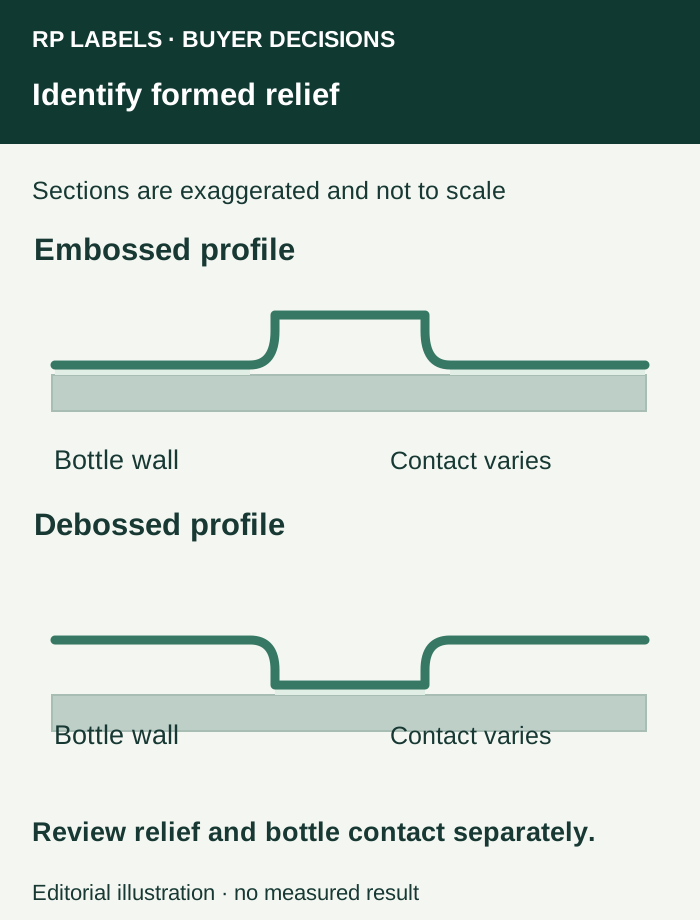
Identify what physically creates the relief
Embossing raises an area of the material. Debossing forms a recessed area. Blind embossing uses the relief without relying on a printed image in that area. Relief aligned to printed artwork adds an alignment question. Avery Dennison's technical guide explains these distinctions and discusses adhesive disruption where relief creates spaces beneath an applied label. Its examples concern wine and spirits labels. They provide a mechanism to investigate on a supplement bottle, rather than a tested RP construction. Avery Dennison technical guide to label embossing.
If the reference is a glossy raised logo, ask whether it was made with a deposited coating rather than material deformation. The UV finish guide helps name that requested operation. If the reference is metallic, the foil comparison addresses the reflective layer. An order can combine operations, but each needs an identified scope.
Keep small information panels outside the decorative discussion until the buyer has checked their readability on the proposed finished bottle. Tactile decoration should have a defined location and purpose. It should also leave the product identity and required copy usable.
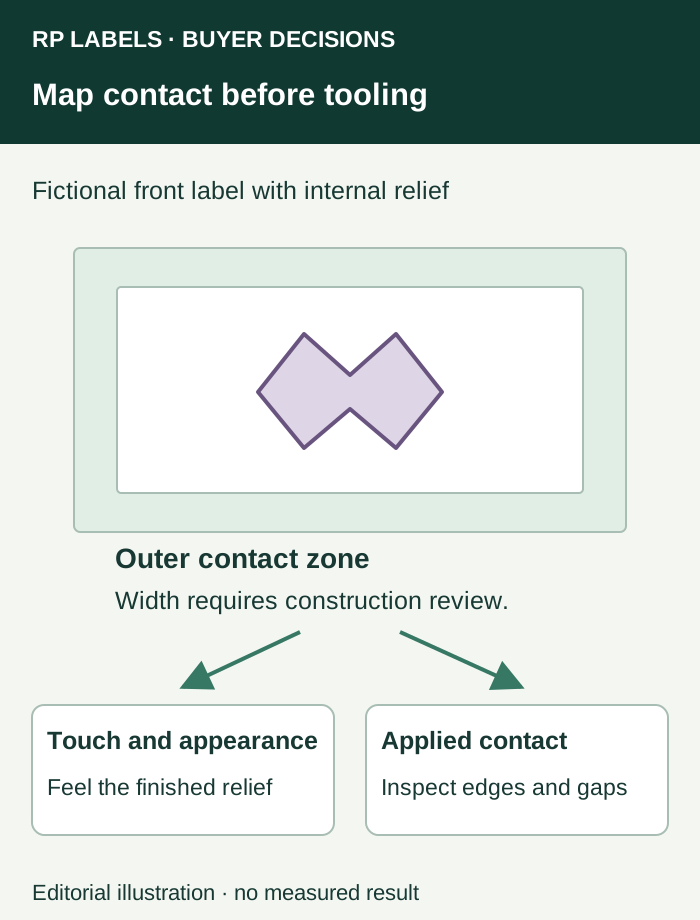
Draw the relief and the contact zones separately
Send the converter a final-size map showing the proposed raised or recessed areas, cut outline, printed elements and label edges. Ask the converter to return the map with its proposed material, relief treatment and production constraints. Keep the drawing's viewing side explicit.
Mark which parts of the label must stay in dependable contact with the container. Ask about the outer edge, seam, spaces between relief areas and any zone beside a code or later-print field. The usable contact area depends on the actual construction and geometry. A dimension recommended for another supplier's wine label should remain that source's recommendation until the proposed supplement construction is reviewed.
On a gently curved broad bottle panel, a decorative area may deserve a representative applied trial. On a very small radius or a heavily textured face, the same design may need a smaller relief area, another material or a flat alternative. The converter should explain the proposed route before the buyer pays for production tooling.
Approve a finished, applied specimen
Use the intended bottle reference and identify the sample's artwork, stock, adhesive, decoration and protection. Note any substituted component. Apply the sample under the proposed material's guidance and the packer's procedure, then evaluate the conditions that matter to the actual product.
| Review point | Question to close | Responsible input |
|---|---|---|
| Appearance and touch | Is the relief recognizable and appropriate at normal use distance? | Brand owner and physical reference |
| Applied contact | Are the intended edges and contact zones holding as required? | Packer and material guidance |
| Handling | Does rubbing, gripping or packing change the relief or print? | Actual handling route and agreed observations |
| Cold or humid exposure, if relevant | Does the applied label retain the required appearance and contact? | Defined exposure and actual sample evidence |
| Print alignment | Does the relief meet the intended printed element? | Returned map and converter's proposed allowance |
The parties should define observation timing and acceptance before the trial. Record the actual result rather than describing an attractive sample as automatically approved. Smithers identifies adhesion, decorated-surface durability and print legibility as distinct testing tasks, including evaluations tailored to the packaging application. Smithers label and decorated-surface testing.
If edge lift or unreadable detail appears, preserve the sample and its identity. Review the relief map, material and application together. Increasing adhesive strength alone may leave the geometric issue unresolved. If a flat printed or foil accent delivers the desired brand effect with a simpler acceptable construction, include it in the comparison.
Match the tooling quote to the approved effect
Ask which preparation, tooling, proof, printing and finishing operations are included. For repeated artwork, ask what tooling is retained and which future changes require another charge. The tooling and reorder guide gives the commercial handoff.
A photograph or a generic embossed sample can help select a direction. Keep production release tied to the identified sample scope and any remaining exceptions. A paper label sample also leaves the suitability of a different film construction open.
For an RP supplement label inquiry, provide the bottle, quantity per design, relief map and tactile reference. Ask whether an embossed, debossed or alternative finish can be proposed for the intended construction, with the relevant sample and tooling scope. Availability and the finished result belong in that project-specific proposal.