Hologram Label Adhesion: Separate Holding from Opening Evidence
A buyer finds a loose seal in a delivery box and wants the next roll to use stronger glue. In that hypothetical situation, I would keep the seal with its package reference before choosing a replacement. The first decision is whether normal retention failed, opening evidence failed, or both questions still need investigation.
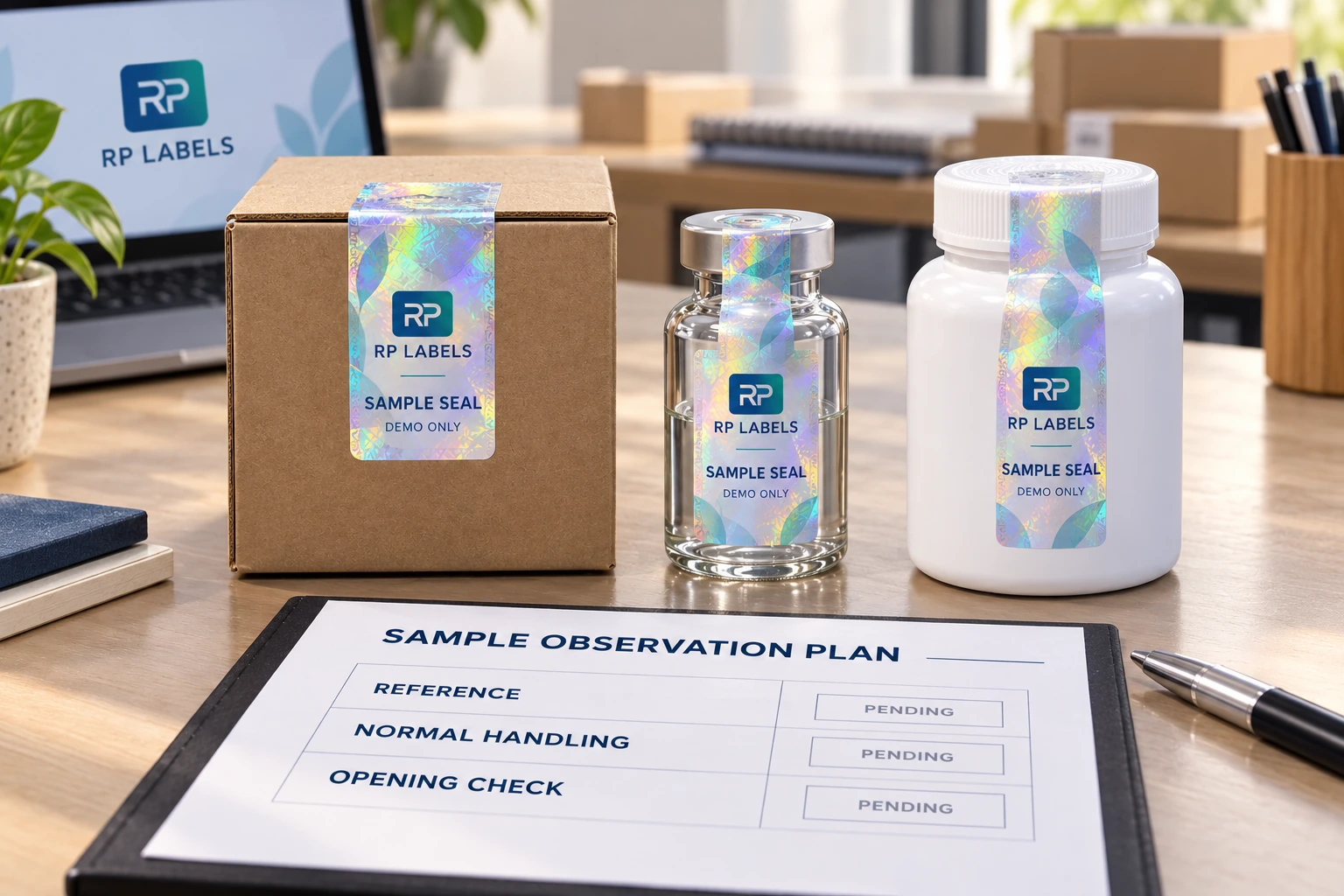
The short answer: choose hologram adhesive against the exact package, not a broad word such as “plastic.” Varnished cartons, clean glass, HDPE and PP create different bonding conditions. Label size, facestock stiffness and curve can matter as much as initial tack.
A request for stronger glue does not identify whether the label met a coating, a tight curve, an unsuitable application surface or a different expected opening response. Give the failure a description before selecting a construction to evaluate.
Cartons: the coating may matter more than the paperboard
A carton can be uncoated, aqueous-varnished, UV-coated, laminated or textured. A security seal crossing a tuck flap also experiences opening force and a step in the surface. A smooth printed sample card is therefore not an adequate substitute for the finished box.
Apply the production-size seal across the intended location. Check whether ink or coating transfers during removal, whether the seal bridges a gap and whether the chosen tamper effect is visible without damaging unrelated regulatory text.
Glass: clean and high-energy does not mean problem-free
Clean glass often supports good adhesive wet-out, but mold release, fingerprints, alcohol residue, dust and condensation can change the result. A small vial creates tight curvature; a stiff holographic construction may try to return flat and lift at the edge.
For neck seals, consider the compound curve and cap transition. A label designed for a flat sidewall may wrinkle or tent when it has to bend across two diameters.
HDPE and PP: identify the resin and the radius
“Plastic bottle” is not enough for an adhesive brief. HDPE and PP are commonly treated as lower-surface-energy materials than glass, and bottle treatments or additives can vary. Small diameters amplify spring-back from thick films and laminates.
Choosing a stronger permanent adhesive before identifying the failure can skip half the diagnosis. A more aggressive adhesive cannot always rescue a construction that is too stiff for the curve or applied to an unsuitable surface. A thinner face material, different seal shape or a controlled application process may be worth evaluating instead.
Buying rule: send a production package for each surface. A carton approval does not qualify the same hologram for glass or polypropylene.
Permanent is not the same as tamper evident
A permanent adhesive is intended to resist removal, but tamper evidence requires a designed and repeatable visible change. A destructible face may fragment. A VOID construction may transfer a message. Another seal may delaminate or leave a pattern. Adhesive, facestock, coating and package must create that response together.
Define what the inspector or consumer should see after an opening attempt. Also define whether residue on the package is acceptable. Without those two decisions, “tamper-proof” is only a marketing phrase.
Pressure and dwell belong in the specification
Pressure-sensitive constructions need the application conditions specified by their supplier. Keep pressure, surface preparation and the available bonding period in the sample record. An immediate check and a later observation answer different questions; use the agreed process rather than a universal waiting period.
Temperature and moisture during application and service also matter. Avery Dennison's adhesive selection guide organizes adhesives by substrate and application needs, which is a useful reminder that no single adhesive is best for every surface. Final selection still requires testing on the actual package.
A seal that releases cleanly leaves two separate questions
Imagine a receiving team opening a carton and finding one seal loose in the bottom. The buyer calls it a failed security label. The supplier asks whether anyone tried to remove it. Those are different questions, and a photograph of the loose seal cannot settle either one.
I would keep the label with its package reference and record what was observed before choosing a replacement. An edge that lifts during ordinary handling is a retention concern. A label removed deliberately without the agreed visible change raises a separate question about opening evidence. One package may expose both problems. Neither observation proves that interference occurred or identifies the adhesive as the cause.
The useful comparison has an untouched reference, a specimen observed after the agreed normal handling, and a specimen used for the agreed opening check. Give each its own identity. Record the same package finish, label construction and application details, and document any differences. The technical owner and supplier should agree the conditions and expected response; this guide does not prescribe a universal peel speed, waiting period or acceptance threshold.
For example, the buyer may require a visible transfer on a particular closure. Before sampling, write down which opening the seal crosses, what an inspector should be able to notice and whether residue on the package is acceptable. Ask the supplier which proposed construction can be evaluated against that brief. Do not describe a completed form as a passed sample.
Use the observation to choose the next action
If the normally handled specimen starts lifting, investigate retention with the actual package and application conditions before approving the roll. If retention is acceptable but the opening specimen does not show the agreed response, revisit the proposed evidence mechanism and placement. If both observations are acceptable, keep the result tied to those exact specimens and conditions. A label remaining attached does not by itself establish authentication, product safety or protection against every opening route.
A permanent decorative label can still be the sensible purchase when the approved task is branding and no opening evidence is required. In that case, removing an unsupported security promise is a better decision than paying for a feature nobody has defined. Use the tamper-evident label guide to distinguish the proposed response from a general claim that a seal is difficult to remove.
The worked observation plan and blank record keep normal handling, deliberate opening and the release decision separate. The worked entries are planning examples with results pending. Contact RP Labels with the package and closure photographs, size and quantity, application and service conditions, and the visible change you need. Ask what construction and sample scope can be quoted; your responsible reviewer retains the approval decision.
Read the record-filling instructions before entering project observations. Keep sample identity and unapproved assumptions visible.
FAQ
Can I use one hologram roll on cartons and bottles?
Possibly, but qualify every surface separately. One construction working on a carton does not prove it will stay on a curved PP bottle.
Why do the corners lift?
Common contributors include surface contamination, low surface energy, insufficient pressure, tight curvature, thick facestock and an unsuitable adhesive.
Does aggressive adhesive guarantee tamper evidence?
No. The face material and engineered failure mode must create the intended visible evidence.
How many samples should we test?
Use enough production-equivalent packages to represent normal variation and every intended surface. Agree on a documented protocol rather than relying on one hand-applied sample.
Sources and scope
Demand layer: competitor and process pages linked here, including Avery, HERMA or OnlineLabels where cited, illustrate buyer language and process topics only. They do not supply RP minimum quantities, lead times, prices, certifications or materials. Authority layer: an RP number is backed only by a factory datasheet, a signed quote or proforma, confirmed product data, or a fact kept on the About page. The March 2026 proforma there is one production-run example, not a standing offer. RP shipping and planning pages describe what to confirm on a quote. Worked figures on this page are fictional unless an authority source is named for them.