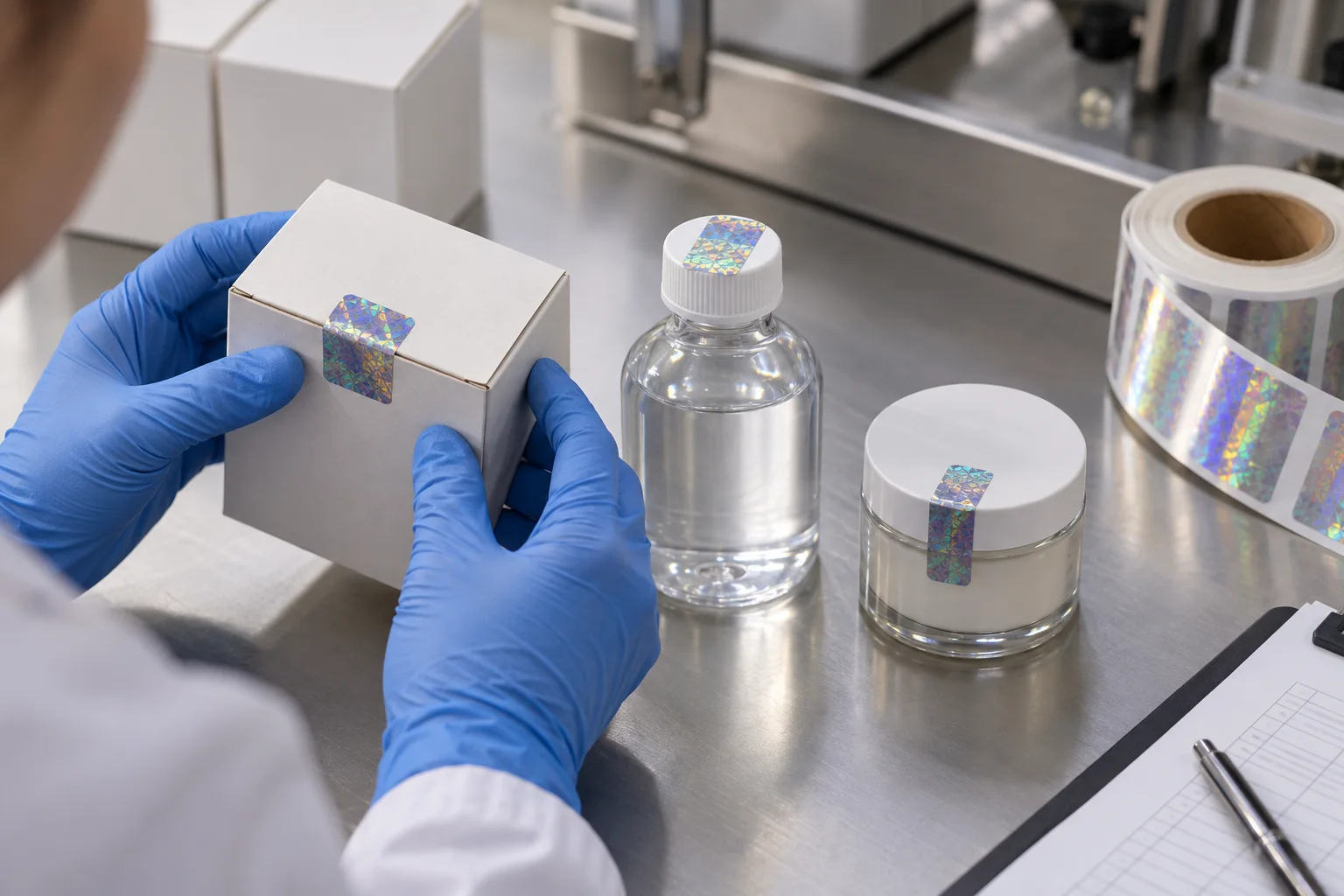
The short answer: place a hologram seal where opening the package forces a visible change, while keeping enough label area bonded to suitable surfaces. A carton flap is often easy to inspect. A cap bridge can show opening directly. A bottle seam may support closure evidence, but curves and surface changes make it less forgiving.
Most hologram inquiries begin with the effect. Buyers send a rainbow reference, choose a size and ask for price. Placement arrives later, usually as a phone photo with a red circle. That order feels natural because the hologram is the thing being purchased. In production, the package is the thing making the decision.
We can make the seal more reflective, more custom and more expensive. None of that creates contact area on a narrow cap shoulder.
Three positions, three different jobs
| Carton flap | Easy to see and often provides broad flat surfaces. Coatings, paper tear and exact flap movement determine the tamper result. |
|---|---|
| Bottle cap bridge | Connects cap to neck or shoulder so opening disturbs the seal. Curves, texture and small side contact require careful sizing. |
| Jar or closure seam | Can show lid rotation or separation. The label must tolerate two planes and remain aligned during application. |
| Decorative front panel | Offers visibility and brand impact, but may provide little tamper evidence if it does not cross an opening path. |
The cosmetics carton and the warranty bottle
A cosmetics buyer wants a premium unboxing detail. The seal sits across a smooth folding-carton flap, customers see it immediately and the opening motion breaks the bridge. A compact custom holographic logo can perform both a presentation job and a basic interference-evidence job. The carton gives the label room to work.
A different buyer wants the same seal on a ribbed bottle cap. The cap top is flat, the neck is curved and the bridge passes over a sharp corner. The first sample looks impressive from above, but the side tabs lift after a day. Making the adhesive stronger may help, but the geometry is still asking a small label to hold three different planes.
The second project does not need a more exciting hologram. It needs a longer bridge, a more flexible construction, better side contact or a different position. Security purchases go wrong when appearance wins the argument before the package has spoken.
Start with the person who will inspect it
A customer at retail needs a feature that is visible and easy to explain. A distributor may inspect placement, serial data or package consistency during receiving. A warranty team may care whether removal leaves evidence. A line operator needs a position that can be applied repeatedly without slowing production.
If the seal is hidden under a secondary sleeve, customers cannot use it as a visible authenticity cue. If it sits on the display face but does not cross a closure, it may deter copying while saying little about opening. One position does not automatically serve every inspector.
Buying rule: first choose the event the seal must reveal, then choose a position that makes that event unavoidable and visible.
Surface contact matters more than nominal size
A 20 x 40 mm seal does not have 800 square millimeters of useful bond if half of it floats over a gap or sharp radius. Measure the flat contact area on each side of the opening. Leave clearance from dusty edges, embossed details and unstable coatings.
Cartons can have varnish, lamination, recycled texture or loose fibers. Caps can be ribbed or low-surface-energy plastic. Glass may carry coatings or condensation. The same adhesive can produce different removal evidence across these surfaces, so the final test must use production packaging.
Hand application and machine application
Hand application tolerates more package variety but introduces alignment variation. Give operators a visual reference edge or simple fixture. If the seal must bridge a flap evenly, define an acceptable offset rather than asking people to "center it" at production speed.
Machine application needs a repeatable package path and a label that presents correctly from the roll. Confirm core, gap, unwind direction, sensor requirements and where pressure is applied. A beautiful prototype placed slowly by hand does not prove that a small reflective seal will track cleanly at line speed.
A placement sample should answer five questions
- Does the seal remain flat through shipping, temperature and normal shelf time?
- Does opening force fracture, transfer or another intended visible change?
- Can the seal be removed and reapplied without obvious evidence?
- Can the intended inspector see and understand the feature?
- Can operators or equipment place it consistently at the planned speed?
Photograph the unopened, opened and attempted-removal states. Keep those images with the approved sample. A security feature nobody can describe consistently becomes an argument after the first complaint.
What to send for an accurate quote
Hologram seal placement brief
- Package photos from front, side, top and open positions
- Dimensions and materials for both surfaces the seal will touch
- Exact opening motion and the event that should leave evidence
- Available flat contact area on each side of the closure
- Decorative, VOID, destructible or other tamper requirement
- Custom logo, QR, serial or variable-data requirement
- Hand or machine application and roll specifications
- Quantity, destination, storage and sample requirement
RP supports custom 3D holographic labels, design help and proofing if the quote includes them. For a new seal position, the most useful reference is the real package. Send one if practical, or provide clear measured photos before the proof is treated as final.
FAQ
Where is the best place for a hologram security seal?
The best position crosses the opening path, provides enough flat contact area, remains visible to the intended inspector and fits the application process. The answer differs for cartons, caps and bottles.
Should a hologram seal cross a carton edge?
It can cross a flap or opening edge when the label construction and carton surface are tested. Avoid sharp folds or heavily textured coatings that prevent reliable contact.
Can a security seal go over a bottle cap?
Yes, but the top and side surfaces, cap texture, bridge length and opening motion must be tested. A seal touching only a small curved area may lift before it provides useful evidence.
Does a more visible seal provide better security?
Visibility helps inspection and deterrence, but security also depends on tamper behavior, custom identity, controlled data and the process used to verify the seal.