Hologram QR Labels: Who Owns the Link After the Roll Is Printed?
A QR code can still scan beautifully after the page behind it disappears. Print approval has to include a link ownership decision.
The expensive mistake is printing a permanent QR symbol that points to a temporary address nobody on the brand team controls. A foil seal may last on a carton for years. The landing page, campaign agency and link-shortening account may not.
I would resolve the web handoff before making the hologram master. The print supplier can reproduce the agreed artwork, but someone on the buyer's side must own the domain, the redirect rule and the destination content. "It scans" is only the first acceptance test.
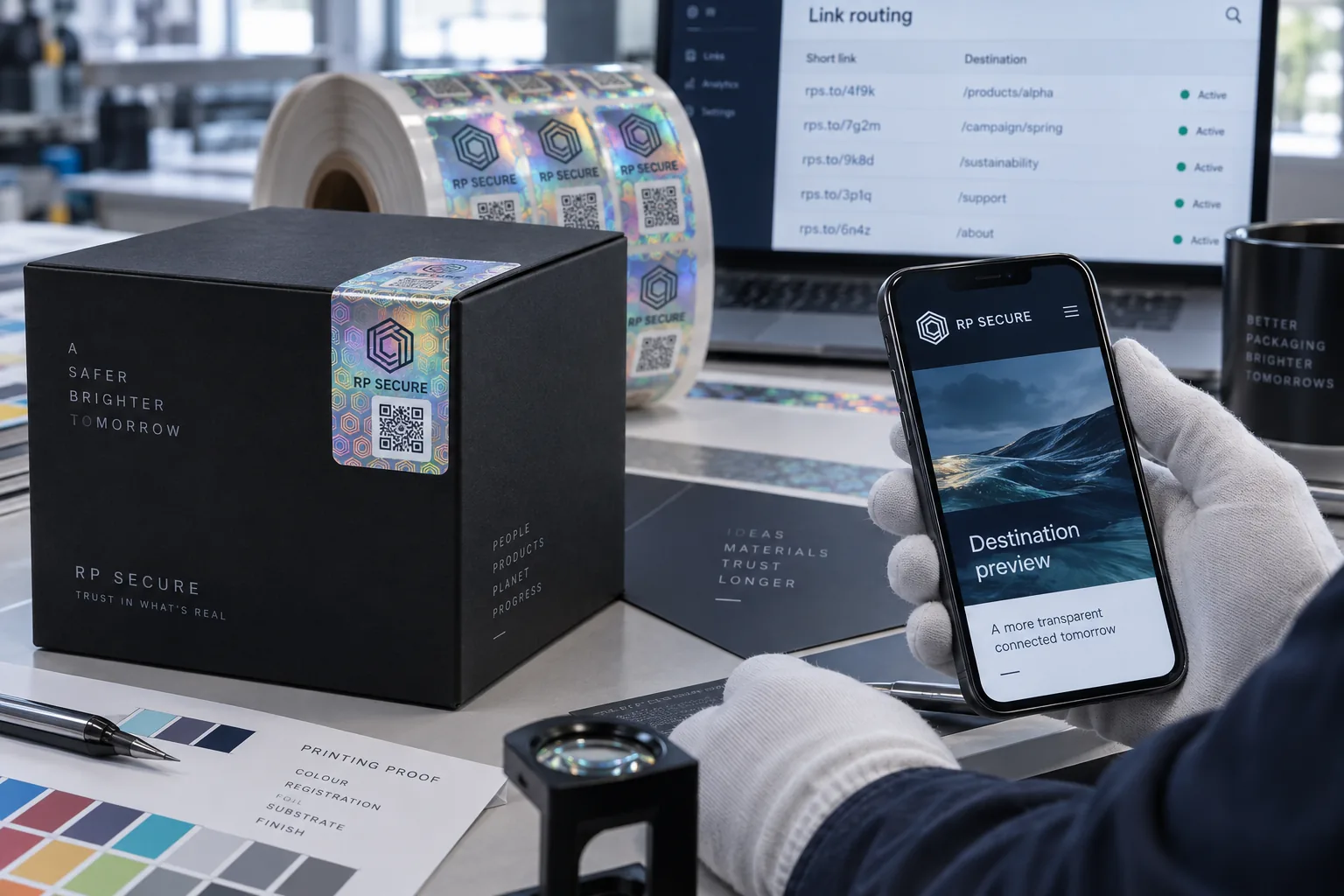
AI-generated concept image. QR-like marks and routing screens are decorative, not functional identifiers or proof of authentication, link operation or security performance.
Separate the printed address from the page it opens
The QR symbol contains data, usually a URL. The visible landing page can change if the controlled URL redirects to it. GS1's Digital Link quick-start guidance separates a persistent product identifier on a brand-controlled domain from a changeable product-information destination. That is particularly useful when a long-lived pack must survive a site redesign.
Not every hologram QR label needs a GS1 Digital Link. A plain brand URL may be adequate for a marketing or warranty page. But the same ownership question applies: will the brand retain the domain and account if the agency, QR platform or label vendor changes? A supplier-hosted short link is a dependency to put in the contract, not something to discover after the labels are delivered.
Agree what happens when content moves
Write down the printed URL, the present destination, the redirect owner and who can change it. Decide what a scan should show when the campaign ends, a product is retired or a regional page is unavailable. GS1's redirection guidance recommends separating the identifier URL from changing content and discusses temporary redirects when the target may change.
A broken page is not a printing defect, but it becomes a customer-facing defect on the printed pack. Have a named team monitor the destination. Before each artwork reprint, scan an applied sample and check the actual final address, language, HTTPS and mobile rendering. Do not rely on the QR generator preview alone.
Keep the printed address when the website moves
Here is a hypothetical handover. The approved label encodes https://id.brand.example.invalid/sample-a. The brand then moves its product information from an old page to a new product page. These are deliberately non-live example addresses.
If the brand retains control of the encoded domain and redirect, its web administrator can arrange the destination change without silently changing the printed address. The content owner approves the replacement page; the packaging owner preserves the original encoded value in the artwork record. The team checks an applied label through to the final phone view before retiring the old route.
Now change one condition: the printed address belongs to an outgoing provider. Control of the new product page does not give the brand control of that old address. Obtain the provider's continued-service or migration arrangements before cancelling the account. If control cannot be preserved, decide what existing printed stock and future artwork require instead of assuming a new website repairs old packs.
The worked migration and retirement sheet, blank sheet and field guide record this distinction. They also include a discontinued-product case: useful support information may still be needed while packs remain in circulation. The worksheet keeps the fallback, content approval, actual applied-scan evidence and reprint check separate. All example approvals remain pending.
Give the migration team the encoded address, not just a screenshot of the old page. The old address may pass through a provider before reaching the brand website. Record that dependency and check what remains available when the provider account ends. Test the intended route from an applied sample instead of approving only the new page in a desktop browser. If language or region changes the destination, include the relevant buyer routes in the check. Keep the evidence with the artwork revision so the next reorder has a known starting point rather than another search for the person who originally made the code.
Define what the scan must do when the connection is unavailable
Owning the destination is only part of the operating brief. Separate three actions: reading the encoded data, opening the linked content, and obtaining a current answer from a connected system. A successfully decoded identifier does not establish that the destination is reachable or that a current status check has completed.
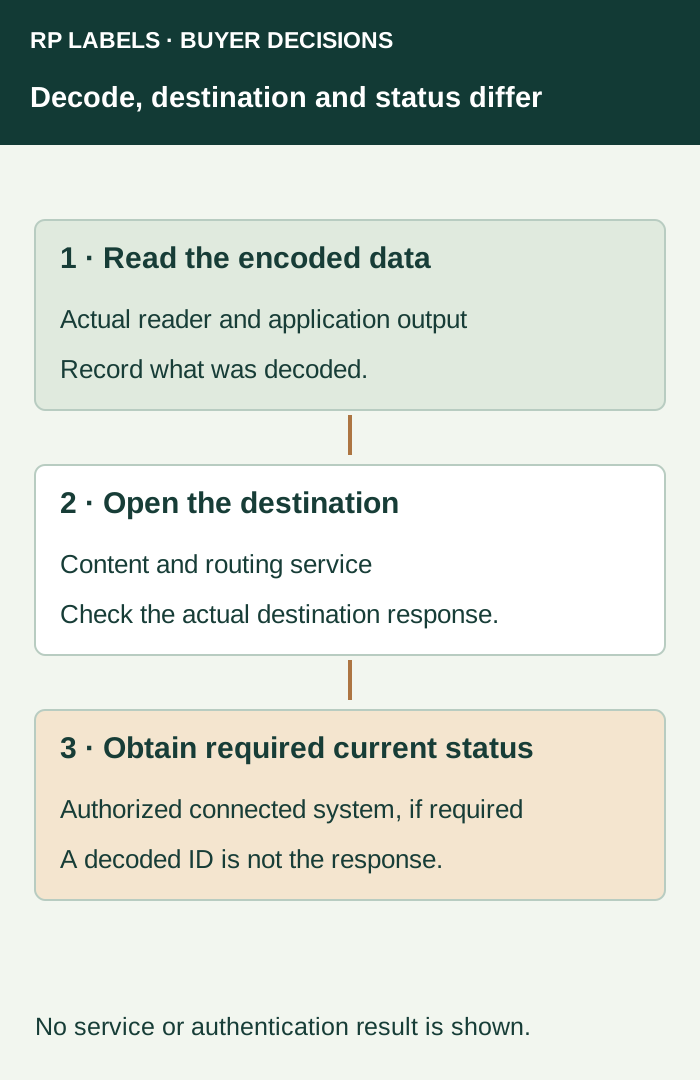
GS1’s Digital Link quick-start guide explains its dual role: structured identifiers can be recognized without an online lookup, while the same URI can connect to web information. That statement depends on compatible software and the relevant data structure. It does not make every phone, custom QR address or application an offline inventory system, and it is not a deployment guide for healthcare applications.
For an ordinary URL, decoding the address and loading the page are likewise different operations. Ask the actual reader and application owner to demonstrate the expected output with the connection disabled under the agreed test conditions. The reader-and-application guide covers the raw-output handoff. Do not conclude that all hardware can perform the desired offline task merely because the printed symbol contains data.
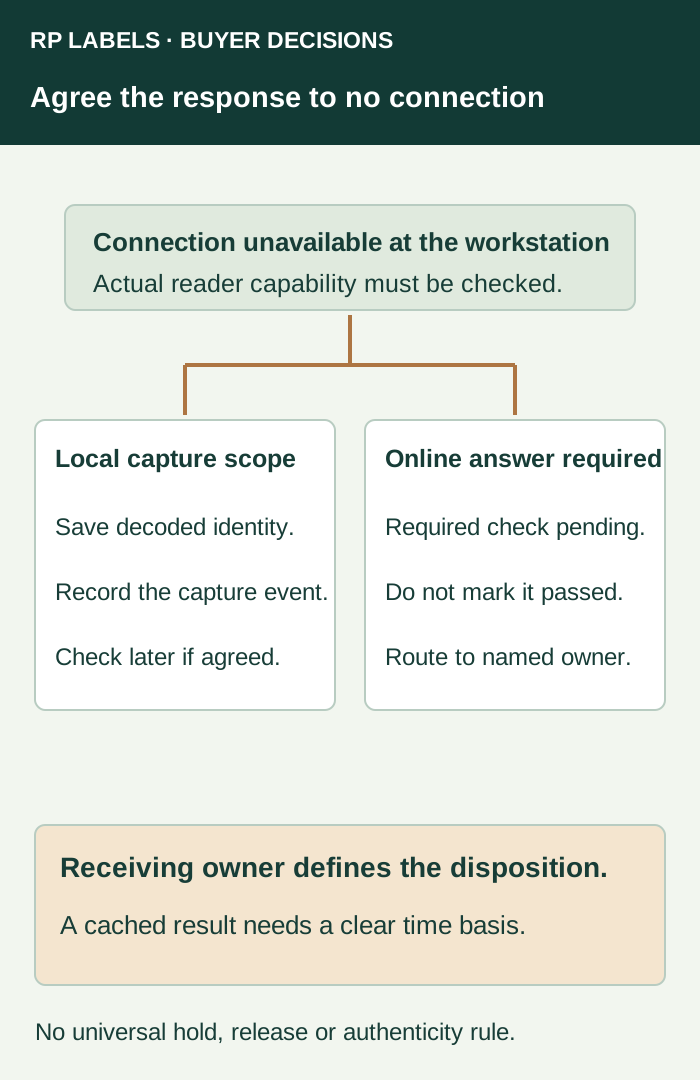
If the buyer only needs local capture for a later agreed reconciliation, the system owner can specify what is saved, how entries are identified and when synchronization is checked. If the operation requires a current online confirmation before proceeding, an unavailable connection leaves that step incomplete. Define the response with the responsible operations owner; do not replace “not checked” with a reassuring success message.
A cached response needs its own identity and time basis. It should not be presented as a fresh lookup unless the system actually performs one and the response supports that description. The precise acceptable workflow depends on the project; this article supplies no universal stock-release or authentication rule.
When requesting hologram QR printing from RP, identify the approved encoded data, physical layout, intended reader and owner of each post-scan operation. Ask the print quote to state its scope separately from any application or service arrangement. A printed QR can carry the agreed data without including connectivity, an offline app, a database or ongoing verification support.
Keep security claims modest
A branded page reached by a QR scan does not, by itself, prove that the physical hologram is genuine. A copied code can be printed again. GS1's digital-signature discussion explicitly notes that a QR containing an identifier can be replicated, and additional physical or instance-level checks may be needed for authentication. If the buyer needs authentication rather than engagement, specify the threat model, unique data, checking workflow and exception response separately.
The static-versus-unique QR guide covers that artwork decision. The foil scan-contrast guide covers the physical scan. Neither substitutes for ownership of the service behind the code.
Put five web questions on the print approval
| Question | Named owner |
|---|---|
| Who owns the encoded domain and DNS? | Brand web owner |
| Who can update the redirect? | Brand or contracted platform administrator |
| Who approves the destination copy and language? | Brand content owner |
| Who tests mobile scans from applied seals? | Buyer and print acceptance team |
| Who monitors broken links after launch? | Ongoing web operations owner |
My approval rule: the buyer provides a controlled URL and a working mobile destination before final art sign-off. Save the encoded address in the artwork record so a later reorder cannot silently point to a different provider. Send RP the exact encoded data, seal size, substrate and intended application surface. Ask the quotation to identify the artwork and printing scope; the brand must assign destination operation and independently review any authentication claim.