Holographic QR Labels: Make the Security Design Shine Without Losing the Scan
Imagine a reflective label opens a page on the designer's phone, but the printed stock is intended for a curved pack under different lighting. That successful demonstration leaves the applied scan question open. It also says nothing about whether the encoded address is the approved one.
The sparkle and the scan are two different jobs. A holographic seal earns attention by changing with the light. A QR code needs its dark and light cells to remain distinguishable in the lighting, angle and package curve where someone will scan it. A flat artwork proof cannot settle that conflict.
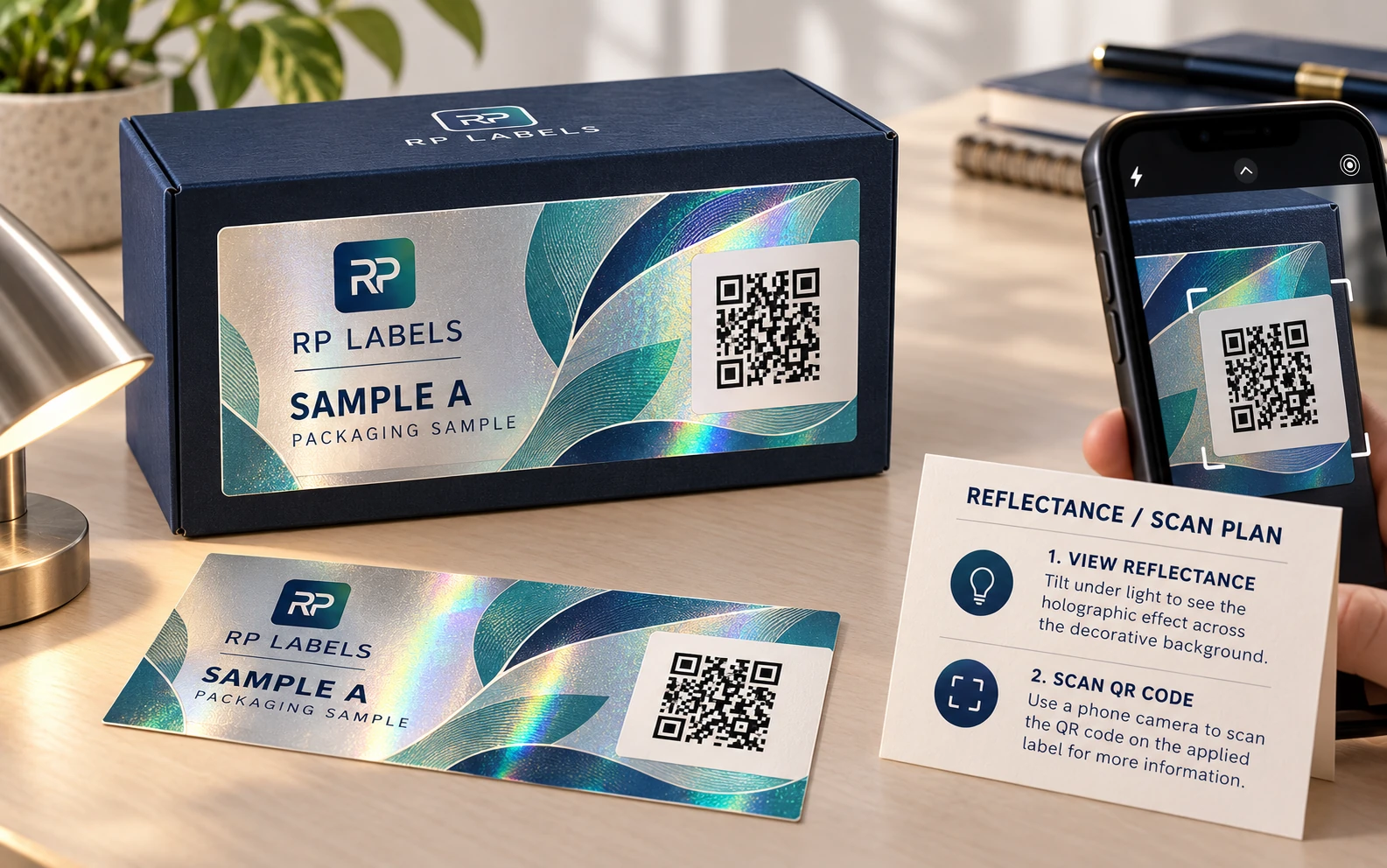
AI-generated packaging illustration. Fictional RP demonstration samples; not an actual order, completed test, authentication or approval record. Any displayed checks or codes are illustrative.
I would decide what the code is for before choosing the optical effect. Is it a consumer link, an internal asset identifier or part of a serialized authentication process? A printed code that opens a URL is not, by itself, proof that the product is genuine. If each item needs an individual identity, the data and verification service require their own controls; see the static versus unique QR guide.
Give the code a quiet place to work
Place the code on an opaque, high-contrast panel separated from the most reflective foil and busy security artwork. Keep its quiet zone clear of borders, guilloche lines and decorative microtext. The GS1 retail 2D implementation guideline explains how reflective packaging, curves and insufficient quiet zones can interfere with reading. Its exact size rules depend on the barcode type and application; do not transplant a retail specification into every promotional QR sticker without identifying the use case.
More white ink is not automatically better everywhere. Keep the optical effect where a buyer will inspect it and the code where a scanner can see it. Our white-ink artwork guide explains the underlying design layer; this guide is about the finished scan test after printing, converting and application.
Test the worst real position
Apply the label to the actual carton, bottle or closure. Scan it at the angle and distance people will use. If the sticker wraps over an edge, test the code on the bend, not only on a flat sample laid beside the package. Ask for specimens from the start and end of the roll if the job will be produced in volume. Record the device or reader types and light conditions used.
Some phone cameras compensate for glare better than others. A single successful scan with the designer's newest handset leaves other intended devices untested. Conversely, a failure caused by one damaged sample does not condemn the whole design. Make the acceptance sample set and conditions explicit before making a bulk order. GS1's quiet-zone contrast guidance recommends keeping the quiet zone consistent with the light background and maintaining contrast with dark modules.
Separate decode from the destination
| Question | How to check | What it does not establish |
|---|---|---|
| Can a reader find it? | Scan the applied label on the actual pack under agreed conditions | Whether the encoded address is right |
| Is the data right? | Compare decoded content with the approved data record | Whether the website or authentication service works |
| Does the destination work? | Open the link or query the authorized verification system | Whether the printed symbol meets a formal quality grade |
If a formal barcode grade is required, use the correct compliant verification method and symbol specification. GS1's verifier guidance distinguishes a measured quality grade from an ordinary scan. A sample photo of a phone reading a sticker is marketing evidence at best, not a verifier report.
Ask what happens when one label fails
For serialized work, define how unreadable codes are rejected, destroyed or accounted for, and how replacements are issued without duplicates. Agree on the count and identity record delivered with the roll. A pretty security pattern does not compensate for a missing number. Our serial reconciliation guide covers that handover.
For a static campaign link, the most useful preflight may be simpler: scan the final sample, compare the URL, and confirm who will maintain the landing page for the lifetime of the packaging. Avoid printing a short-lived redirect onto stock expected to sit in distribution for months.
Give the converter a complete brief
Send the finished package sample, label size, optical effect reference, code type, destination or data schema, desired print quantity, intended scanning devices and whether each label has unique data. Ask for an applied, production-representative sample with the actual finish. Approve both the reflective appearance and the code performance. If either one is missing, the label is not ready.
My preference is to give the hologram the surrounding field and reserve a disciplined matte island for the code. It is less dramatic in an enlarged design file, but much better than explaining to a buyer why the security sticker only scans under one desk lamp.
A decode record is more useful than a green check picture
The worked scan-evidence record, blank plan and field guide put device and lighting beside the applied pack, then separate decoded payload, approved reference and destination check. No example code has passed; the empty observations are intentional.
Imagine a phone opens a page immediately, but the decoded address belongs to an earlier campaign. That is a successful decode and a data failure. In another conditional case, the right address works on a flat sample but cannot be read on the intended curved pack. That points to a different investigation. Keep the outcomes separate so the next revision addresses the relevant problem.
Use an independently approved payload reference. Copying the value from the same unverified print file into the expected-data column can make a wrong code agree with itself. Record the relevant devices and views chosen by the buyer. If a formal quality grade is required, obtain the correct compliant verification rather than interpreting a phone scan as a measured grade.
An opaque island can be a fair trade when decorative reflection conflicts with the code's intended reading conditions. If an existing construction already has applicable evidence, retain it and review the changed part rather than redesigning for sparkle. Send RP the scan plan, artwork, quantity, actual pack and approved code-data scope, identifying which physical questions the requested sample must answer.