Scratch-Off Hologram Codes: Approve the Visible-to-Hidden Pair
The visible serial is on the approved list. The revealed code is also on the approved list. They can still be the wrong pair. In a hypothetical scratch-label file, sorting one column without the other creates labels that look correctly numbered but lead to the wrong concealed relationship. Checking each list on its own will not catch it.
The designer can see the serial and the silver patch. The data owner knows what is meant to sit underneath. I would bring them together around a dummy pair, then reveal an actual sample. It is a less dramatic moment than admiring the hologram, but it establishes whether the two sides of the label are telling the same story.
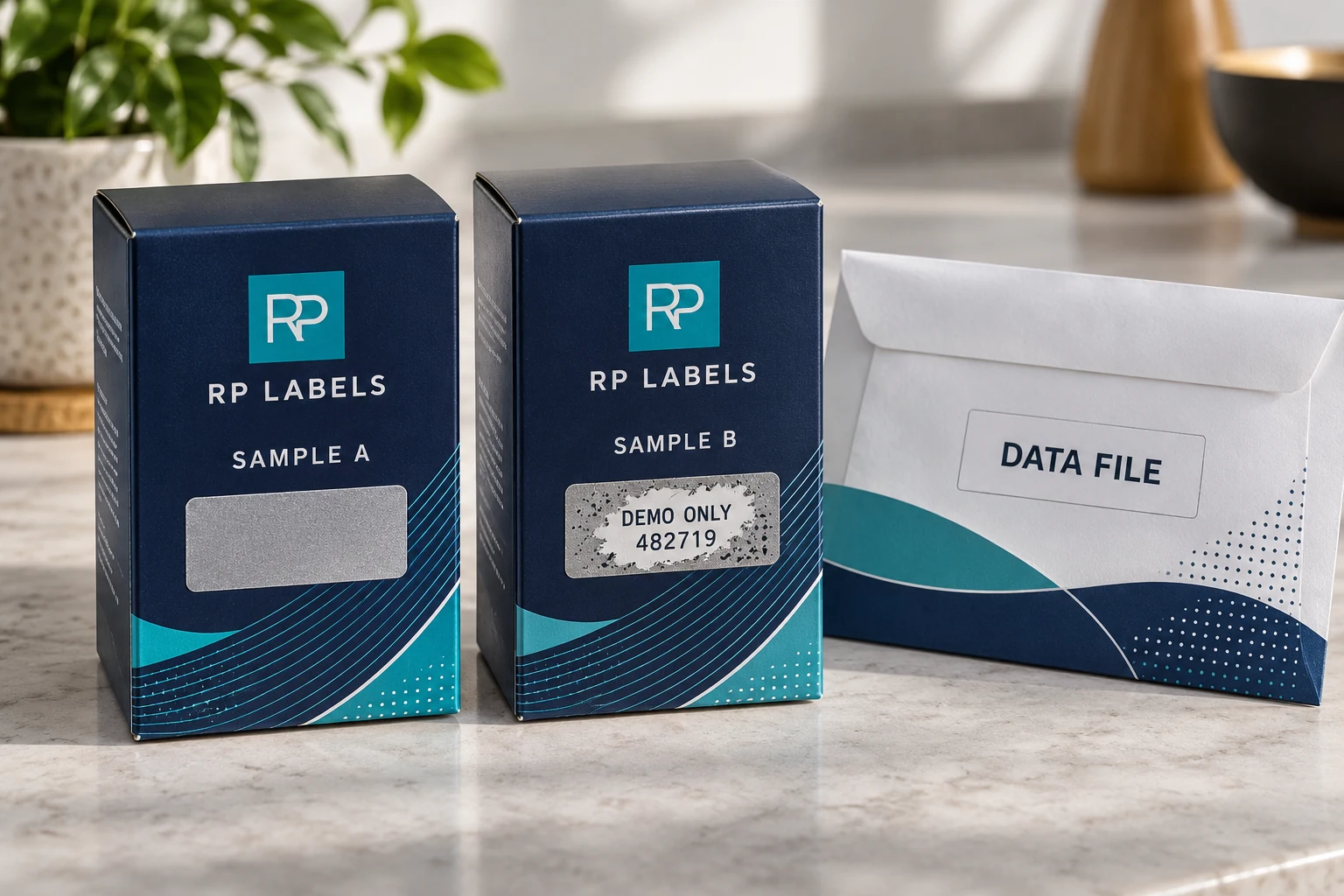
AI-generated packaging illustration. Fictional RP samples show the proposed decision; no physical test or customer order is documented.
Check the pair before checking the full shipment
Ask the brand's system owner to define the authoritative relationship. Is the visible value a unit identifier, a batch reference or a shared campaign value? Is the concealed value unique or shared? The print supplier needs that explicit relationship, not two loose lists and an instruction to make them match. Keep the public example entirely separate from live values.
The worked record uses three dummy visible identifiers. Each has a corresponding dummy concealed value. One challenge row deliberately carries the value from another row. Both values exist, but that relationship is wrong. A reviewer should identify the pairing error without deleting either value or changing the authorized master to make the sample appear correct. This is a proposed review exercise, not a real incident or secure production file.
On a physical sample, read the visible identifier, reveal the concealed field through the intended action and compare that exact pair with the controlled source. Record whether the physical reveal leaves the value legible as a separate observation. Then have the system owner check the intended demonstration response. Correct pairing, usable concealment and the operated response are three different evidence items.
A shared campaign code can be a sensible simpler choice when unit-specific relationships are unnecessary. Where individual pairs are required, preserve them as a controlled record through data preparation and printing. The separate serialized-label guide covers accepted, rejected and replacement identities across a shipment; this article concerns the relationship inside one finished label.
Send RP Labels a dummy schema, the required visible/hidden relationship, proposed patch area and quantity. Ask how a pair can be demonstrated without exposing live secrets in public artwork or approval images. The brand's data owner confirms the relationship and transfer controls, while the supplier confirms the actual printing and sample scope.
Choose the job of the concealed value
A hidden code can be used as a second factor in a verification workflow, as a one-time registration value, or simply as a campaign entry. Those are different promises to a buyer. GS1's digital-signatures guidance describes workflows in which an authentication code from a physical security marking is checked alongside digital data. GS1 does not prescribe a scratch-off sticker for every product; the scratch layer is one possible packaging design choice. A code on its own is not evidence of cryptographic signing or a secure service.
Write a one-sentence user action before artwork starts: "Reveal the code, enter it at the brand-owned destination, and see one of these defined responses." Decide whether the code is unique per item or shared by a batch. If unique, decide who creates the list, who prints it and who controls the database. If a QR also appears, determine whether it merely opens the form or carries item-specific data. Never let a printer assume that a generic QR automatically authenticates every sticker.
Reconcile print files and physical rolls
Ask for an agreed data-file format with field names for visible serial, hidden code and artwork version. A small sample can be checked manually: reveal one patch, compare it with the corresponding draft row, then have the brand's system owner test the response. After production, record total codes supplied, printed, rejected and delivered. The exact controls depend on your risk level, but a missing count should not be waved away as a design issue.
GS1's current digital-signatures standard discusses binding digital data to an individual physical entity through a security feature. It also describes cloned identifiers as a risk. That is why a brand should own the verification logic and investigate duplicate or implausible checks rather than promise that a shiny surface alone prevents copying.
Proof the physical reveal
Ask for a real applied sample on the intended carton, pouch or bottle. The scratch coating should hide the value before use, reveal it without destroying the code, and survive ordinary packing until a buyer deliberately removes it. Check several samples from the beginning and end of a trial roll. If the patch crosses a carton fold or sits under a clear overlaminate, its behavior may differ from a flat loose sticker.
The image is AI-generated and demonstrates only the visual brief; it cannot show scratch durability, code secrecy or database behavior. A physical trial and a system test are separate sign-offs. If the code is exposed in a marketing photograph or printed in an open spreadsheet, the scratch layer no longer provides the intended concealment.
Send the converter a complete specification
Provide the original hologram master, finished size, substrate, application surface, visible serial format, concealed-code format, scratch area, intended roll direction, sample size and secure data-handoff owner. Ask who handles replacement labels and how rejected labels are documented. Keep the verification URL or system specification under the brand's control rather than burying it in a supplier's generic landing page.
I would approve the order only when a sample label, one data row and one verification response agree. The attractive hologram gets attention; the handoff and checking process make that attention useful.
Sources and scope
Reviewed October 6, 2026. The primary references linked below support the identified technical points. Buying scenarios and inspection checklists are editorial guidance, not RP production records, certification, legal approval or universal acceptance standards.
- GS1: digital signatures and authentication codes in physical markings - GS1: digital signatures current standard
Worked scratch code handoff record
The rows below are hypothetical planning examples. Empty observation or commercial fields must be completed from the actual project; no sample has been tested for this article. Use the worked CSV and blank worksheet with the field guide. Keep the example references separate from production records.
| demo visible id | authorized concealed value | observed demo value | relationship expected | physical reveal observation | system owner review |
|---|---|---|---|---|---|
| DEMO-101 | CODE-DEMO-A | CODE-DEMO-A | MATCH in example | No physical test performed | Demonstration only |
| DEMO-102 | CODE-DEMO-B | CODE-DEMO-C | MISMATCH in deliberate challenge | No physical test performed | Investigate original pairing |
| DEMO-103 | CODE-DEMO-C | CODE-DEMO-C | MATCH in example | No physical test performed | Demonstration only |
Bring this decision into the print inquiry
Contact RP Labels with the completed scratch code handoff record, the actual packaging reference, approved artwork and quantity per design. State which fields remain unresolved so the print specification and any relevant sample scope can be discussed against the same decision.
Related buying guidance: 3D Holographic Labels; Reconcile serialized labels; Own the verification destination; Separate visual and digital checks.