Hologram Seals on Corrugated Cartons: Record Where the Evidence Remains
A removed seal carries a patch of brown fibers. The buyer receiving the carton may never see that removed piece. What can they see on the box that remains? That question should shape the seal trial before the holographic pattern is approved.
The supplier can show the removed sticker. The receiver usually sees the carton that arrived. I would judge the feature from that second position. If the useful evidence disappears with the discarded label, the inspection instruction needs another reference, another construction or a more modest claim about what the seal can do.
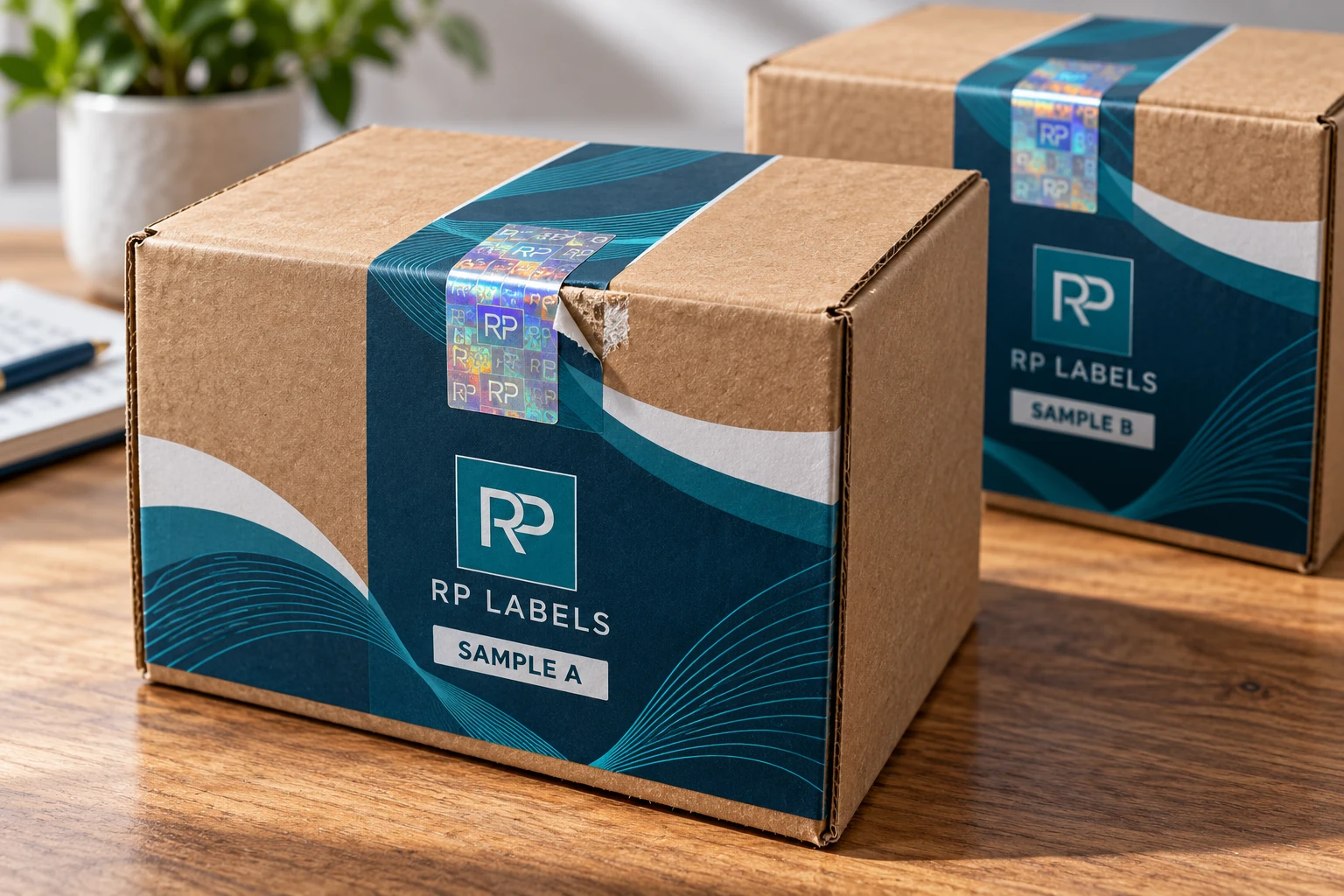
AI-generated packaging illustration. Fictional RP samples show the proposed decision; no physical test or customer order is documented.
Inspect the carton and the removed label separately
Identify the actual board, printed surface and finish. Plain kraft, varnished graphics and a coated label panel are different test surfaces even when they belong to one carton. Place the candidate across the actual opening route and record how much contact is available on each side. The worked observation sheet has separate fields for the remaining carton and removed seal.
After the agreed conditioning and handling sequence, use the planned opening or removal method. Photograph both surfaces with their specimen reference visible. Describe the result plainly: fibers displaced, surface coating lifted, pattern transferred, label broken or no obvious change. These are observations to collect, not assumed outcomes for a particular RP construction.
Then ask whether the intended receiver can distinguish the observed change from normal shipping wear. A fiber patch may be visually strong on one printed panel and hard to interpret on another. If the instruction needs a reference photo, keep the accepted example tied to the actual carton revision. A technical observation is useful only if the downstream check can use it.
A destructible or transfer construction may be a better candidate where fiber tear is inconsistent or the brand cannot accept board damage. A simple decorative hologram may be enough for branding alone. The buyer should choose the intended evidence mechanism with the supplier instead of asking every surface to produce the same removal pattern.
Send RP Labels the finished board sample, opening geometry and the evidence location you need. Include the package changes expected over the order's life. The trial then supports a precise statement about an identified pack rather than a general claim that shiny seals cannot be removed.
Define what “tamper evident” means on this carton
The buyer needs to specify an observable outcome: carton-fiber damage, a broken label, a transferred pattern or another visible change on attempted removal. Avery Dennison's security-label overview illustrates fiber-tear constructions; its tamper-evident information sheet also shows labels crossing box seams. Those are examples of possible mechanisms, not evidence that every holographic seal on every carton will behave the same way.
Ask whether the desired evidence should remain on the box, on the removed sticker, or both. Think about the buyer receiving the parcel: can they identify a compromised seal quickly, or would ordinary shipping scuffs look the same? This matters more than the complexity of the diffraction pattern. A security feature only helps if someone knows what to inspect.
Place the seal where opening actually breaks it
Use an assembled and filled sample carton. Mark the flap that opens first and the full route the sticker must bridge. Avoid a placement that only touches a decorative outer sleeve while the real flap can be opened from another edge. The seal needs enough bond on both sides of the seam; a narrow strip over a large gap may lose useful contact. Check the fold angle so the material does not tent above the corrugation.
Carton coatings and print finishes belong in the sample request. If the final carton will have varnish or soft-touch laminate, a plain brown sample is not equivalent. Also identify whether packing staff press the seal by hand or use equipment. A die-line that works slowly on a bench may snag at production speed. The placement guide covers other pack geometries.
Run a simple, documented opening trial
Apply candidate seals to several finished cartons using the agreed pressure and environment. Inspect initially, after the specified dwell, after normal shipping handling and when the carton is opened by a person who has not seen the design proof. Photograph the intact seal and the disturbed surface. Record whether the intended evidence was obvious, whether the carton was damaged in a way the brand accepts, and whether legitimate opening became impractically difficult.
Worked corrugated fiber trial record
The rows below are hypothetical planning examples. Empty observation or commercial fields must be completed from the actual project; no sample has been tested for this article. Use the worked CSV and blank worksheet with the field guide. Keep the example references separate from production records.
| specimen | board finish | placement reference | removal method | remaining carton observation | removed seal observation | receiver interpretation | decision |
|---|---|---|---|---|---|---|---|
| DEMO-K | Actual uncoated board required | Across real flap | Agree relevant method | Compare with intact reference | PENDING | ||
| DEMO-C | Actual coated panel required | Equivalent opening route | Same comparable method | Check against ordinary wear | PENDING |
Bring this decision into the print inquiry
Contact RP Labels with the completed corrugated fiber trial record, the actual packaging reference, approved artwork and quantity per design. State which fields remain unresolved so the print specification and any relevant sample scope can be discussed against the same decision.
Related buying guidance: 3D Holographic Labels; Tamper-evident constructions; Where to place a seal; VOID versus destructible.
Sources and scope
Demand layer: competitor and process pages linked here, including Avery, HERMA or OnlineLabels where cited, illustrate buyer language and process topics only. They do not supply RP minimum quantities, lead times, prices, certifications or materials. Authority layer: an RP number is backed only by a factory datasheet, a signed quote or proforma, confirmed product data, or a fact kept on the About page. The March 2026 proforma there is one production-run example, not a standing offer. RP shipping and planning pages describe what to confirm on a quote. Worked figures on this page are fictional unless an authority source is named for them.