Warranty Card Hologram or Carton Seal: Release Separate Checks
The warranty card and carton carry the same hologram design. That makes the set look coordinated. It does not mean the person inspecting the card and the person checking the carton are looking for the same evidence.
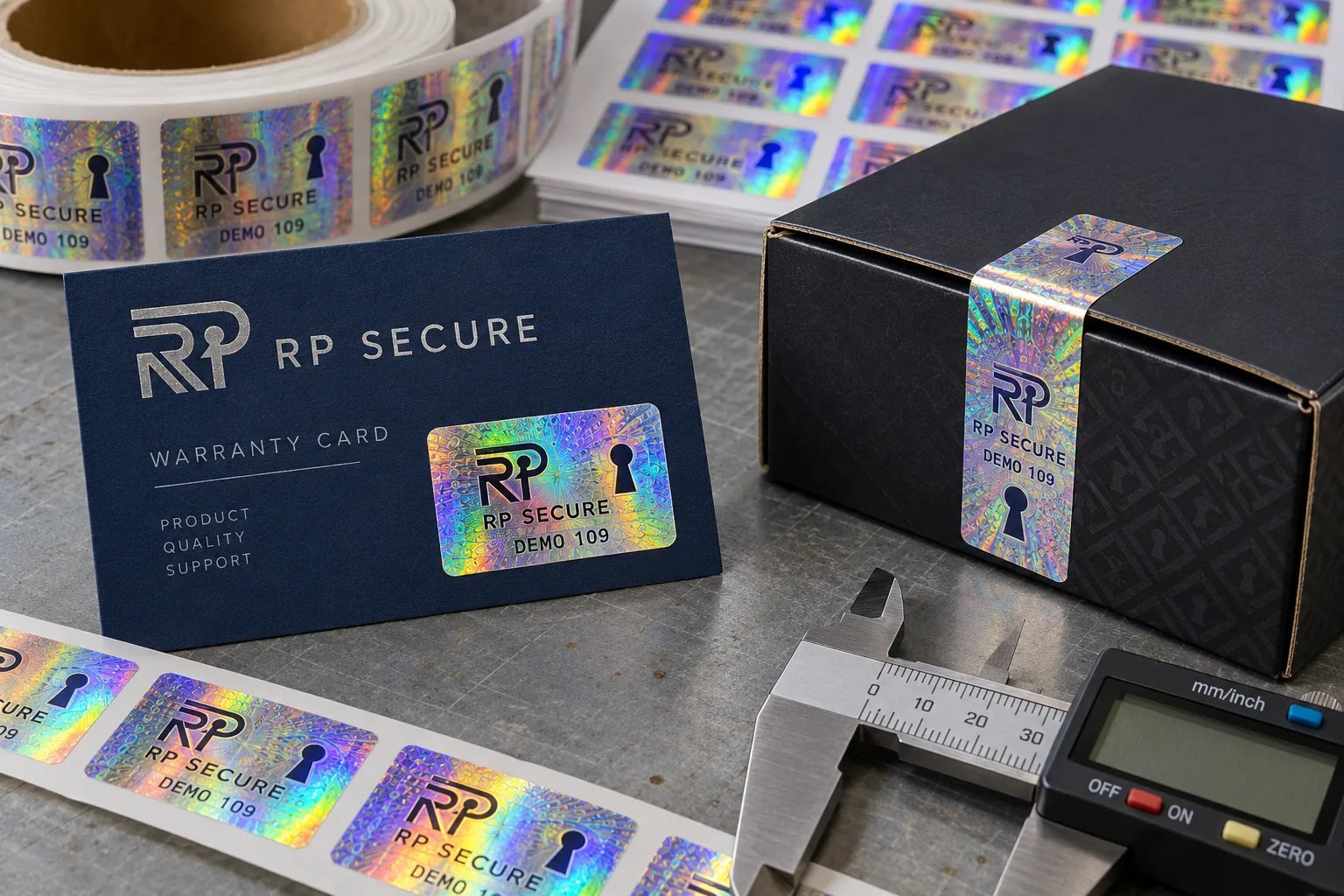
A warranty card hologram is often approved because it photographs well. A carton seal is often requested for the same reason. I would ask the buyer to write one sentence for each: what should a person learn from seeing this mark? A sticker on a card says the card carries a mark. It does not show that the box was unopened. A strip across the box seam may show disturbance when opened, but it says little about whether a separate card is genuine.
The RP Secure scene above is an AI-generated comparison. The warranty card, carton, holograms and DEMO 109 are fictional. The image proves neither authentication nor tamper performance.
Give each receiving person a question the label can answer
Write the card question and carton question on separate lines. The card may carry a visual reference or an issued identifier that a warranty team checks. The carton may be intended to show what happens at first opening. Ask who sees each item, when they see it and what record they can actually consult. If the person has no reference or process, adding another printed symbol will not create one.
For the card, retain the proposed physical card and mark the feature to be compared. If an identifier is involved, the issuing owner must describe its record and exception route. For the carton, retain a closed applied sample and the agreed opening observation. A matching card graphic does not validate the seal construction, and an opened seal does not establish that the enclosed card was issued legitimately.
The example release sheet keeps two outcomes rather than one combined pass box. A card can have a satisfactory visual sample while the carton trial remains open. The carton can show the intended opening change while the card's identifier process remains undefined. Those are useful partial decisions, not reasons to declare the complete set approved.
If matching numbers are truly needed, connect the two approvals to the separate pairing and reconciliation procedure. Decide what happens to the counterpart when a damaged card or carton is rejected. If the brief needs only a coordinated visual mark, do not add serialized matching simply to make the design appear more secure; the extra handling needs an owner and a purpose.
Ask the buyer's warranty and packaging owners to sign their own release scopes and name where a doubtful result goes. Send RP the card stock, carton surface, positions, quantities, artwork and intended checks, with any identifier requirement separately stated. Two physical products may share one design, but the buying record should preserve the two different jobs that made them necessary.
Download the worked example CSV · Open the working CSV · Read the field guide. The entries are planning examples, not completed results.
Separate identity from opening evidence
On a card, a hologram can be a recognizable visual feature and perhaps hold a serial reference. Its value depends on what an organization does with that reference: who issues cards, who records numbers, and how a buyer checks one. A pretty repeating pattern with no issuance controls can be copied into an unauthorized card just as readily as any ordinary printed graphic.
On a carton, the sticker must touch the surfaces that separate at first opening if the aim is opening evidence. HERMA's tamper-evident label information describes construction approaches for seals. It does not certify our fictional strip. Ask for the intended failure mode in writing: tearing, destructibility, VOID transfer, or another visible change. Then test it on the actual carton finish.
Do not put serial numbers into artwork without a handoff plan
If the card and carton carry matching identifiers, decide when they are paired and who reconciles them. Are both labels supplied on one numbered roll, or on two rolls that a packer has to match? What happens when one card is damaged or one carton is rejected? A mismatch is worse than having no number at all because it creates a false sense of precision.
For a low-complexity project I would start with an original visual pattern and a controlled distribution process, then add variable data only when there is an owner for the database and exception handling. Our visual-versus-QR guide explains why a code and a destination are separate design decisions. Do not promise a customer that a printed serial or QR mark is automatically an authentication system.
Proof each physical surface
Card stock may be porous, heavily coated or textured; a retail carton may have glossy laminate or a fold directly under the label. A finish that looks vivid on a flat card could bridge a carton edge poorly. HERMA's closure-label example shows that carrying a closure function changes the construction brief. It does not authorize a universal adhesive claim for every card and box.
Ask for a physical warranty card with the hologram in place and a closed carton with the seal applied. Check card stacking, handling and rub resistance. Open the carton in the exact way a buyer would, then try to reseal it. Record what actually changes. If no visible change occurs, the printed strip may still be decorative, but it should not be sold internally as tamper evidence.
What the quote should say
Provide card size and finish, carton sample and finish, seal location, quantity per design, variable-data requirement, application method and whether card and carton numbers must match. Request separate die lines and separate acceptance criteria. A flat card mark and a carton bridge may share the same RP art, but they are different physical products. I would pay for the right two proofs rather than rely on one attractive digital rendering to stand in for both.
Bring the decision into your print brief
Use the identified references and open items in the worked record when discussing your custom print project. Include the actual package, artwork revision, quantity per design and the conditions explained above; leave unknown inputs marked for confirmation. Review the relevant custom-label service, then send the project details to RP Labels.
Related buying decisions
- Hologram Plus QR Labels: Give Visual and Digital Checks Separate Jobs
- Serialized Hologram Labels: Reconcile Every Number Before Shipment
- Hologram Carton Seals for Returns: What the Receiving Team Can Actually Check
Sources and scope
Reviewed October 25, 2026. Primary supplier or official reference supports the identified production concept. Procurement comparisons and worksheets are editorial guidance. Conditional examples are not customer records, completed tests, regulatory approval or universal acceptance standards. Confirm the actual proposed construction and process with the responsible supplier and buyer. Demand layer: competitor and process pages linked here, including Avery, HERMA or OnlineLabels where cited, illustrate buyer language and process topics only. They do not supply RP minimum quantities, lead times, prices, certifications or materials. Authority layer: an RP number is backed only by a factory datasheet, a signed quote or proforma, confirmed product data, or a fact kept on the About page. The March 2026 proforma there is one production-run example, not a standing offer. RP shipping and planning pages describe what to confirm on a quote. Worked figures on this page are fictional unless an authority source is named for them.