REACH or RoHS for Labels? Define the Requirement Before Ordering a Report
When a supplement-label supplier receives a request for “REACH and RoHS certificates,” the first useful question is what the buyer needs the documents to establish. EU REACH article information, RoHS restrictions for electrical and electronic equipment, and a retailer's own substance specification are different requirements. Do not pay for a vaguely named report before identifying the market, product and acceptance criteria.
Give the supplier the customer's actual requirement where available. A technical or regulatory owner should decide its applicability. Purchasing can then request evidence tied to the label construction that will actually be supplied.
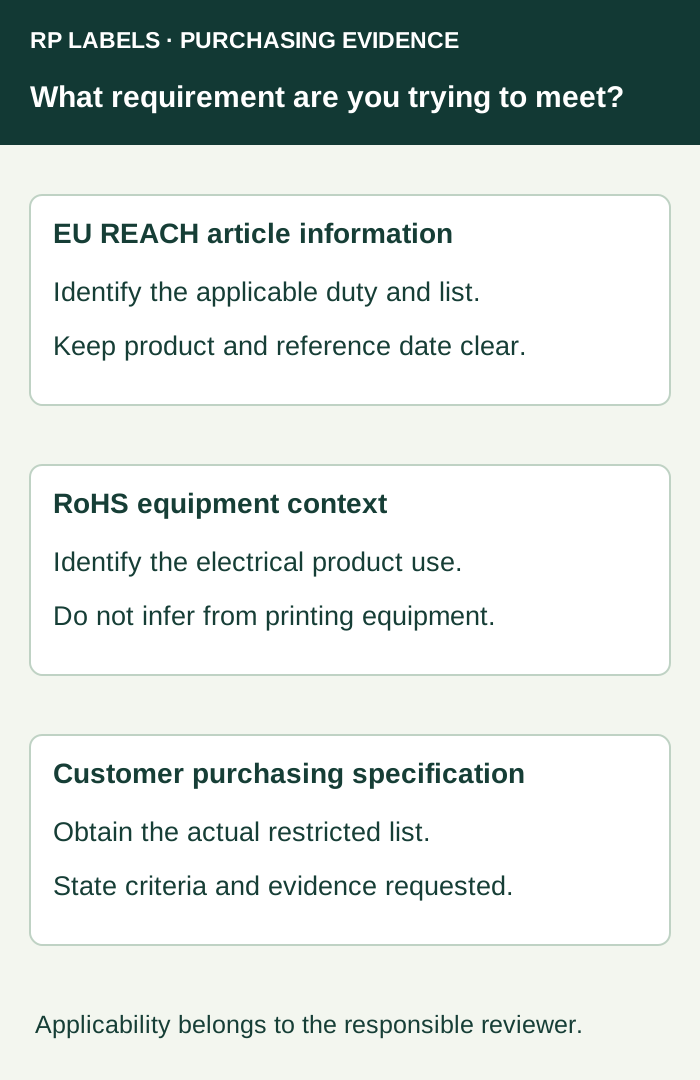
Keep the REACH question specific
ECHA explains that Candidate List inclusion can trigger obligations for article suppliers, importers and producers under stated conditions. Its supply-chain guidance describes communication for articles containing a Candidate List substance above 0.1% by weight, including information needed for safe use.
That specific information duty should not be reduced to an undefined “REACH pass.” Ask which list or restriction the supplier's statement addresses, its reference date, the product and components covered, and what supporting information underlies it. A statement about Candidate List substances alone does not answer every possible REACH requirement.
Have the responsible reviewer determine the applicable article and supply-chain scope. Do not average component results or invent a concentration basis to make a statement appear to fit. Where a customer asks for something beyond the applicable legal information, record that additional contractual requirement separately.
RoHS needs its equipment context
The European Commission describes RoHS as restrictions on hazardous substances in electrical and electronic equipment. A supplement bottle is not an electrical product merely because its label is printed on electronic machinery. A RoHS-style test request can still be part of a customer's purchasing specification, but the request should say so.
If the label will be incorporated into equipment, give the responsible product owner the actual use and proposed construction so it can determine the requirement. If the request instead comes from a general supplier-onboarding checklist, ask the reviewer which substance evidence it expects for these bottle labels. A document should solve the stated requirement, rather than repeat a phrase from an unrelated product category.
Match the evidence to the material on the quote
Record the face material, adhesive, liner and finish references relevant to the assessment. Ask whether the document covers a component, a finished printed construction or a defined group of products. Keep the issuer, report or declaration number, revision, sample identity and stated limitations.
A report for an unprinted white film does not automatically cover a different film, ink system, adhesive or protective finish. It may remain useful supporting evidence within a documented assessment. The reviewer needs to know what it actually represents, especially when the quote offers several alternative constructions.
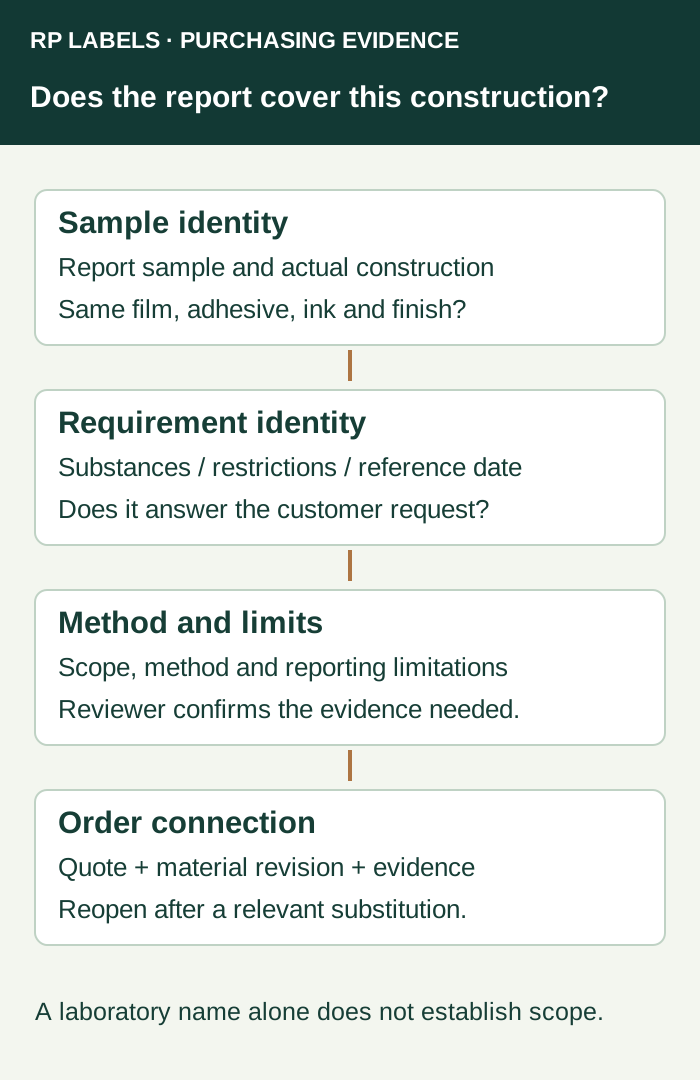
Make a test request that can be priced
If testing is needed, have the reviewer define the substances or criteria, required method, reporting limits, sample scope and acceptance basis. Ask the supplier what existing evidence can be supplied before commissioning new work. Do not assume a report from a named laboratory covers every substance, material and future order.
In a fictional comparison, Proposal A includes a supplier declaration for CONSTRUCTION-R2 against an identified customer list. Proposal B includes a laboratory report for a different white film. The second document is not automatically stronger for the quoted job. First resolve sample identity and scope, then let the reviewer compare the evidence against the actual requirement.
Have the supplier confirm any additional testing charge and schedule before it is arranged. A requested report is not automatically included in the label unit price. Keep those costs and approvals visible in the quote scope.
Recheck when the construction or requirement changes
Keep the accepted evidence linked to the order and material revision. A new ink, adhesive, finish, supplier or customer specification can change the coverage question. A more recent document is useful only if it still identifies the relevant product and requirement.
The material-document guide separates performance, safety and use evidence; the substitution guide covers the change decision. Neither turns a broad certificate request into a complete regulatory assessment.
Prepare an RP inquiry with your supplement-label or holographic-label construction, destination market, actual customer requirement and quantities. Ask what matching evidence is available and what remains to be reviewed. Do not describe an unverified construction as REACH- or RoHS-certified in the artwork.