Custom Label Quotes: Compare the Same Delivered Scope
A supplement brand receives one quotation with a low price per label and another with printing, preparation and freight combined. The first number looks attractive. Before choosing it, the buyer needs to know whether both offers deliver the same designs, quantities and finished rolls to the same place.
Compare a defined order total before comparing a unit price. List the common print specification, one-time charges, required finishing and delivery scope. Keep unquoted costs open. A missing freight or setup line is a question for the supplier, rather than a zero in the spreadsheet.
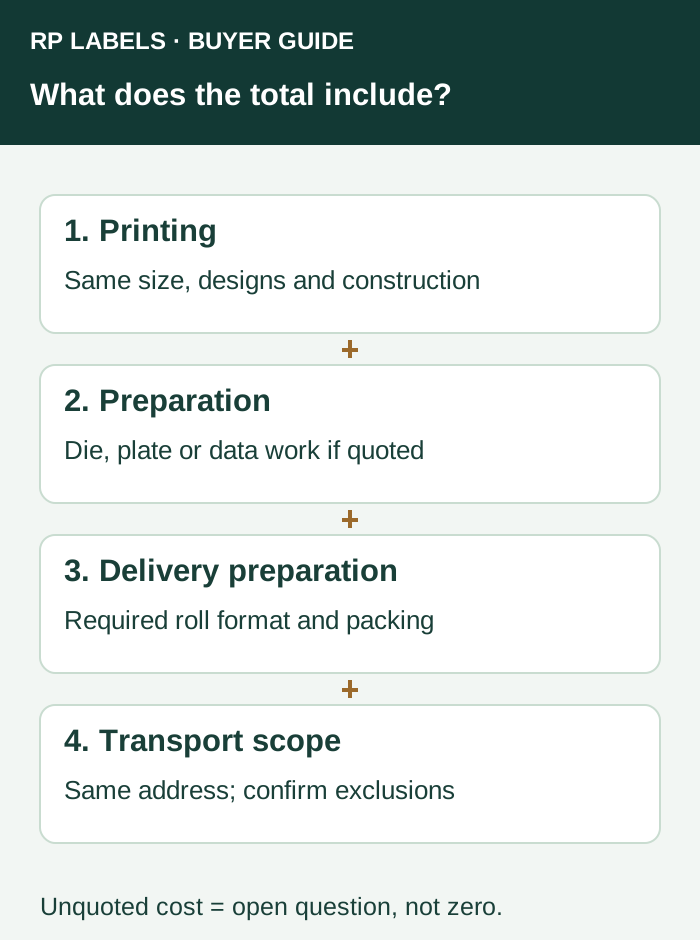
Give both suppliers one order reference
Start with the actual container, finished label dimensions, approved artwork revision and quantity per design. State the proposed material construction, print and finish, along with hand or machine application. For rolls, include the core, maximum outside diameter, unwind and the packer's other requirements. A lower quotation for a different material or a roll requiring additional work is an alternative proposal; record that difference before treating the prices as comparable.
For a research-vial label, identify white-ink areas, any later batch field and the actual use conditions. For supplement bottles, include the approved copy and SKU split. For a hologram seal, specify whether the quote covers printing on an existing optical pattern or originating a new design, plus the required seal construction and any variable data. These are different production inputs, even if the finished labels have the same size.
Avery's quotation guidance asks for artwork, number of designs, quantities per design, material, finish and unwind for custom-shape roll enquiries. Its process illustrates why a specification matters; its prices and conditions do not establish RP's offer. If the unresolved question is material equivalence, use the separate construction comparison guide first.
Separate four cost layers
Printing and conversion: record the ordered quantity by design, material, ink and finish, label shape and supplied format. Ask whether stated quantities include any agreed production variation, and whether the unit price applies to each SKU or the combined order.
Preparation: identify any die, plate, optical origination, artwork or data-preparation charge. Ask which items apply again on an unchanged reorder, and which changes create new charges. A bundled total can be acceptable if the supplier explains its scope. The plate and die guide covers the separate reuse and ownership questions.
Required delivery preparation: identify any rewinding, split-roll allocation, special packing or other work needed to match the receiving line. Do not add a hypothetical charge where the supplier already includes that work. Equally, a service that is necessary for the agreed order should not disappear from the comparison because it is supplied separately.
Transport and destination scope: give the full destination and ask what the shipping line includes, which costs remain with the buyer, and when the quotation expires. Keep transit estimates separate from production time. Tax, customs and delivery responsibilities should be confirmed in the actual written offer; this guide supplies no country-specific charge or trade-term interpretation.
A lower print price can lead to a higher order total
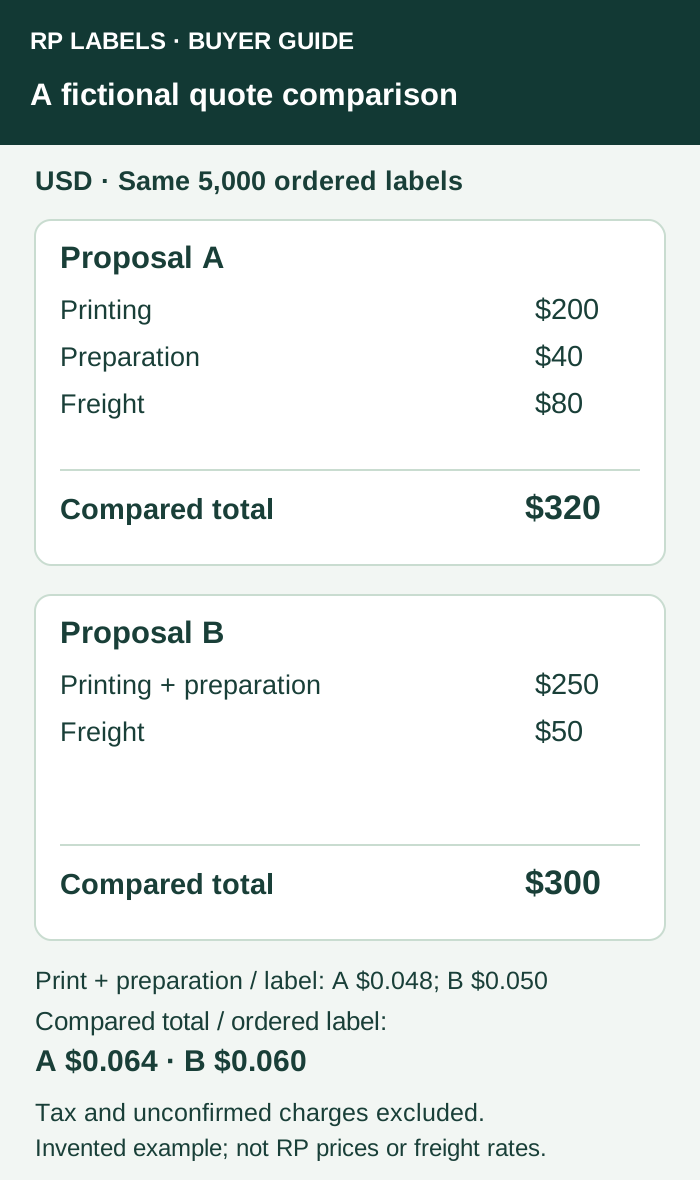
Consider a fictional order of 5,000 labels using an identical approved specification. Proposal A lists printing at $200, preparation at $40 and freight at $80: the stated total is $320. Proposal B lists $250 for printing with preparation included, plus $50 freight: the stated total is $300. A's $0.040 printing rate excludes preparation, while B's $0.050 rate includes it. Add preparation to A and both pre-freight rates become $0.048 and $0.050 respectively; after the stated freight, their compared totals are $0.064 and $0.060 per ordered label.
These invented amounts demonstrate arithmetic only. They are not RP prices, current freight rates or a complete landed-cost estimate. Both examples assume the same quantity, destination, currency and confirmed scope; any tax or other unconfirmed charge remains outside the conclusion. Do not declare B cheaper for an actual order until those fields are resolved.
The denominator matters too. If a supplier's minimum changes the quantity you must buy, calculate the cash commitment and surplus by SKU before dividing. Do not use ordered labels as a claim that every label has passed inspection or will be consumed. The low-MOQ quantity guide covers why an inexpensive extra run can still be the wrong purchase.
Use a short comparison record that leads to an answer
For each offer, record: supplier and quote date; currency and validity; order reference and exceptions; pieces per SKU; print subtotal; preparation; required finishing and packing; transport destination and amount; remaining buyer-paid or unknown items; stated total; and person responsible for closing each open field. Mark an amount as included only when the quotation confirms that inclusion.
Send a focused clarification: “Please quote 5,000 labels against specification R2, including the stated roll format and delivery to this address. Identify preparation, freight and any exclusions, and show what changes for an unchanged reorder.” Replace the fictional quantity and reference with your actual project. If a cheaper alternative changes the material or finish, request a separate line so the brand can decide whether that change meets its needs.
Choose for the order you can actually approve
A simpler finish or a locally completed step may be sensible when the buyer has the equipment, evidence and capacity to manage it. A more inclusive offer may be useful when it removes work the packer cannot perform. Include the actual confirmed extra cost and responsibility; avoid inventing downtime savings or assigning an arbitrary risk premium.
For an RP Labels quote, send the container photo or drawing, label dimensions, artwork and pieces per design, proposed material and finish, application format, delivery address and required date. Ask for any preparation and delivery exclusions to be stated. Use the quote planner to prepare the brief, then send artwork and photos through the existing email or WhatsApp enquiry route. RP must confirm the actual quotation and availability for your project.
Sources and scope
Reviewed November 3, 2026. Demand layer: Avery’s quotation guidance is a competitor process illustration. It may show which specification fields buyers are asked for. It does not supply RP minimums, lead times, prices, certifications or materials. Authority layer: RP shipping information and the quote planner say what to confirm on a written quote. They are not a standing price list or lead-time promise. The only published RP production-run figures on this site are the March 2026 proforma example on the About page, and that example is one run, not a catalog. The worked totals in this guide are fictional arithmetic, not a customer case, RP price, freight rate or customs estimate.