Label Roll Leaders and Trailers: Agree the Setup Material Before Finishing
A roll can have the right core and winding direction while still being awkward to start. The operator may need exposed liner for threading, labels for calibration or a defined arrangement near the core at the end. Before finishing the order, ask the actual equipment owner what the leading and trailing sections must contain.
Specify that requirement separately from the count of usable labels. Blank carrier is not a printed label. Printed labels consumed during setup are a different quantity again. Keeping those three things distinct lets purchasing understand what the roll will deliver to the packing operation.
Identify the loading route and operating mode
Ask the packer to identify the printer, applicator, dispenser or combined route and the operating mode used for this job. A thermal-transfer printer in peel-off mode can need a different loading arrangement from a manual bench dispenser. Refer to the equipment owner's accepted procedure rather than copying a supplier's convenient default.
cab's MACH 4S instructions, for example, describe removing labels from a starting section when loading in peel-off mode and then synchronizing the machine. That is an equipment-specific procedure, not an RP leader length. It illustrates why the loading mode should be known before the converter confirms the delivered roll.
Have the line owner say whether it wants blank liner supplied, intact labels it will remove itself, or another accepted arrangement. Ask how much is required and in what units, using the actual manual and process. The converter should confirm what can be supplied without introducing an unapproved joint or incompatible carrier.
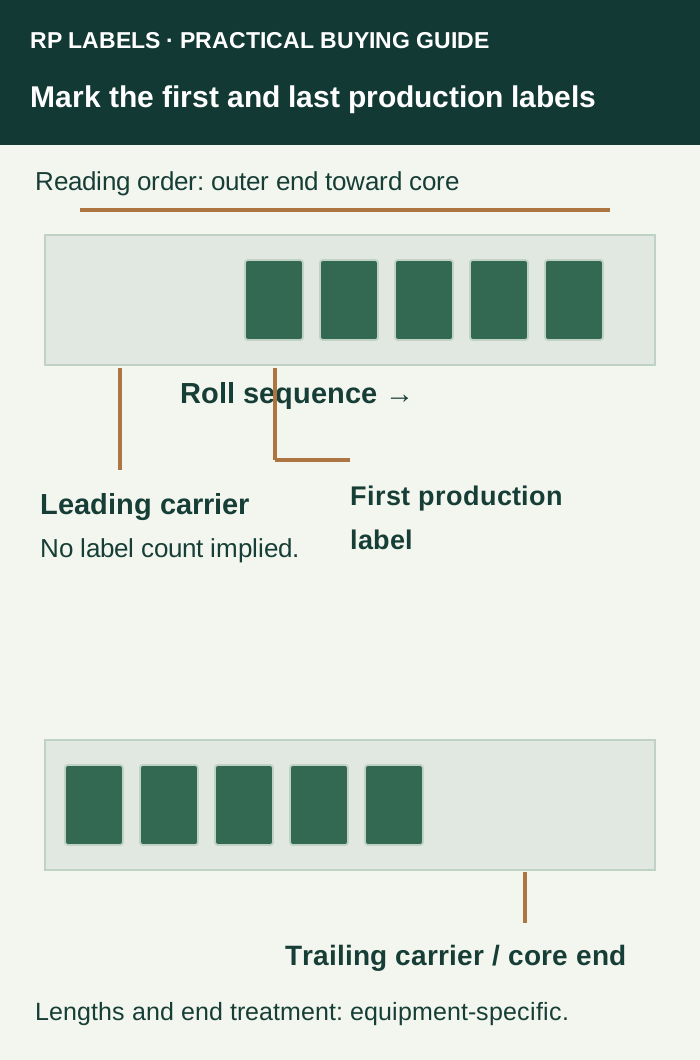
Draw the first and last production labels
Use a strip drawing with the feed direction marked. Identify the outer leading end, any nonproduction section, the first intended production label, the last intended production label and the carrier toward the core. State which side of the carrier is shown.
Confirm any trailing requirement and core attachment with the equipment owner. Do not prescribe an improvised tape, loose tail or end treatment that could interfere with sensors or the web path. The operator needs an agreed way to stop and change rolls before the carrier arrangement becomes an unexpected event.
Keep this map with the unwind drawing and core and diameter brief. The starting end is a position on that agreed roll, not a second way to redefine the winding direction.
Count setup consumption separately
Suppose a fictional manual process needs 1,000 accepted applied labels. The buyer estimates that its actual setup and checking procedure will consume 20 additional labels, for a planning pool of 1,020. The operator's blank carrier requirement is recorded separately as an equipment-derived length. Neither value is an RP default or a recommended waste allowance.
A delivery of 1,000 printed labels plus blank liner does not satisfy the proposed pool of 1,020. Conversely, counting blank liner as extra “pieces” conceals the shortage. Have the supplier state what its finished-label quantity includes and what the packer expects to consume.
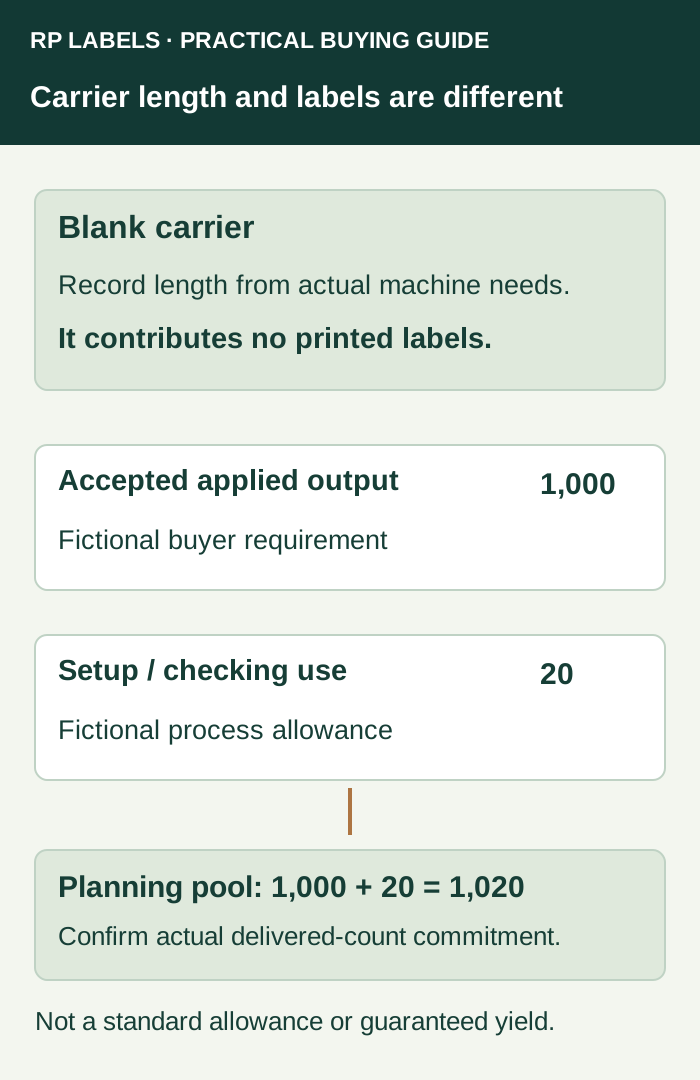
The quantity-agreement guide addresses minimum delivery and permitted variation. This drawing defines the physical start and end sections so the same quantity does not mean different things to the converter and operator.
Serialized or preassigned data needs an extra boundary
If the labels carry controlled serials or preassigned lot data, identify what may be consumed during threading and synchronization. Do not use live identifiers as disposable setup material without the data owner's agreed handling rule.
Dummy setup artwork may be appropriate if the converter and line owner accept it, but its physical or data differences must be understood. If production identifiers are consumed, record their status and disposition through the agreed reconciliation process. A clean first accepted label does not account for the labels removed before it.
Approve the handoff before all rolls are finished
Ask for a representative finished section or roll arrangement where the project needs one. The line owner checks loading and start/stop behavior under its equipment procedure. The buyer and converter confirm whether the agreed beginning and ending arrangement is included on each roll, including short or partial rolls.
If the roll count changes, revisit the setup allowance: more roll changes can create more startup work. Keep that trade-off visible when comparing labels per roll. A smaller roll may fit the machine better while requiring a different label pool for the same accepted output.
For vial labels or supplement labels, prepare an RP inquiry with the machine brief, feed drawing, quantity per design and equipment owner's leader/trailer requirement. Ask the converter to confirm the delivered start/end arrangement and count basis before finishing the batch.