Why Label Freight Can Exceed the Scale Weight: Check the Packed Cartons
A label shipment can weigh 8 kg on a scale and still be quoted on a 12 kg weight basis. Before disputing the freight line, ask for the sealed carton's outside dimensions and the carrier's charging rule. Express services can compare actual weight with a dimensional weight based on the space the package occupies.
The purchasing decision is whether the quote uses the correct packed measurements and agreed service. A lower-weight label material will not necessarily lower freight if the packed volume remains the governing measure. Reducing protection merely to make the carton smaller can create a different cost problem at receipt.
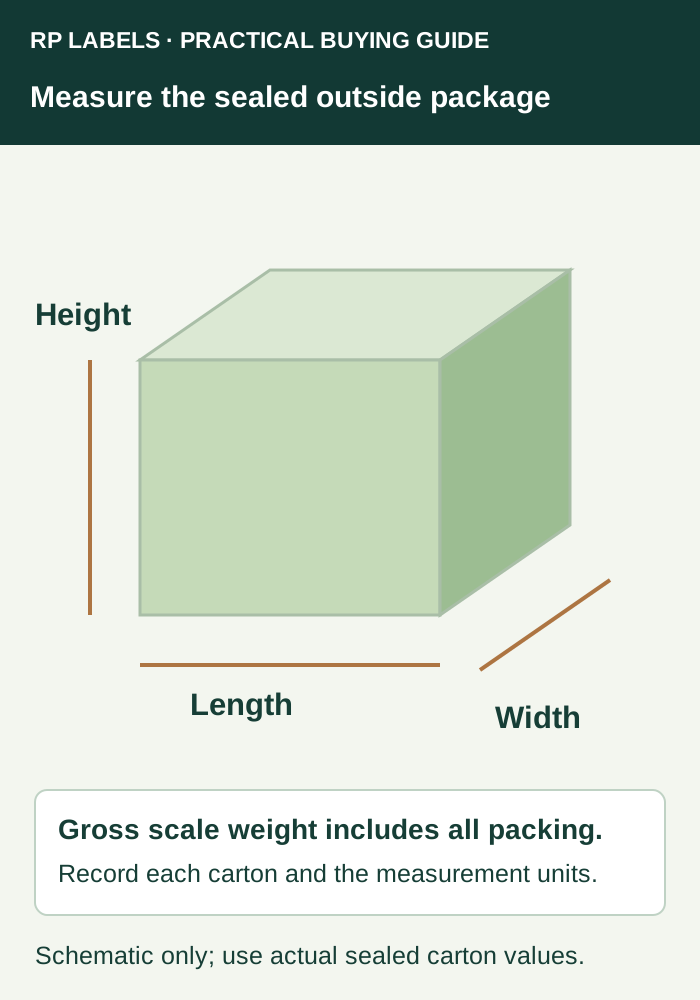
Ask for gross weight and external dimensions
Record the carton identifier, outer length, width and height, units and packed gross weight. Include the carton, cores and protective material in the scale weight, rather than using the net weight of labels alone. Identify whether the measurements are an early estimate or the final sealed pack.
DHL's carton-measurement guidance explains why outside measurements matter and why bulges or projecting areas can affect the measured size. For the actual service, ask how the carrier measures and rounds dimensions and weight. Keep that basis with the quote.
For several cartons, obtain a line for each package or an identified group of genuinely identical packages. A single combined cubic volume can hide different actual-versus-dimensional comparisons between cartons.
Use the carrier's divisor, not a universal formula
DHL UK's Express explanation uses length × width × height in centimeters divided by 5,000, giving a dimensional weight in kilograms. It compares that with actual weight and uses the greater basis, calculated separately for multiple packages.
That is the stated service example used below. Confirm the applicable rule for the quoted origin, destination, carrier and service. Do not apply the same divisor or rounding to every express, air, road or sea quotation. A freight estimate also needs its validity and charge scope.
Work the comparison carton by carton
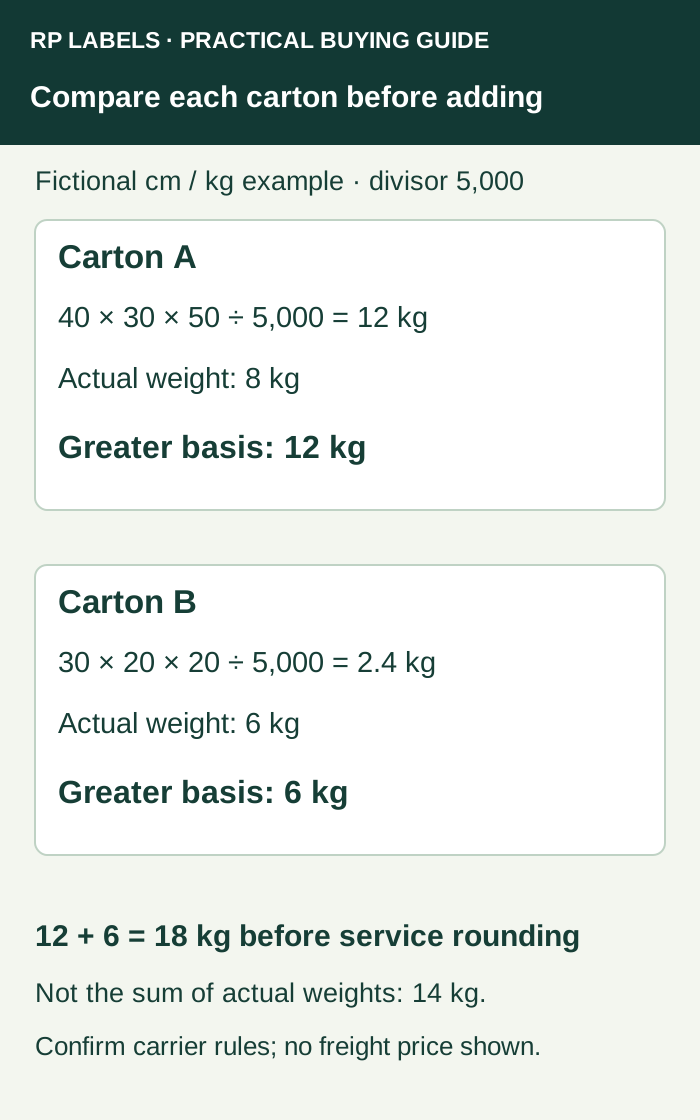
Consider two fictional label cartons using that 5,000 divisor, before any service-specific rounding. Carton A measures 40 × 30 × 50 cm and weighs 8 kg. Its dimensional weight is 12 kg, so the greater basis is 12 kg. Carton B measures 30 × 20 × 20 cm and weighs 6 kg. Its dimensional weight is 2.4 kg, so its greater basis is 6 kg.
The sum of those bases is 18 kg. Taking only the combined actual weight of 14 kg, or comparing that with the combined dimensional figure of 14.4 kg, misses the per-carton comparison. These are arithmetic examples, not a shipment quote, a rate or an RP order.
Compare a packing alternative without changing the order silently
If volume governs the quote, ask whether the converter can propose a more compact arrangement that still protects the rolls and preserves the packer's required format. A different carton layout may be worth considering. So may combining compatible designs in one shipment when the delivery plan permits it.
Do not reduce a required core, exceed an accepted roll diameter or remove necessary edge protection to pursue a smaller box. Those changes can affect machine fit and receiving condition. The packing and evidence guide covers the protection discussion; the machine-roll brief controls the finished rolls inside.
Ask the supplier to return the revised carton count, external dimensions and weights, and obtain the corresponding freight comparison. A smaller package is not automatically cheaper if the service, surcharges or number of pieces changes.
Read the charge scope after the weight basis
A correct 18 kg basis does not establish the total price. Confirm the currency, service, destination, charge validity, fuel or other applicable surcharges, and any collection or delivery exceptions. Keep import duties and taxes separate unless the accepted delivery arrangement explicitly includes them.
The delivery-scope guide addresses responsibility and the delivery point. The document check connects carton references to what is shipped. A freight weight calculation is only one part of that handoff.
Prepare an RP inquiry for your supplement labels or vial labels with quantities, required roll format and destination. When freight is quoted, ask for the estimated carton count, dimensions, gross weights and applicable charging basis. Reconfirm against the final packing arrangement before dispatch.