Peel-and-Reveal Supplement Labels: Test Whether People Can Find and Use the Tab
A multilayer proof can solve the designer's space problem while leaving the reader searching for the opening tab. The extra panel earns its cost only when the intended person can reach the information and the bottle remains usable afterward. Ask somebody outside the design meeting to try it before authorizing the roll.
The designer knows exactly where the tab is because they placed it there. The customer does not have that advantage. I would hand the sample to somebody who has not seen the artwork and keep quiet for the first attempt. A small hesitation can tell the team more than another guided presentation of all the space they gained.
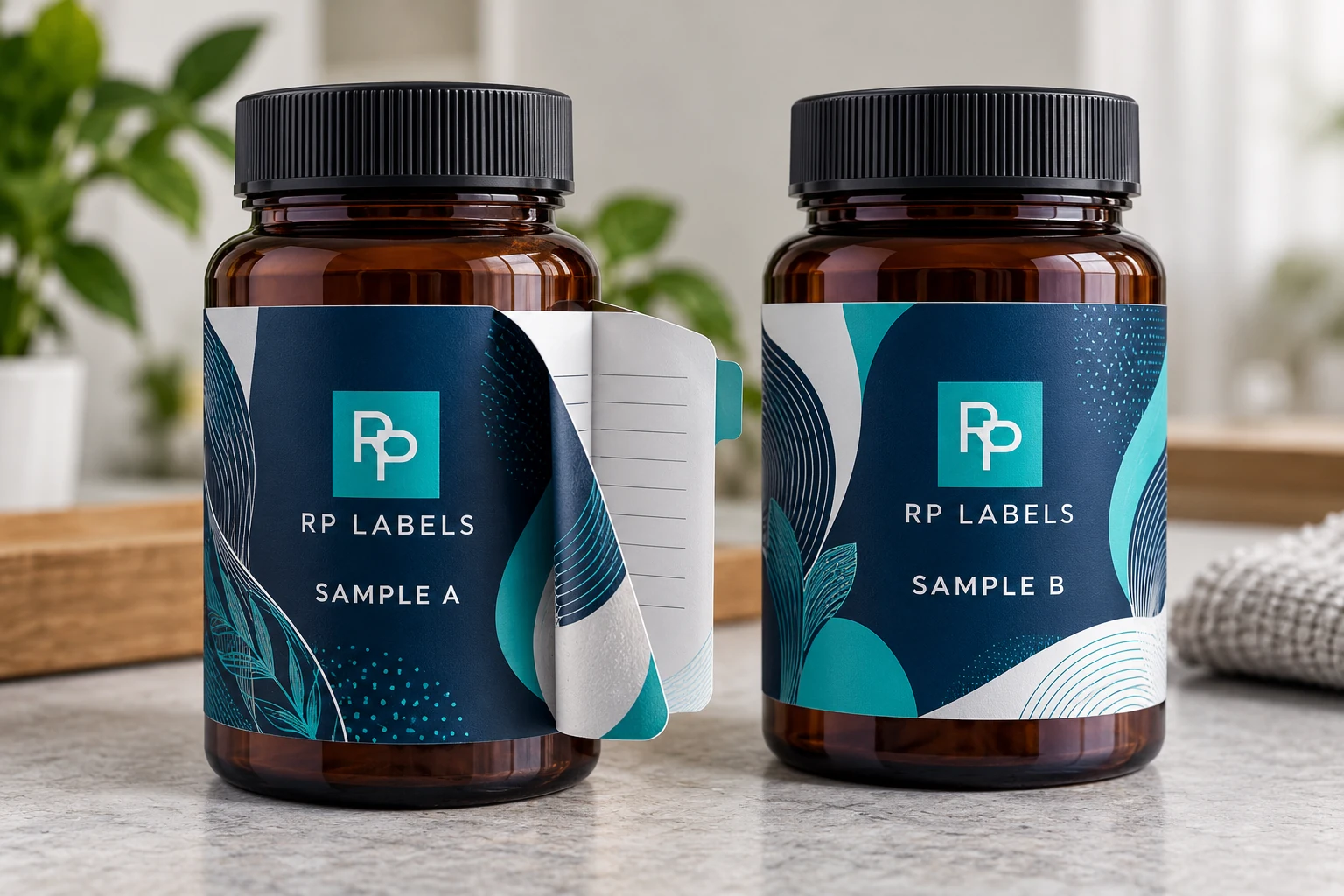
AI-generated packaging illustration. Fictional RP samples show the proposed decision; no physical test or customer order is documented.
Use a task observation instead of a guided demonstration
Define the task in neutral language: find the relevant information, open the panel and close it if reclosure is required. Do not point at the tab first. Use the actual bottle and proposed finished construction. The worked observation sheet separates finding the tab, opening the intended layer, reading the inner panel and returning the outer layer.
Record what the person does and where help becomes necessary. An instruction printed on the label may be a useful design change, but it should be tested at actual size rather than explained verbally by the designer. If the whole base label starts to lift, that is a construction concern distinct from a hard-to-find opening cue.
The copy owner still decides which information may occupy each panel for the actual product and market. A successful usability task does not approve that allocation legally. Keep the final approved copy file tied to the same panel structure so an extra language or paragraph cannot arrive after the physical design has been released.
A slightly larger container, an outer carton or a simpler single-layer layout may be a better purchase when it avoids a complex interaction. A multilayer label can make sense when the compact bottle is necessary and the additional panels serve a clear task. The comparison should include application and use, not just available square centimeters.
Send RP Labels the bottle, final panel copy, intended opening/reclosure behavior and the observations still unresolved. Ask what construction and sample scope can be quoted. The accepted reference should show both the outer appearance and the actual user action, so a repeat order preserves more than a flat cover design.
What a peel-and-reveal label actually changes
| Printable area | Adds one or more panels for extended information without increasing the bottle diameter. |
|---|---|
| Construction | Adds material layers, a hinge or fold, release behavior and a defined opening tab. |
| User action | Requires the customer or operator to notice, open and sometimes reseal the label. |
| Application | Changes thickness, stiffness and dispensing behavior compared with a standard pressure-sensitive label. |
| Cost | Adds printing and converting steps, which should be compared with other packaging options rather than a basic label alone. |
The crowded 60-count bottle and the multilingual launch
Consider a hypothetical buyer with a familiar supplement bottle and an information panel that almost fits. The design team responds by tightening the type, narrowing the spacing and moving the barcode into a corner. A peel-and-reveal label may solve the space problem, but an outer carton or slightly larger bottle may be simpler and easier to apply. Multilayer is an option, not a trophy.
A different hypothetical buyer needs several language panels for one regional launch. The front identity remains consistent while the extended copy changes by market. A carefully planned peel-and-reveal construction can keep the bottle compact and organize the copy better than a dense wrap. The value is not merely more words; it is a clearer information architecture.
The first buyer may be paying for complexity to avoid changing a bottle. The second may be paying for complexity to reduce several other packaging components. Same label mechanism, different arithmetic.
Decide what stays outside
The outer panel is not decoration wrapped around an instruction manual. It remains the quickest point of recognition and the only panel some users will ever see. Brand and product identity, opening cues and information that must remain immediately available need deliberate placement.
The exact regulatory allocation depends on product, market and applicable rules. The printer can support layout and printability but should not invent the compliance plan. Ask a qualified reviewer to approve the final copy and panel placement before production.
Buying rule: move secondary detail inside to protect readability; do not hide primary identity or frequently needed information simply because the inner panel has space.
The opening tab is part of the artwork
A peel tab needs enough size and contrast to be found and used. Its position should make sense when the bottle faces forward. If the customer has to rotate the bottle twice and scrape an edge with a fingernail, the mechanism has already spent the goodwill it was supposed to create.
The tab also affects the visual layout. Do not put a critical word under it or let a decorative shape disguise it. Opening arrows and instructions should be simple, tested at actual size and translated where required.
Reseal, removal and bottle curve
Some labels need to open once. Others should reseal through repeated consultation. Define the expected number of opening cycles and the required appearance afterward. Oils, dust, moisture and handling can change reseal performance.
On a curved bottle, the outer layer carries its own stiffness and memory. A construction that behaves well on a broad jar may resist lying flat on a narrow bottle. The hinge, tab and closing edge should avoid shoulder and base radii where contact becomes unstable.
Automatic application needs an equipment trial
A multilayer label is thicker and can dispense differently from a standard roll label. Confirm core, roll diameter, web width, gap, winding, liner stiffness and sensor behavior. The applicator must also press the construction evenly without catching the tab.
A slow hand-applied sample proves the label can stick. It does not prove the roll can unwind, peel from the liner and land squarely at production speed. Send the equipment specification before the label is engineered, not after the finished rolls arrive.
How to approve a peel-and-reveal sample
- Apply the sample to the production bottle and check the front panel position.
- Ask a person who has not seen the design to find and open the tab.
- Read every inner panel at normal distance and light.
- Open and reseal it for the planned number of cycles.
- Run expected humidity, handling, shipping and shelf tests.
- Check that barcodes, dates and variable fields remain accessible.
- Trial the final roll construction on the intended applicator where applicable.
Worked peel reveal access record
The rows below are hypothetical planning examples. Empty observation or commercial fields must be completed from the actual project; no sample has been tested for this article. Use the worked CSV and blank worksheet with the field guide. Keep the example references separate from production records.
| sample reference | task | prompt given | observed action | help needed | construction issue | review owner | next action |
|---|---|---|---|---|---|---|---|
| DEMO-BOOKLET | Find and open information | Neutral task only | Usability owner | PENDING | |||
| DEMO-BOOKLET | Read then reclose if required | Actual intended use | Packaging owner | PENDING |
Bring this decision into the print inquiry
Contact RP Labels with the completed peel reveal access record, the actual packaging reference, approved artwork and quantity per design. State which fields remain unresolved so the print specification and any relevant sample scope can be discussed against the same decision.
Related buying guidance: Custom supplement labels; Supplement Facts on small bottles; Packaging checklist; Materials and finishes.