Detachable Vial Label Tabs: Reconcile the Vial, Tab and Receiving Record
A tab peels neatly from the vial and sticks to a record card. That is a useful mechanical result. It does not yet show whether the card identifies the right vial after several tabs are removed together. The purchase needs an identity exercise as well as a peel demonstration.
The person filling the record would like less transcription. The person picking up the vial later still needs a reliable identity. I would put those two tasks in the same sample review. The tab earns its converting cost when it makes the handoff easier without making the remaining bottle harder to understand.
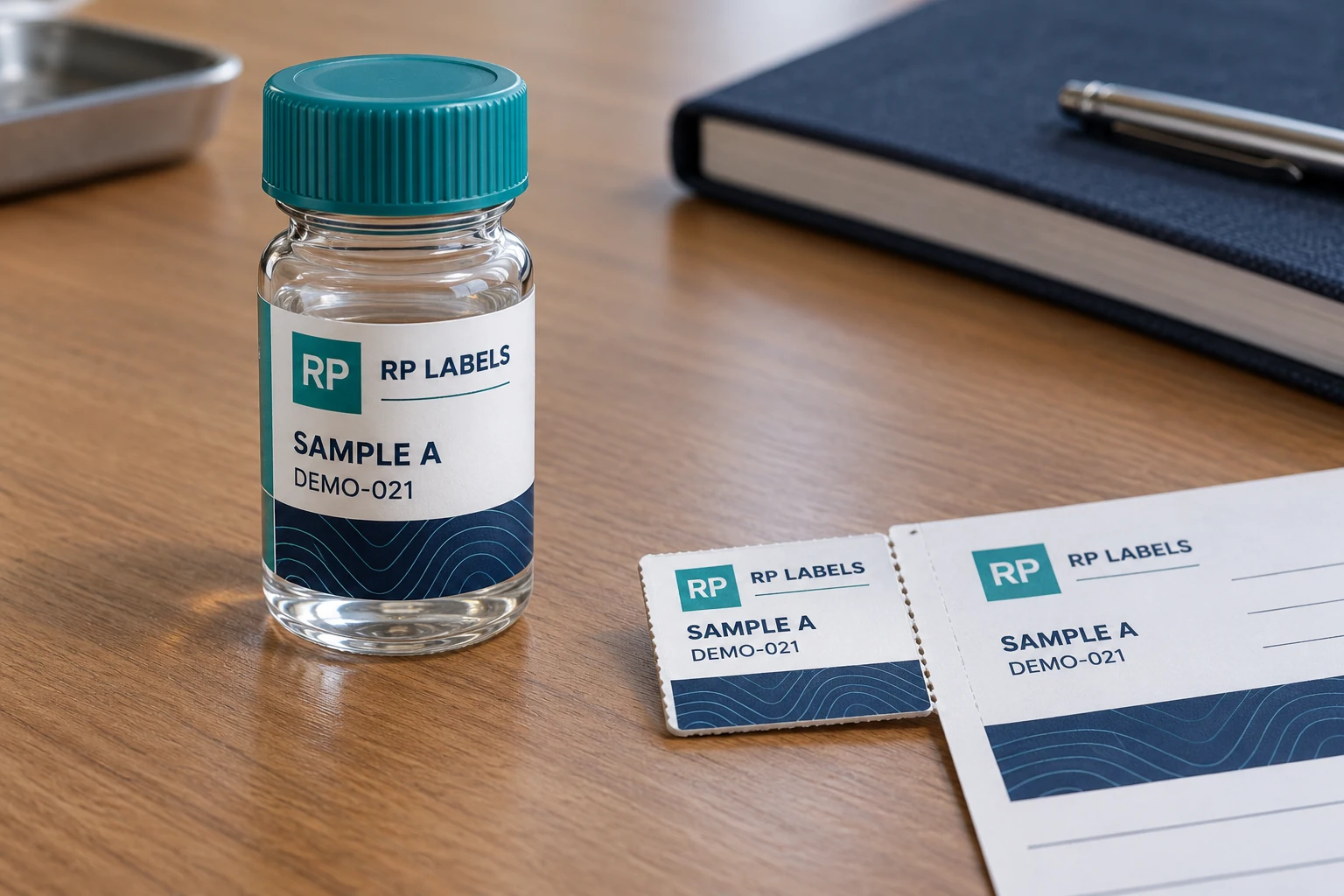
AI-generated packaging illustration. Fictional RP samples show the proposed decision; no physical test or customer order is documented.
Keep three references in the same proof
Write the stay-on-vial fields, transferable fields and receiving-record fields side by side. State whether the relationship is by batch, sample or individual unit. A repeated batch value must not be described as a unique unit identifier. If the tab uses a short reference, the process owner should define how it resolves back to the retained vial information.
The worked reconciliation record uses two dummy identifiers and an unresolved destination record. Apply the actual sample labels, detach the tabs through the intended action and place them on the intended surface. Review both adhesion actions and the legibility of what remains. The tab must not remove the only usable identity from the vial.
Then mix the sample positions and ask another operator to reconcile them without memory of the design sequence. Record any ambiguity in the printed fields or the receiving-record layout. This is a proposed demonstration, not a validated traceability system or statistical test. The buyer defines any additional controls required for the real process.
A plain wrap plus controlled transcription may be adequate for a low-frequency task. A detachable tab may reduce repetitive entry where the transfer happens often and the paired identities are controlled. The extra die-cut and release construction should solve that actual task rather than decorate the bottle.
Send RP Labels the vial, destination record surface, field map, dummy data format and application sequence. Ask for the physical sample scope covering main label retention and transferred-tab behavior. Keep the accepted field map with the cut specification so the next reorder cannot change one copy without reviewing the other.
Choose what is repeated before drawing the perforation
Write the identity fields in two columns: stay-on-vial and transfer-to-record. Product name, batch or sample identifier, and any variable code should be assigned deliberately. If a record tab carries a shortened code, document how that code maps back to the vial. If the code is unique per vial, the supplier needs a data file and an agreed sequence; if it is only a batch reference, do not call it unit serialization.
HERMA's documentation-label overview explains the basic construction: parts of an applied main label can be detached and moved to another surface. Its vial-labeling application page also notes detachable documentation labels on vials. Those examples establish that the format is real, not that any off-the-shelf die cut will suit a particular research vial or record card.
Proof the peel, not just the printing
The tab must peel without pulling the whole wrap off the small glass body. It must also stick to the destination card or document. Ask for both actions to be tested after the label has been applied for a realistic amount of time. A tab that peels beautifully immediately after application may behave differently after storage; the acceptance condition needs to be specified by the buyer.
Check where the die cut runs relative to the wrap seam and the curved bottle. A narrow tear line can cut into a code, leave a sharp corner or expose an edge that catches during tray packing. Inspect the liner under the tab as well: a die that cuts too deeply may make roll dispensing unreliable. This is a converting question, not something a PDF can prove.
Keep the two copies easy to reconcile
Use a deliberately simple test set: two different product names, the longest permitted batch string, and several consecutive identifiers if variable data is planned. Apply the labels to actual vials, detach the tabs in a mixed group, and try to match each tab to the correct vial and record without relying on memory. That exercise often exposes tiny type or insufficient distinguishing information before a full roll is printed.
Send one complete purchasing brief
Provide the actual vial and cap, dimensions, intended application method, tab destination surface, stay-on and removable text, variable-data format, roll direction, expected quantities and sample acceptance steps. Ask the converter to quote the finished construction and a physical trial. A quote for a normal wrap label with a dotted line drawn in the artwork is not the same product.
I would approve the job only when someone who was not in the design meeting can remove a tab, place it on the record, and still identify the vial confidently. The point of the extra die-cut work is less transcription and fewer mix-ups, not another decorative feature on a tiny bottle.
Sources and scope
Reviewed October 6, 2026. The primary references linked below support the identified technical points. Buying scenarios and inspection checklists are editorial guidance, not RP production records, certification, legal approval or universal acceptance standards. Demand layer: competitor and process pages linked here, including Avery, HERMA or OnlineLabels where cited, illustrate buyer language and process topics only. They do not supply RP minimum quantities, lead times, prices, certifications or materials. Authority layer: an RP number is backed only by a factory datasheet, a signed quote or proforma, confirmed product data, or a fact kept on the About page. The March 2026 proforma there is one production-run example, not a standing offer. RP shipping and planning pages describe what to confirm on a quote. Worked figures on this page are fictional unless an authority source is named for them.
- HERMA: documentation and patient labels - HERMA: vial labeling and detachable documentation labels
Worked detachable tab match record
The rows below are hypothetical planning examples. Empty observation or commercial fields must be completed from the actual project; no sample has been tested for this article. Use the worked CSV and blank worksheet with the field guide. Keep the example references separate from production records.
| demo identifier | retained vial fields | detachable fields | destination record | after peel identity | match observation | owner | decision |
|---|---|---|---|---|---|---|---|
| DEMO-021 | Buyer-defined fields | Mapped repeated reference | Actual record type required | To inspect | Process owner | PENDING | |
| DEMO-022 | Buyer-defined fields | Different mapped reference | Same intended record type | To inspect | Process owner | PENDING |
Bring this decision into the print inquiry
Contact RP Labels with the completed detachable tab match record, the actual packaging reference, approved artwork and quantity per design. State which fields remain unresolved so the print specification and any relevant sample scope can be discussed against the same decision.
Related buying guidance: Peptide Vial Labels; Release variable identifiers; Check die-cut quality; Proof camera inspection.