A buyer says the vial is too small for another line of text and asks whether a little tab can stick out from the side. I would start by asking where those vials spend most of their life. On an isolated sample tube, a flag may offer a readable face. In a tightly packed tray, that same face can snag a divider, fold over another vial, or break off when someone removes the sample.
The RP Research photograph is an AI-generated construction sketch, not a finished product test. The vital identity remains on the body label in both examples. The protruding flag is an optional second identifier, never the only place where the sample name lives.
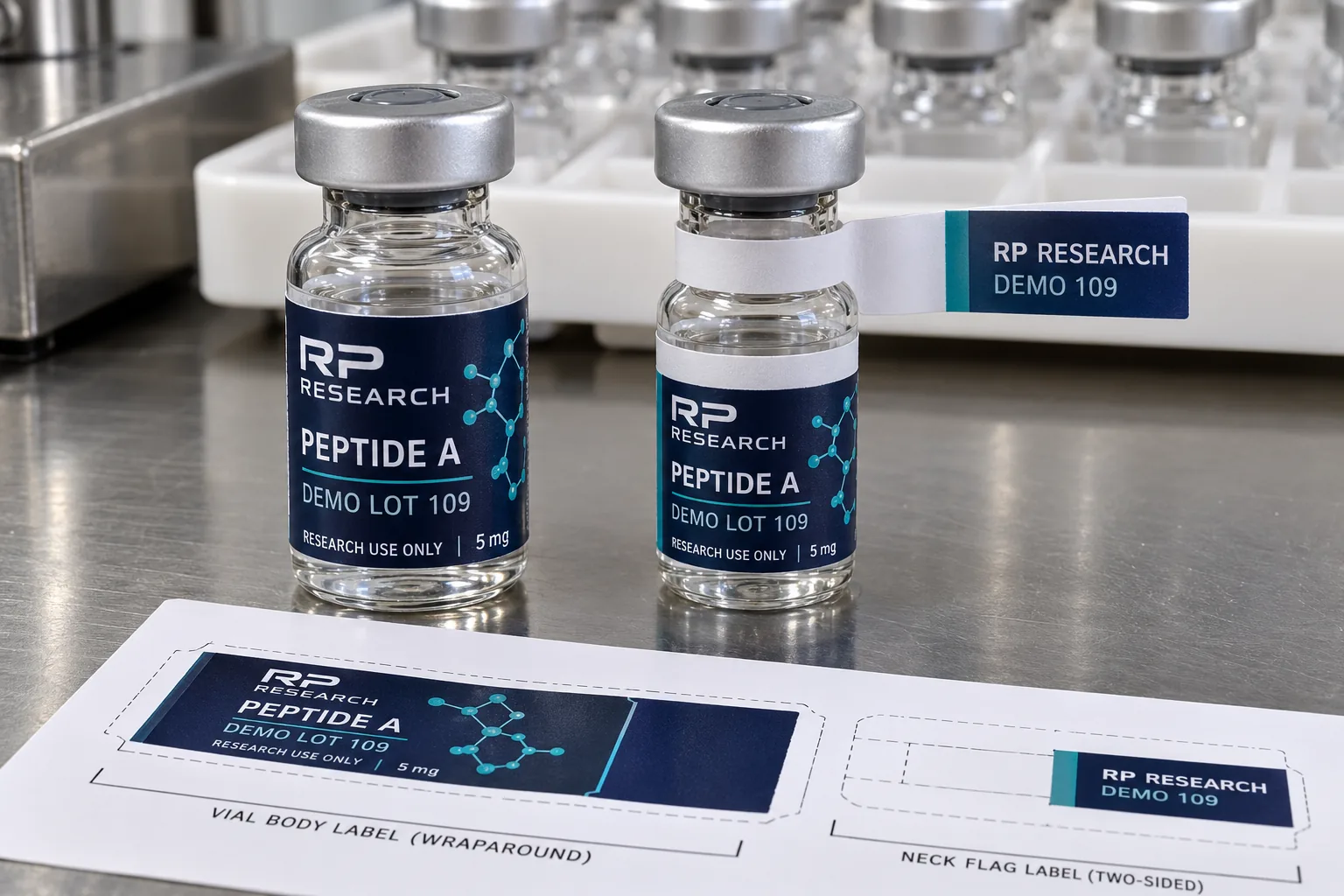
First decide whether a better wrap solves it
Measure the usable straight wall, not the total height of the container. Put the identity, lot or internal code your workflow requires in the first reading zone. The vial size chart helps define that space; it does not create extra glass. A well-edited wrap, shorter copy, or different information hierarchy may solve the job without a projecting piece.
HERMA describes wraparound labeling for small cylindrical surfaces and the need to match material and adhesive to curvature. That is a construction reference, not a guarantee that a given wrap stays on your exact research vial. I would prototype the simplest wrap first because it fits trays and routine handling more predictably.
Understand what a flag physically is
A flag has a narrow portion that attaches around the object and a printed portion that projects outside it, often made by joining two face panels. Brady's flag-label guidance shows this principle on small cylindrical cables. A glass vial is not a cable. That source explains the geometry, while the vial's cap, glass wall, tray and handling sequence all need their own proof. Do not simply buy a cable flag and assume it is suitable for a sample container.
If the flag is only a quick tray-location cue, keep the body label fully usable when the flag is damaged or removed. If the customer wants extra mandatory information on the flag, escalate that placement decision to the relevant quality or regulatory reviewer before art approval.
Run the tray test before discussing material options
Apply a printed prototype to the actual vial. Then fill the exact tray, close it, move it through the normal packing motion and pull vials out one at a time. Does the flag hit the cap of a neighboring vial? Does it bend toward the glass and hide its own code? Does its adhesive tail lift at the narrow neck? Repeat with several operators. A single clean studio photograph proves none of this.
Check the tray-friction scenario separately from print legibility. A flag can look large enough to read and still be a poor purchase if the customer's packing path treats it as a handle. Ask whether the packing arrangement could be changed instead, or whether an outer tray index gives the required top-level identification more safely.
What belongs in the purchase brief
Send the exact vial and cap, filled tray, usable glass-wall measurements, minimum readable code, artwork versions, application method and quantity per design. Ask for a full-size die-line and a small set of physical samples. Specify whether the flag is an auxiliary identifier or must survive repeated handling, and who decides when a sample is rejected.
I would order a normal body wrap when it meets the reading task. I would buy the flag only after the physical tray test shows an actual advantage and acceptable snag behavior. A larger print area is not an improvement if it creates an unreliable component on every vial.
Sources and scope
Reviewed October 9, 2026. The primary references linked below support the identified technical points. Buying scenarios and inspection checklists are editorial guidance, not RP production records, certification, legal approval or universal acceptance standards. Demand layer: competitor and process pages linked here, including Avery, HERMA or OnlineLabels where cited, illustrate buyer language and process topics only. They do not supply RP minimum quantities, lead times, prices, certifications or materials. Authority layer: an RP number is backed only by a factory datasheet, a signed quote or proforma, confirmed product data, or a fact kept on the About page. The March 2026 proforma there is one production-run example, not a standing offer. RP shipping and planning pages describe what to confirm on a quote. Worked figures on this page are fictional unless an authority source is named for them.