The usual request sounds simple: "We have too much information for a 2 mL vial. Can you add a second layer?" I would not approve the extra layer until I knew what must remain visible while the label is closed. A peel-back construction creates room, but the person holding the vial should not have to open a flap to discover which sample it is.
For a research-only vial, start with a field inventory. Put product or sample identity, the buyer's required lot or internal reference, and any essential handling identifier in a closed-state column. Put additional process notes, language variants, or a longer reference in an inside-panel column. This is an editorial layout exercise, not a regulatory determination. Ask your own quality or regulatory team which fields are necessary for your actual market and use.
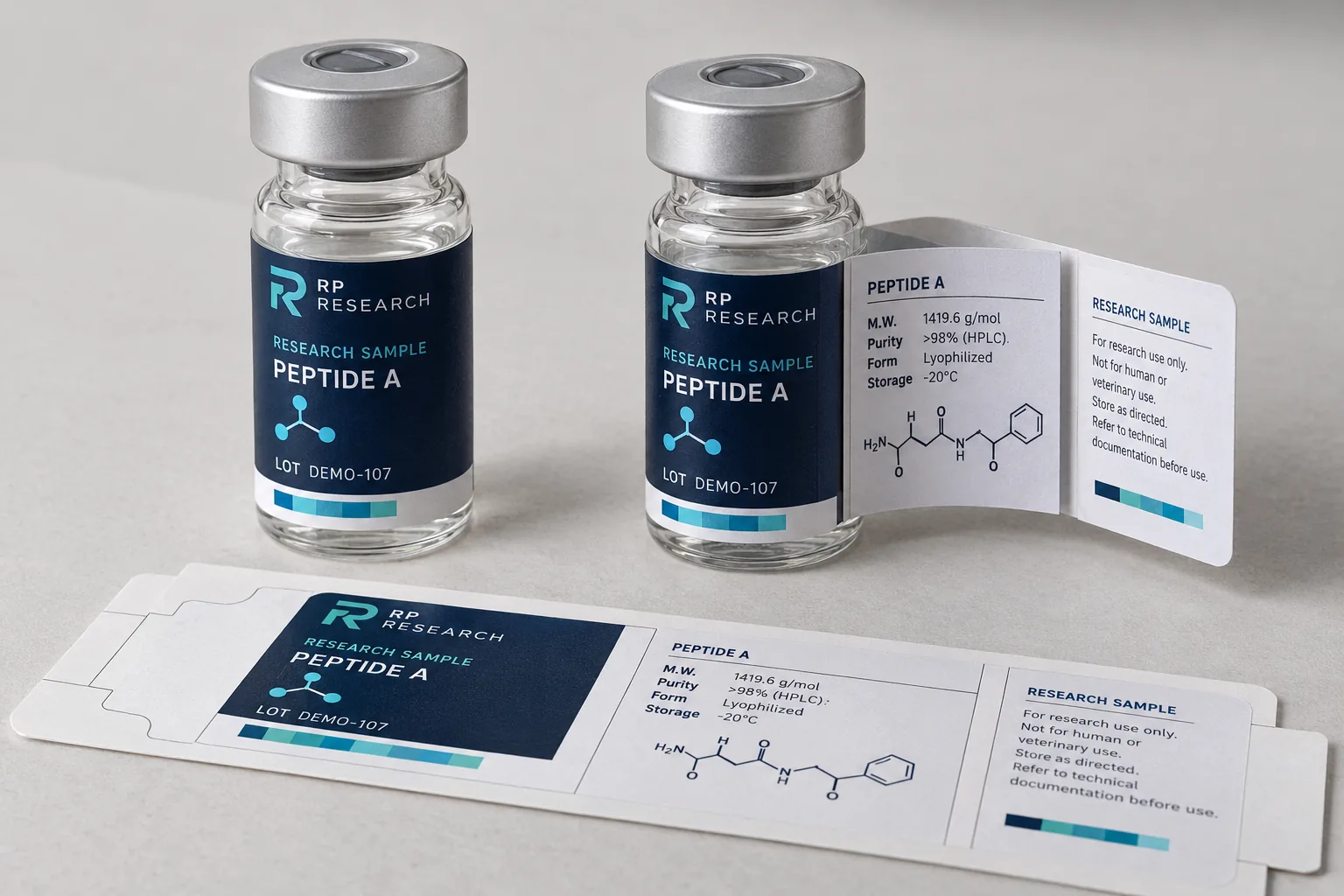
Decide whether a second layer earns its space
A basic wrap costs less to explain, apply and inspect. A peel-back label adds a hinge, an opening edge, a reseal area and extra material thickness. Avery Dennison's multilayer overview describes hinged constructions with two or three printed layers and notes that material choice affects converting and dispensing. That supports the format's feasibility; it does not prove that a particular construction will stay closed on your small glass vial.
I would use the second layer only for information that genuinely belongs on the container. If the extra copy is primarily sales language or a document that will be revised frequently, a carton insert or linked online document may be simpler. Conversely, if the inside information must travel with every vial and be consulted at the point of use, the additional converting work may be worthwhile. The decision belongs to the use case, not to the amount of white space in the artwork file.
Keep a permanent identity on the base
Place the hinge and opening tab away from the main identity and any scan target. Close the label in the drawing and mark what is visible from the normal viewing angle. Then open it and mark what stays attached to the glass. Do not assume that a printed outer flap is the same as a permanent base: the flap can be lifted, torn or left open. The small vial must still be recognizable in the least tidy real-world state.
Check whether the peel-back edge approaches the glass curvature, the cap skirt or the viewing window. HERMA's curved-surface guidance explains why small radii challenge both face material and adhesive. The correct response is a physical sample on the actual vial, not an unqualified claim that one adhesive works on every surface.
Test the opening and closing sequence
Ask for a printed prototype with the maximum inside copy, not a blank construction. Have someone open it with the gloves and hand position used in the intended setting. Can they find the tab? Does the top layer curl, catch a neighboring vial in a tray, or cover the lot when it is resealed? Can it close again without obscuring the original identity? A second-layer design that works for one demonstration opening is different from one that remains understandable after handling.
Inspect the stack in the packaging path. A thicker label can change how closely vials sit in a divider and how the roll dispenses. If there is machine application, give the converter the applicator model, unwind direction, liner specification and target speed. If application is by hand, show the person who will apply it where to start and where the seam finishes. Do not quote a complex label against the assumptions for a normal single-layer roll.
Send a brief that can be priced accurately
Provide the exact vial and cap, usable straight-wall height, closed-state fields, inside copy, opening direction, expected number of openings, application method and quantity per artwork. Include a photo of the vial in its tray or carton. Request a construction proof and state what would make you reject it: obscured identity, flap lift, difficult opening, misaligned text or failed dispensing. Keep the approved physical sample beside the final digital artwork when you reorder.
The photograph above is an AI-generated RP Research example; its chemical-looking details and DEMO lot are fictional, not a tested formulation or approved print file. I would buy this format only after the label remains readable both closed and open on the actual container. If the second layer solves no real retrieval problem, a clean custom vial wrap is the better order.
Sources and scope
Reviewed October 7, 2026. The primary references linked below support the identified technical points. Buying scenarios and inspection checklists are editorial guidance, not RP production records, certification, legal approval or universal acceptance standards. Demand layer: competitor and process pages linked here, including Avery, HERMA or OnlineLabels where cited, illustrate buyer language and process topics only. They do not supply RP minimum quantities, lead times, prices, certifications or materials. Authority layer: an RP number is backed only by a factory datasheet, a signed quote or proforma, confirmed product data, or a fact kept on the About page. The March 2026 proforma there is one production-run example, not a standing offer. RP shipping and planning pages describe what to confirm on a quote. Worked figures on this page are fictional unless an authority source is named for them.