Small Vial Label Films: Compare the Finished Wrap Before Choosing a Micron Number
The proposed film is thinner. The loose sample bends easily, and the supplier expects it to suit a narrow vial. Purchasing would like that to settle the material question. The packer still needs to know whether the finished label will leave its liner and land correctly.
Those are two different observations. In this hypothetical comparison, one candidate is supplied as a loose printed sample and the other as a finished roll. Calling one “more conformable” before comparing equivalent evidence can turn a sensible material discussion into a guess.
I would choose between identified finished constructions, with separate records for the applied wrap and the planned dispensing method. A face-film thickness is useful specification data. It cannot stand in for the rest of the label or either review.
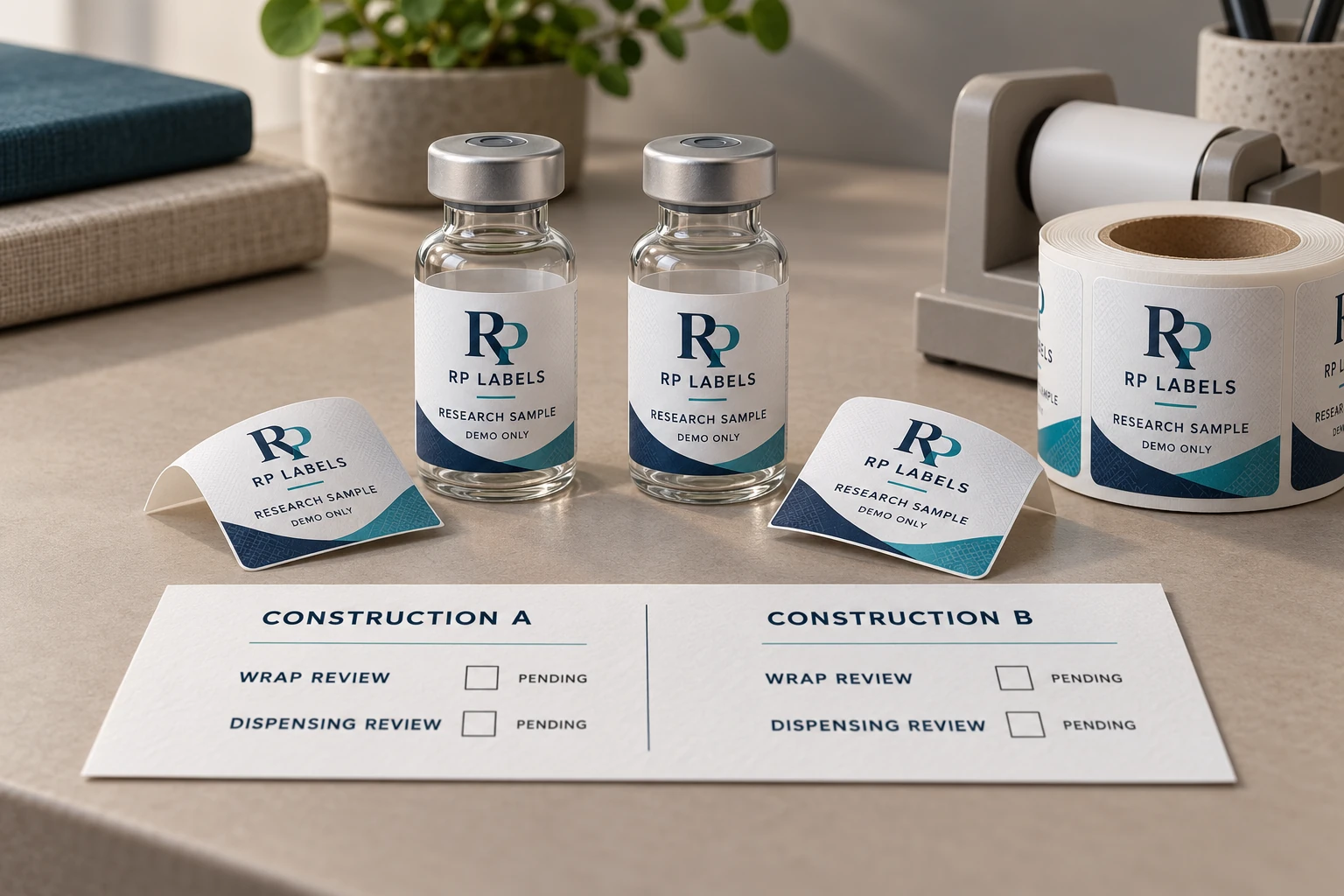
AI-generated packaging illustration. The RP samples depict a proposed comparison. No edge-retention, dispensing or customer performance result is shown.
Find out which part of the label the number describes
Ask the converter whether the quoted thickness refers to the face film, a protective laminate or another stated component. Request the identified face, adhesive, print and protective finish, along with the liner used for the proposed application. Preserve the references rather than recording only “thin clear film.”
The liner matters to delivery and dispensing, but it does not remain on the vial after application. Keep it visible in the specification without confusing it with the applied stack. Likewise, a loose unprinted film does not represent every property of a finished printed and protected sample.
HERMA's curved-surface guidance describes flexible label material and a suitable adhesive as joint requirements for small radii. That supports evaluating their combination. It does not establish that a particular thickness or RP construction will work on the buyer's vial.
If the supplier changes several components between candidates, record all of them. You can compare two complete proposals and select one for a defined use. You cannot then attribute any observed difference solely to face-film thickness.
Convert the unit only after identifying the layer
A quote saying “2 mil” cannot be compared with another saying “50 microns” until both describe the same component or stack. A mil is one thousandth of an inch. Using NIST’s exact 25.4 mm definition of the inch, 1 mil equals 0.0254 mm or 25.4 µm. Therefore 2 mil equals 50.8 µm. The arithmetic is exact; the actual material still has its own specification and variation.
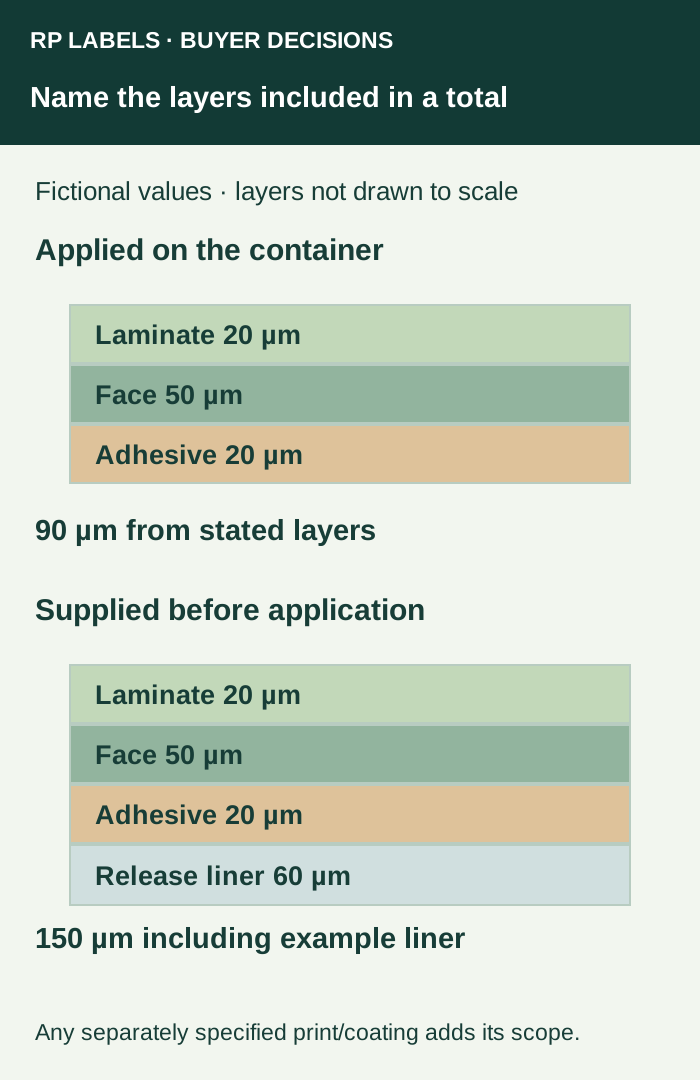
Suppose, only for illustration, a proposal identifies 50 µm face film, 20 µm adhesive and 20 µm laminate. Those stated components total 90 µm on the container, before any additional specified contribution. A separate 60 µm release liner gives 150 µm in the supplied construction. Comparing that 150 µm figure with another supplier’s face-only 50 µm would compare different physical items.
Do not use the invented component thicknesses as a formulation or stock recommendation. Ask the converter which layers a quoted total includes, how the value is specified or measured, and which construction the representative sample actually uses. The applied stack and the supplied web answer different questions; actual bending and dispensing still require the relevant evidence.
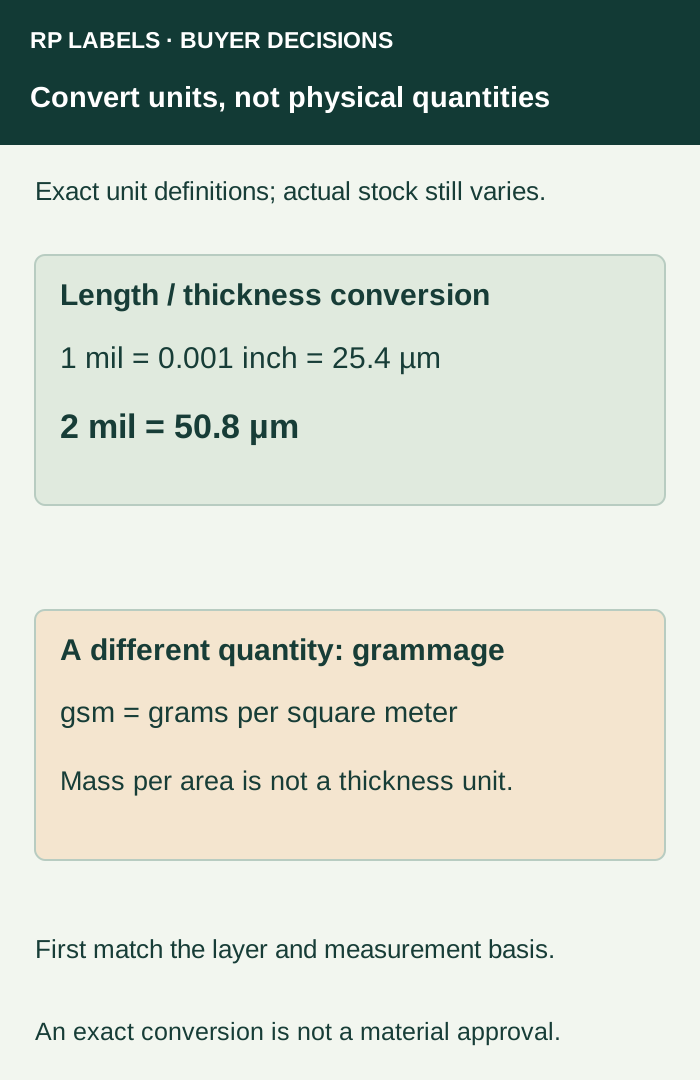
Paper may instead be described in g/m² or gsm: mass per unit area. Holmen’s paper explanation distinguishes grammage from thickness and discusses bulk. Its publication-paper examples are not label-stock recommendations. Without the material’s relevant density/bulk information and a stated scope, a gsm value cannot be treated as a micron value.
Keep three fields in the quote comparison: the identified component or stack, its stated value and unit, and the applicable reference or measurement basis. If one of those is missing, request it before ranking which label is thinner. Even a fair thickness comparison does not establish equal stiffness, conformability, opacity or performance.
For a change to roll capacity, send the actual finished construction and relevant effective web data to the converter; use the roll-size guide for the mechanical envelope. For a change to the applied vial wrap, retain the physical construction comparison described here. Do not let an exact unit conversion become an unsupported material approval.
Make the wrap comparison recognizable
Give the candidates separate references and use the same production vial reference. Keep the finished dimensions, corner profile, artwork and application arrangement comparable where possible. Record unavoidable differences. Otherwise, a shorter wrap or a different adhesive could receive credit intended for the film.
Ask the responsible application owner to define the sample preparation, application conditions, observation stages and criteria relevant to the job. Record the actual surface condition and agreed interval before observation. Do not silently replace the production arrangement with extra hand pressure on a carefully cleaned demonstration vial.
Photograph the leading edge, trailing edge and seam in repeatable views. Describe what is visible: an edge standing away, a wrinkle, a local contact gap or no visible change under the stated observation. Do not turn one photograph into a diagnosis of adhesive failure or proof of long-term retention.
If both candidates approach the shoulder or base curve, resolve the usable height and placement first. If only a corner catches during handling, the corner-profile comparison addresses a different purchasing decision. Replacing the whole material construction may be unnecessary for that narrower issue.
Map material direction to the part that bends
If two finished vial labels have the same thickness but wrap differently, ask whether the material is specified in the machine direction, across the web or both. Ask the converter to show those directions on the converted label as well as the finished roll's feed direction. A roll unwind number describes presentation at dispensing. It leaves open which material direction runs around the bottle unless the converter identifies the relationship.
Avery Dennison's application guide compares machine-direction and cross-direction stiffness separately for named materials. HERMA's wraparound guidance relates material flexibility and adhesive selection to tight radii. Ask for the applicable data for the film or finished construction being quoted. The comparison chart illustrates why the direction matters.
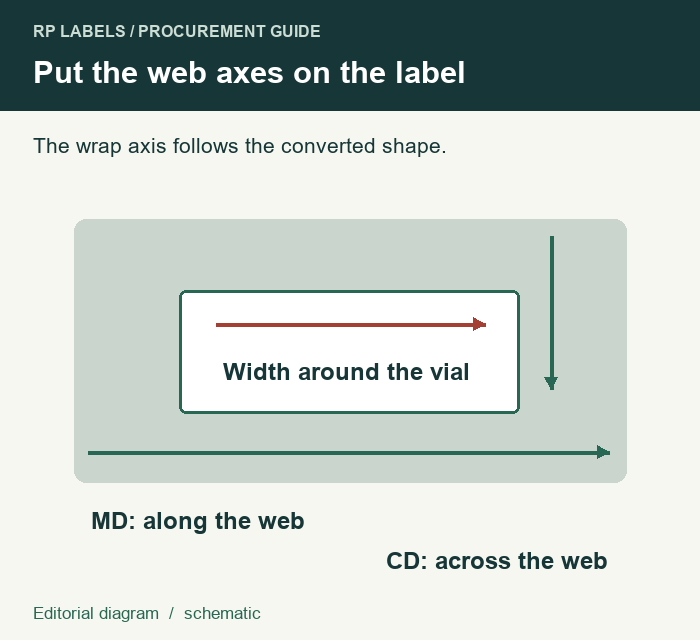
Where a change in web layout is being considered, mark the artwork's width around the vial, vertical height and the direction of travel. Ask the converter whether the proposed change alters the direction of bending around the vial. Keep the actual adhesive, finish, size and container constant if the purpose is to isolate orientation in a trial. If changing layout also changes the roll or finish, compare complete candidates and record those differences.
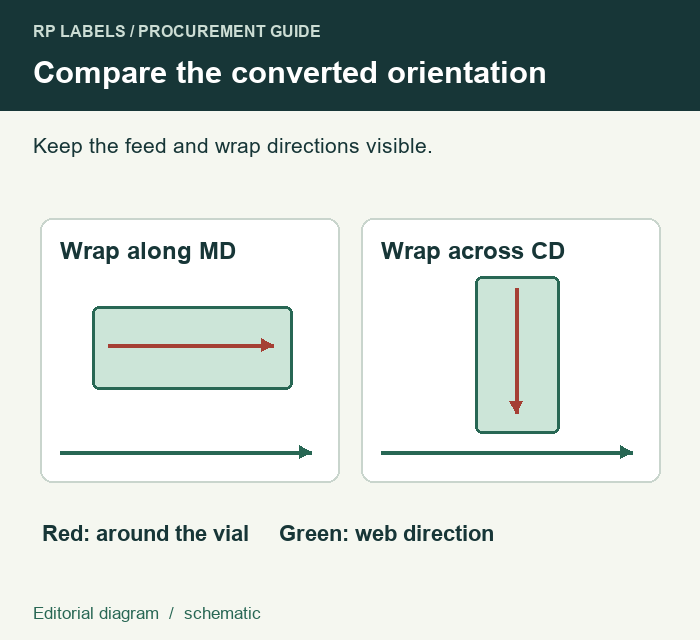
On an applied specimen, check the seam and leading and trailing edges after the intended handling. On the representative roll, ask the packer to confirm feed direction and dispensing separately. If one orientation looks acceptable around the vial but is incompatible with the roll presentation, ask for a revised conversion proposal before approving. Bring the marked drawing to the RP inquiry with the vial, quantities and roll brief.
Keep dispensing evidence on its own line
A loose sample can help assess artwork and a proposed wrap. It does not demonstrate how a finished roll will release, travel through the actual application path or maintain the required placement.
For a machine-applied order, ask the packer which roll-sample scope and process review it needs. Identify the liner, die cut, label gap, rewind direction, core and outer diameter supplied for that review. Record the equipment or application reference and who can authorize the resulting setup. The roll-direction guide and core and diameter guide help prepare those inputs.
A hand-applied order can reasonably need a simpler sample arrangement. Do not buy an unnecessary machine trial merely because another buyer uses one. Conversely, a successful hand placement cannot approve an unattended application route. Match the evidence to the process the order will actually use.
Let either construction win for a stated reason
A flexible film candidate may be worth pursuing when the finished wrap needs to follow a tight cylinder. Another construction may offer a preferred appearance, opacity or handling arrangement that matters more in a different project. Those are requirements to compare, not reasons to declare one material universally premium.
If the existing construction already meets the agreed wrap and application requirements, retaining it can avoid an unnecessary change. If the new one solves an identified limitation, record that limitation and the evidence supporting the choice. Do not order a thinner face simply to make the specification look improved.
When protection or appearance changes, discuss what else needs review. A construction selected for its wrap still needs the project's relevant printing, marking and handling checks. Keep those scopes named instead of allowing “material approved” to imply every possible exposure has been tested.
Use a comparison record with two open decisions
The worked construction record contains two fictional proposals. Candidate A has a loose sample proposed; candidate B has a roll-sample scope to confirm. Neither has a completed wrap or dispensing result. This uneven starting evidence is the problem the record is intended to expose.
The blank record and field guide connect each construction reference to the vial, shared dimensions, changed components, wrap observations, application evidence, owner and next action. A pending dispensing review stays pending even if the wrap review is satisfactory.
Use the record to ask a specific next question: obtain an equivalent finished sample, identify the missing component or arrange the application review the packer requires. Avoid collecting more attractive photographs when the missing item is the sample's identity or scope.
For custom vial labels, send RP Labels the candidate comparison and actual vial reference, finished dimensions, artwork, quantity per design and planned application method. State whether the current question is the applied wrap, dispensing or both. Ask for an identified proposal and sample scope so the next approval refers to a construction the supplier can reproduce.
Sources and scope
Demand layer: competitor and process pages linked here, including Avery, HERMA or OnlineLabels where cited, illustrate buyer language and process topics only. They do not supply RP minimum quantities, lead times, prices, certifications or materials. Authority layer: an RP number is backed only by a factory datasheet, a signed quote or proforma, confirmed product data, or a fact kept on the About page. The March 2026 proforma there is one production-run example, not a standing offer. RP shipping and planning pages describe what to confirm on a quote. Worked figures on this page are fictional unless an authority source is named for them.