Shrink Sleeves vs Pressure-Sensitive Labels: Confirm the Packer
The sleeve rendering covers the shoulder beautifully. The packer has only confirmed its roll-label line. Before paying to finish the artwork, get a clear answer about which decoration route can actually be run for this order.
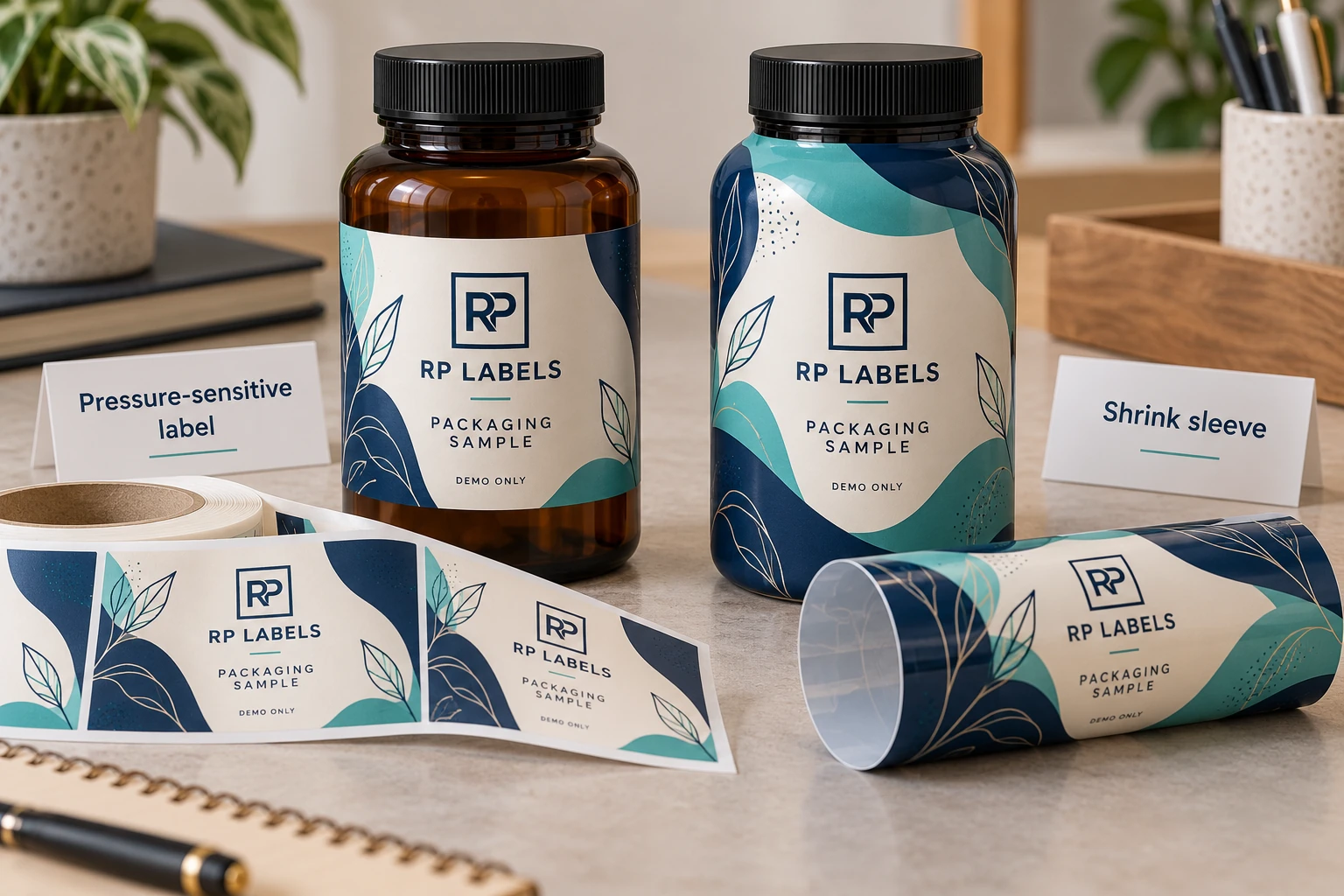
The short answer: choose pressure-sensitive labels for straight or gently curved bottles, flexible short runs, many SKU changes and simpler application. Choose shrink sleeves when the bottle has complex contours, the design needs near-total coverage or the sleeve must extend over the closure. Confirm the co-packer has the correct equipment before artwork begins.
Imagine a supplement project with a full-body sleeve rendering and a straight bottle, while the contract packer has only confirmed a roll-label line. The application route needs to be settled before the artwork is released.
The opposite also happens. A brand selects a narrow adhesive label for a deeply waisted bottle, then asks the printer to stop the edges from bridging and lifting. The bottle was asking for a conformable decoration method from the start.
Ask the packer to release a route, not a general capability statement
'We can label bottles' leaves the important part open. Give the packer the bottle reference, closure, proposed coverage and whether the container is filled at decoration. Ask which installed route they propose for that exact combination. A subcontracted option can be valid, but its handoff, trial and lead-time assumptions belong in the comparison rather than appearing after artwork approval.
For pressure-sensitive labels, obtain the roll and application brief for the identified line. For a sleeve, ask who confirms the sleeve dimensions, artwork distortion and application process on the actual package. Do not copy settings from a supplier's different bottle or treat a flat sleeve proof as an applied result. The buyer should not invent process temperatures or product-tolerance limits; those need the appropriate process and product owners.
Use the route sheet to record a proposed physical trial, its inputs and who accepts the result. A packer may confirm equipment availability while still needing a container sample. A converter may supply artwork guidance while the packing line still needs to prove the applied view. Recording those open points prevents a general yes from becoming an unintended production release.
A straight bottle with short, changing designs may remain more practical with pressure-sensitive labels on an established line. A shaped pack and broad graphics may justify sleeve development where a suitable process is available. The comparison should include what each route asks the team to change, not only the decoration price per unit.
Keep a separate decision for any opening feature; a body sleeve ending below the cap does not by itself demonstrate first opening. Send RP the actual container, intended coverage, approved copy, per-design quantities and the packer's written route note. Ask for the label options that fit that brief, and confirm availability and scope before committing to any proposed alternative process. The best-looking rendering can wait until the package has a route to production.
Download the worked example CSV · Open the working CSV · Read the field guide. The entries are planning examples, not completed results.
How the two formats work
| Pressure-sensitive label | An adhesive-backed label dispenses from a liner and is pressed onto the package. It may be a front label, back label or wrap label. |
|---|---|
| Shrink sleeve | A printed film tube is placed around the container and shrunk with controlled heat to follow the bottle shape. |
One format bonds to the surface. The other contracts around the object. That difference affects artwork, equipment, inspection, recycling and the economics of every SKU.
Bottle geometry usually decides first
A straight-wall vitamin bottle is friendly to a wraparound pressure-sensitive label. The applicator can control placement, and the brand may leave the amber or white bottle visible. For a heavily tapered, fluted or hourglass package, a flat adhesive label has fewer places to sit without stress.
A shrink sleeve can follow shoulders, waists and grip features, but the film does not shrink equally everywhere. High-distortion zones need a calculated artwork map. Put a face, barcode or small legal copy in the wrong area and the heat tunnel will reveal the mistake.
Coverage and shelf impact
Sleeves create a continuous canvas and can hide the base container color. They are useful when the design relies on uninterrupted illustration or when a generic bottle must look proprietary. Pressure-sensitive labels offer precise material contrast: clear film, textured paper, metallic stock, matte laminate or selective exposed bottle.
More coverage is not automatically more premium. A restrained front-and-back label on a good bottle can look more deliberate than a sleeve filled with claims. The format should support the brand architecture, not replace it.
Buying rule: if the project is still changing bottles, do not finalize sleeve artwork. If the co-packer is still changing equipment, do not finalize roll specifications. Lock the physical line before polishing the graphic.
Short runs and SKU changes
Pressure-sensitive roll labels are often practical for a young brand with several formulas and modest quantities. The same bottle can carry different label rolls, and changeovers may be straightforward on common labeling equipment.
Shrink sleeves can make sense at larger volumes or when full-body decoration creates real packaging value. They add converting and application steps, and the heat process needs control. Ask for the cost by SKU, not only the combined annual quantity.
Tamper evidence is a design decision
A full sleeve can extend over the closure and include a perforation for opening. A pressure-sensitive body label can pair with a separate neck band, destructible seal or cap label. Neither arrangement becomes tamper evident simply because it is shiny or hard to remove.
Define what visible evidence should remain, where the consumer tears the package and whether the seal interferes with instructions. Test the opening action with the final cap and bottle.
Application equipment and line speed
A pressure-sensitive job needs roll dimensions, web width, core, unwind, gap, liner and label stiffness matched to the applicator. A sleeve job needs the correct layflat, cut length, seam, shrink curve and heat-tunnel setup.
Ask the packer for a written specification. A photo of the machine nameplate helps, but it does not replace the web and container requirements. The cheapest label quote becomes expensive when rolls must be rewound or sleeves distort on line.
Recycling and material planning
Packaging recovery depends on the bottle resin, label or sleeve material, coverage, adhesive, inks and the local recycling stream. Avoid generic claims such as "100% recyclable" unless the complete package has been reviewed for the intended market.
Discuss wash-off or compatible constructions where relevant, and consider perforations or consumer removal instructions. Sustainability belongs in the package specification, not as a late icon added to the artwork.
What to send for a useful comparison
Format decision checklist
- Physical bottle samples and technical drawing
- Bottle resin, color, shape and closure
- Required graphic coverage and viewing panels
- Supplement Facts, barcode and variable fields
- SKU quantity now and likely reorder quantity
- Co-packer equipment and line specification
- Tamper-evident requirement
- Target market and recycling objective
I would rather lose a sleeve order because the buyer's existing labeler makes pressure-sensitive labels more sensible than win the wrong format and explain the distortion later. The profitable job is the one that can be repeated without surprise.
Bring the decision into your print brief
Use the identified references and open items in the worked record when discussing your custom print project. Include the actual package, artwork revision, quantity per design and the conditions explained above; leave unknown inputs marked for confirmation. Review the relevant custom-label service, then send the project details to RP Labels.
Related buying decisions
- Tapered Bottle Labels: Tie the Curved Dieline to the Bottle
- Automatic Supplement Label Rolls: Get the Packer to Sign the Roll Brief
- Supplement Bottle Neck Seals vs Side Labels: Proof Each Job Separately
Sources and scope
Reviewed October 25, 2026. Primary supplier or official reference supports the identified production concept. Procurement comparisons and worksheets are editorial guidance. Conditional examples are not customer records, completed tests, regulatory approval or universal acceptance standards. Confirm the actual proposed construction and process with the responsible supplier and buyer.