Printed Labels or Labeled Bottles? Define the Supply Before Comparing Quotes
State what must arrive at the next operation: printed labels on their agreed carrier, empty containers already decorated, or containers with labels applied. A price for 1,000 “pieces” is not comparable until both parties identify which physical item and which completed operations the count describes.
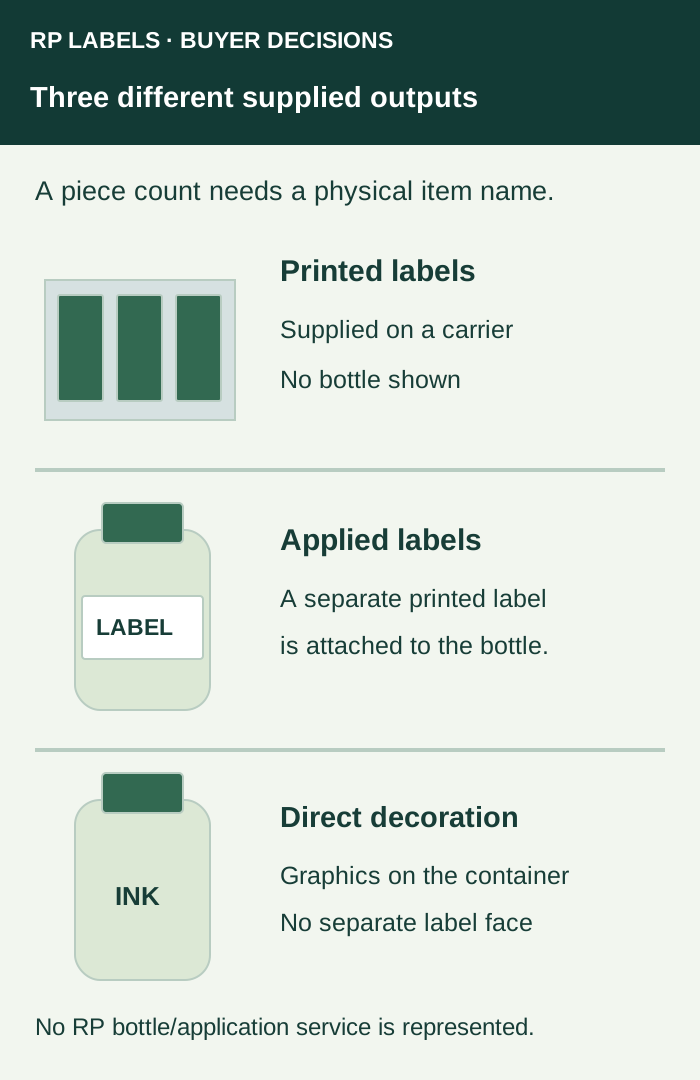
Separate making a label from putting it on a bottle
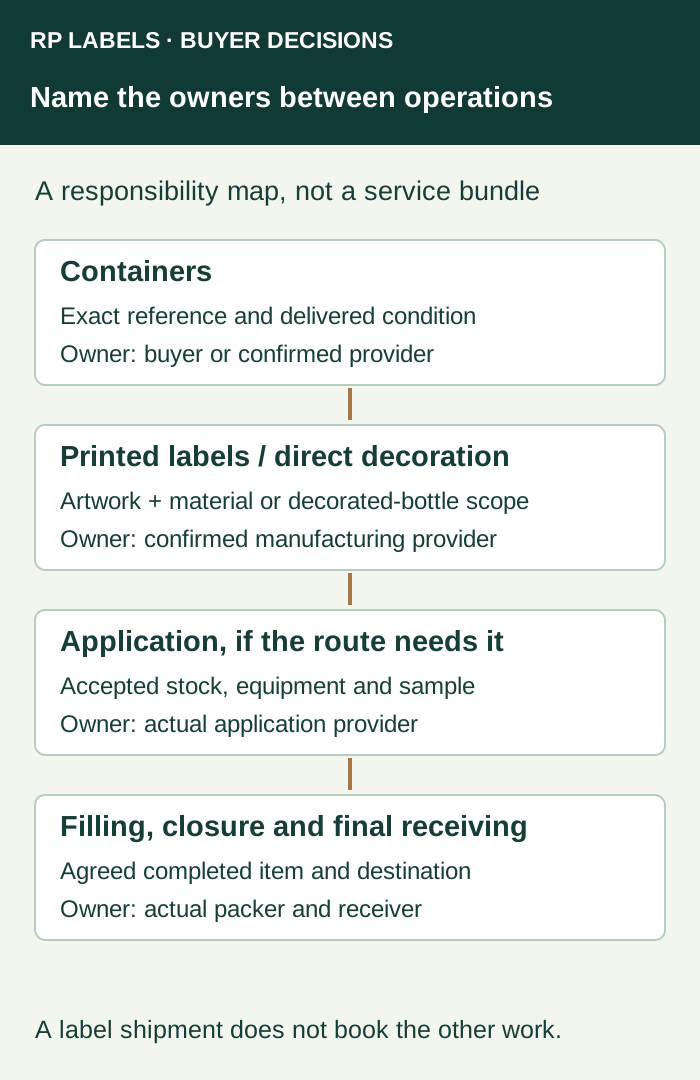
A printed label supply can be completed before the bottles reach the packing site. Someone still owns container preparation, loading the accepted stock, application and the relevant checks. If purchasing only asks when the labels can ship, an unassigned application step can remain hidden until the packing date.
For a buyer already using a contract packer, ask that packer for its label and receiving requirements before releasing the print order. For a buyer planning manual application, identify the operator, place and usable supply format. The rolls-versus-sheets guide helps choose the carrier; it does not appoint someone to apply the labels.
If the requirement is delivery of labeled containers, ask the prospective provider to identify the application scope explicitly. Do not assume it is included in a custom-label quote, or that it can be added without changing the order. The same discipline applies if containers are already filled: the actual application provider must accept their condition and handling requirements.
Direct container decoration is another proposal
Printing graphics directly onto a bottle is different from printing a separate self-adhesive label. Berlin Packaging’s decorating overview distinguishes screen-printing and pressure-sensitive application services from its separately shipped label option. Its services, minimums and times do not establish RP’s offer.
A direct-decorated bottle may suit an accepted package and stable design when the proposed supplier’s process and quotation meet the requirements. A separate label can suit an identified bottle program with a defined application route. Neither route is universally cheaper or more durable, and neither word means the product is filled, closed or ready for sale.
Define the changing fields too. A fixed decorative image may still need later lot or other approved information. Keep that later operation and its responsible owner visible. Use the stable-and-changing-field brief for the content split instead of assuming every field is settled by the decoration choice.
Try a quote comparison that exposes the missing operation
Suppose a fictional launch needs 1,000 completed bottles at a packer. Offer A covers 1,000 printed body labels supplied on rolls. Offer B covers 1,000 empty bottles with graphics printed directly on them. Neither description states filling, closure or final packed delivery. A spreadsheet treating both rows as 1,000 completed units hides the missing work.
The buyer should first confirm whether the container itself is included, who performs any application, what later marking remains, and where each item must go. Only then can actual prices and timing be assembled on a comparable basis. These are invented scope examples, not supplier offers or an RP order.
| Required output | What to identify in the proposal |
|---|---|
| Printed labels | Artwork, construction, dimensions, quantity per design, carrier/roll specification and receiving destination. |
| Containers supplied | Actual container reference, quantity, condition and ownership before decoration or application. |
| Application or direct decoration | Provider, accepted container, completed operation, later coding and relevant sample/inspection scope. |
| Filled and packed product | Responsible packer, approved product and packaging inputs, completed assembly and receiving requirement. |
Connect the schedule at the handoff points
A label shipment date does not reserve an application slot. An available bottle does not establish that its label construction has been accepted. Give the relevant providers the actual incoming items, desired output and required date, and ask which dependency controls their schedule.
For a repeat where the same packer, container and accepted label remain in use, a controlled reference to that arrangement may be sufficient. A new container, application provider or completed-delivery requirement reopens the affected handoff. Preserve what is already accepted without inheriting an unsupported service assumption.
Make the RP inquiry specific to the printed-label requirement
RP’s vial and supplement-label pages are routes for discussing custom label printing. Prepare an inquiry draft that states the intended deliverable, container reference, quantities by design, artwork and the actual application owner. Ask the quote to identify the proposed print and supply scope and any separately confirmed operation. If you need finished labeled bottles rather than label stock alone, say that at the start and confirm who can accept the additional work.
Once scope is settled, use the delivered-cost comparison for the agreed label shipment. A detailed freight line cannot repair an unresolved production handoff.