The refill idea often begins with a simple request: “Use our protein tub label on a lighter pouch.” The brand should carry over, but the print file should not. A rigid tub offers a stable cylindrical wall. A flexible pouch has a zipper, heat seals, changing fullness and a base gusset. A label that looks centered on an empty pouch may crease when the product is filled.
The RP Wellness image is an AI-generated comparison. The illustrated claims, quantities and nutrition-style copy are fictional. Use it to see the two package types, not as approved artwork or evidence that a particular label passes a filling line.
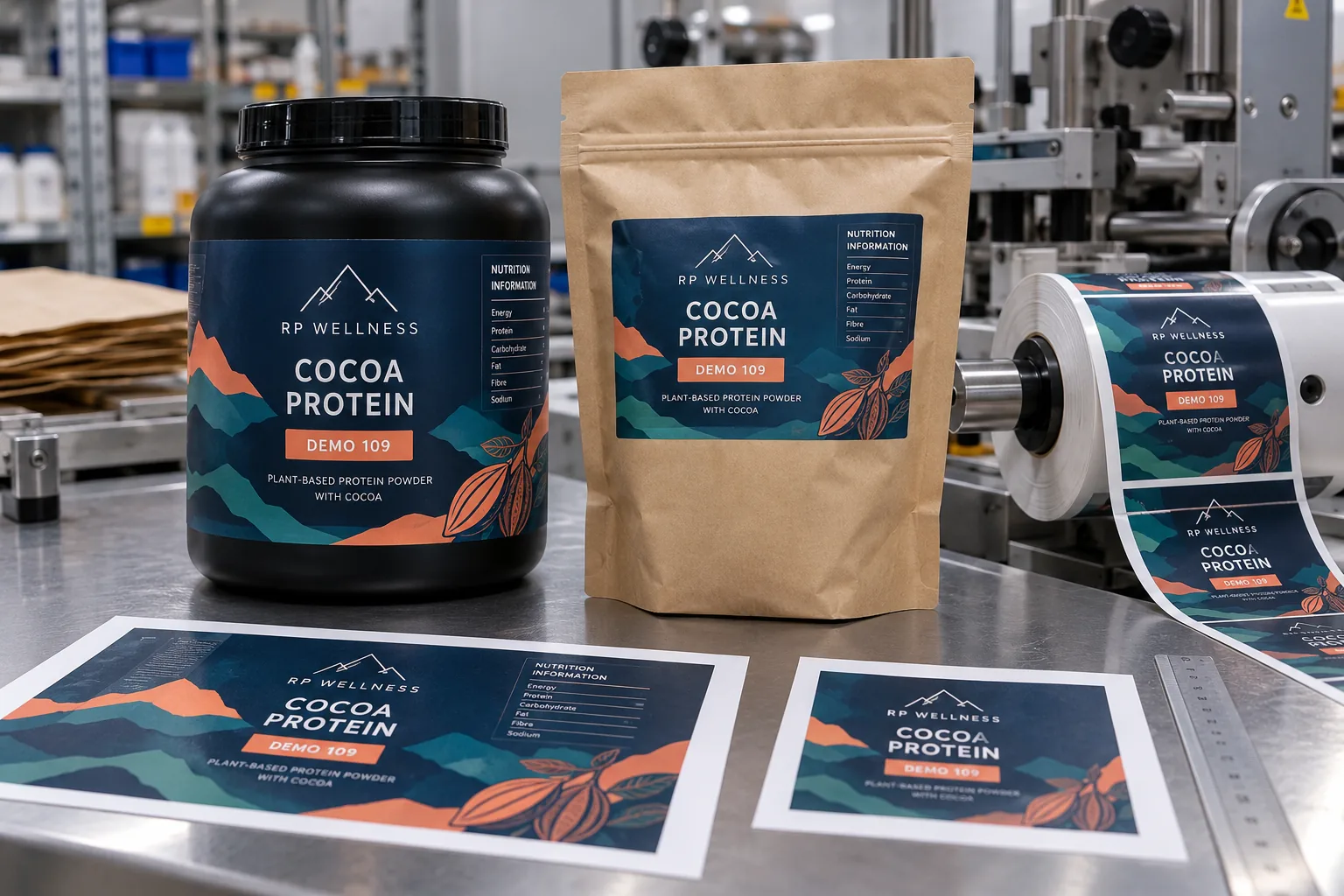
Measure the pouch in its filled state
I would request a filled pouch, an empty pouch and the rigid tub. Mark the pouch's front flat zone while it is standing as customers will see it. Keep the label clear of the zipper, tear notch, heat-seal margin and gusset folds. A die-line measured only from the pouch's nominal flat width can mislead; the usable area changes with fill volume and film stiffness.
HERMA lists stand-up pouches among food-pack labeling formats, while noting that small packs may need separate front and back labels. That supports treating a doypack as its own labeling surface. It does not make every pouch film compatible with any adhesive. Test the actual laminate, printed surface and sealing process.
Keep a shared visual family, not shared geometry
Use the same brand mark, palette, variant names and product hierarchy on both packages. Build separate artwork masters for tub and pouch, with independent dimensions, panel maps and proof versions. On the tub, the seam might sit at the back. On the pouch, the label may need to stay entirely on a flat front panel, with information placed on a second panel or on the pouch print itself. Do not reduce the tub file until it technically fits a pouch rectangle; its text hierarchy may become unreadable.
Before a supplier quotes, ask whether the pouch will be printed directly, labeled after filling, or labeled empty. Those are different paths. If the pouch film already carries brand graphics, a supplemental adhesive label might only need variable or language-specific content. If the pouch is plain, a small label may not carry the whole retail information set. Decide this early rather than letting the printer discover it after the first proof.
Protect reviewed copy
For a US dietary supplement, the FDA's general guide identifies required identity, quantity, nutrition, ingredients and business information. A qualified regulatory reviewer needs to place the actual product's copy correctly on each finished package. I would not assume the pouch is exempt because its front sticker is small or because the tub has already been reviewed. Artwork revision control matters when a refill has a different net quantity or use instruction.
The existing tub panel layout and pouch clearance guide can serve as two separate checklists. Review the actual information panel at full print size, not just an enlarged PDF on a monitor.
Prototype both packs together
Fill a few pouches, apply the intended label, squeeze them as a buyer might, stand them on a shelf and pack them for shipment. Watch for wrinkles, edge lift, print scuff and a label corner catching at the zipper. Then place the tub beside the pouch to check brand consistency. If both packages look related but each remains legible and fits its surface, the design system works.
Send the printer physical samples, material description, fill state at application, front and back copy, SKU count, quantity per version and any applicator details. Quote the tub and pouch as separate formats. I would spend a little more time on two accurate proofs rather than save a dieline fee and carry an awkward label through every refill order.
Sources and scope
Reviewed October 9, 2026. The primary references linked below support the identified technical points. Buying scenarios and inspection checklists are editorial guidance, not RP production records, certification, legal approval or universal acceptance standards. Demand layer: competitor and process pages linked here, including Avery, HERMA or OnlineLabels where cited, illustrate buyer language and process topics only. They do not supply RP minimum quantities, lead times, prices, certifications or materials. Authority layer: an RP number is backed only by a factory datasheet, a signed quote or proforma, confirmed product data, or a fact kept on the About page. The March 2026 proforma there is one production-run example, not a standing offer. RP shipping and planning pages describe what to confirm on a quote. Worked figures on this page are fictional unless an authority source is named for them.