A buyer asks for a label that works in a freezer. I ask one question before discussing film: will the team label a clean room-temperature vial and then cool it, or will they pull a frozen vial from storage and put a label on it? Those are different jobs. A label that remains attached in storage has not automatically been qualified for application to a cold, damp surface.
The photo shows two fictional RP Research sample designs. It is a useful way to compare workflows, not evidence that either printed construction survives a particular temperature or thaw cycle. I would keep that distinction on the purchasing brief, where it is easy to lose.
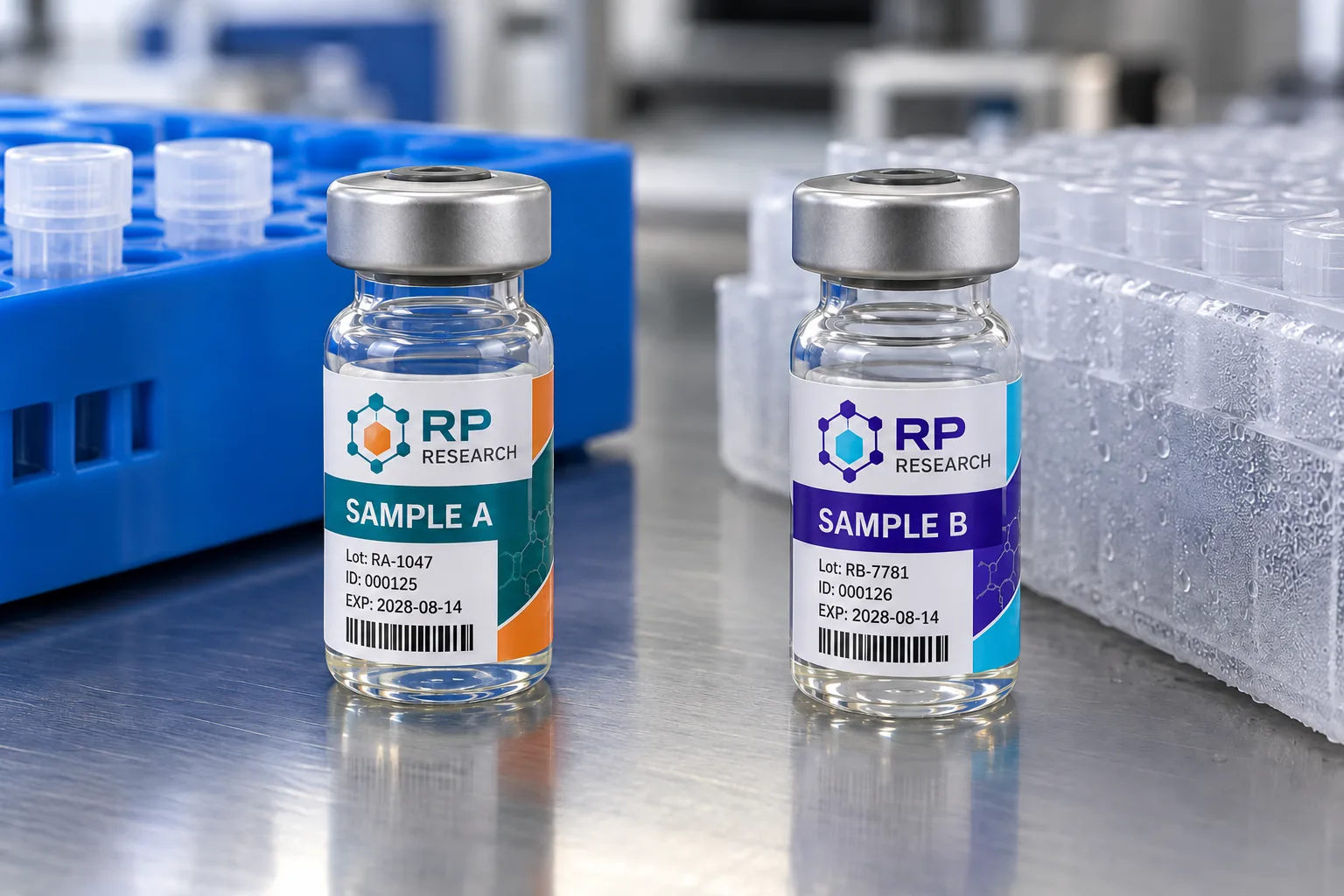
Write the application sequence before choosing stock
Start with the real sequence: container material, fill and cap stage, surface-cleaning method, temperature when the label is applied, time before chilling, storage range, and whether vials will be warmed and cooled repeatedly. Include the operator's glove type and whether the finished vial sits in a close-fitting rack. If the team labels before cooling, the adhesive gets a different initial contact than it would on an already frosted vial.
Brady's laboratory label guide describes cold and cryogenic identification as material-specific. Its examples show that specialty constructions exist, not that every polyester face and adhesive combination is interchangeable. Do not buy a product merely because a supplier's sheet lists an impressively low service temperature. Confirm the application temperature separately.
Do not call condensation a temperature rating
A refrigerated vial may be cold enough to collect droplets when it moves into a humid packing room. A freezer vial may carry frost. Either condition can prevent intimate contact at the glass surface even if the adhesive itself is rated for low-temperature service after bonding. In the condensation guide, the practical issue is when and where moisture appears, not simply the number on the thermostat.
One purchasing route is to label before cooling and validate that exact storage cycle. Another is to choose a construction intended for application to cold or already frozen samples and validate it on the actual container. Brady's freezer-label example illustrates the second route, but it belongs to that particular product and application method. It cannot be borrowed as a performance claim for a custom RP label.
Proof the label as a readable system
Test finished labels, not just unprinted stock. Apply samples to several production-representative vials. Record application temperature and dwell time. Cycle through the real storage and handling route, then inspect lifting at the overlap, wrinkles at the shoulder, abrasion in trays, and legibility after moisture is wiped away. Scan the actual printed code through the normal scanner at the normal distance. A barcode that looked fine on a flat proof may curve away from the reader once wrapped.
For identification, put the most important short code where a gloved operator sees it without rotating the vial repeatedly. The vial measurement guide helps establish the straight-wall area. Leave the cap and neck alone unless that placement has its own defined purpose. Do not mistake a larger label for a clearer one when the glass wall is short.
What to send for a useful quote
Send the vial and cap sample, usable wall dimensions, application sequence, cleaning agent, lowest and highest handling temperatures, storage duration, rewarming pattern, code size, quantity per artwork and application equipment. Ask which parts of the proposal are material specifications and which are still assumptions to be tested. For a frozen-surface job, request a physical proof on a container at the intended application condition.
I would not approve a custom run from a freezer icon on a datasheet. The decision is made when the printed label survives the buyer's actual sequence and can still be read after it returns to the bench.
Sources and scope
Reviewed October 16, 2026. The primary references below support the cited technical or regulatory points. The illustrated buying scenarios are editorial guidance, not RP production records, certifications, legal approvals or universal acceptance standards.