How to Specify Non-Tacky Areas on a Bottle Label
Specify a local non-tacky area with a back-view map tied to the final cut outline. Identify the exact region that should bond, the region that should remain free to lift or project, and what behavior each needs after application. A white shape in the front artwork does not define an adhesive pattern.
For a vial flag, a lift tab or another bottle-label detail, this map lets the converter assess the functional construction before the buyer approves the appearance. Use a fully coated ordinary label when it already does the job. Selective treatment adds a separate alignment and performance question.
Distinguish the required behavior from the manufacturing route
A pattern-coated construction puts adhesive in selected areas. An adhesive-deadened construction reduces tack in selected parts of an adhesive layer. A proposed deadened region may have a defined residual tack rather than a completely adhesive-free surface. Ask the converter to identify what its proposal means and which behavior it can support.
A published patent application describes applying an agent to selected regions to reduce tack and discusses different degrees of deadening. It establishes a documented process concept. It does not establish RP capability, a suitable formulation for your pack or permission to use a particular patented route. Methods for reducing tack of pressure-sensitive adhesive.
If the purpose is to grip a tab, define whether the exposed underside may feel tacky. If the purpose is a projecting flag, define which surfaces meet after folding and whether exposed adhesive is allowed. If the concern is roll-edge residue, first use the adhesive-ooze inspection guide. A local dry region is a design proposal to assess, while an unidentified sticky edge needs investigation.
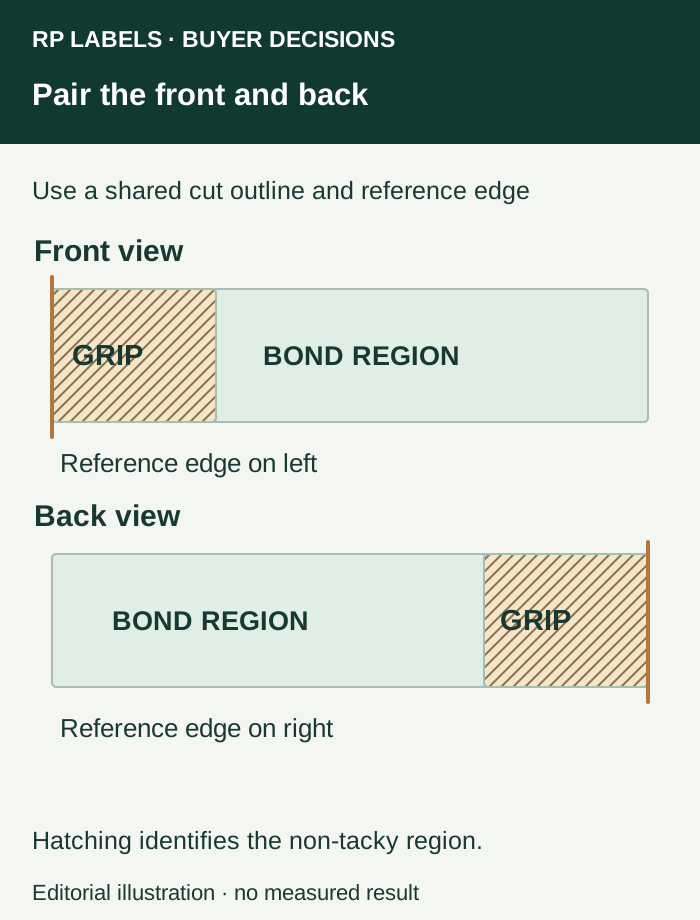
Make the front and back maps agree
Provide the final cut outline, finished dimensions, front artwork revision, back-view orientation and a clear reference edge. Mark the active bond area and proposed non-tacky area with named patterns. Place dimensions on the functional boundaries. A front-view overlay and a back-view map can mirror each other, so the converter should return both interpreted views for confirmation.
Include the container contact area or fold line where relevant. For a vial flag, distinguish the portion that anchors to the vial from the surfaces that join together and the part that projects. The flag-versus-wrap guide covers whether that geometry is useful in the tray at all.
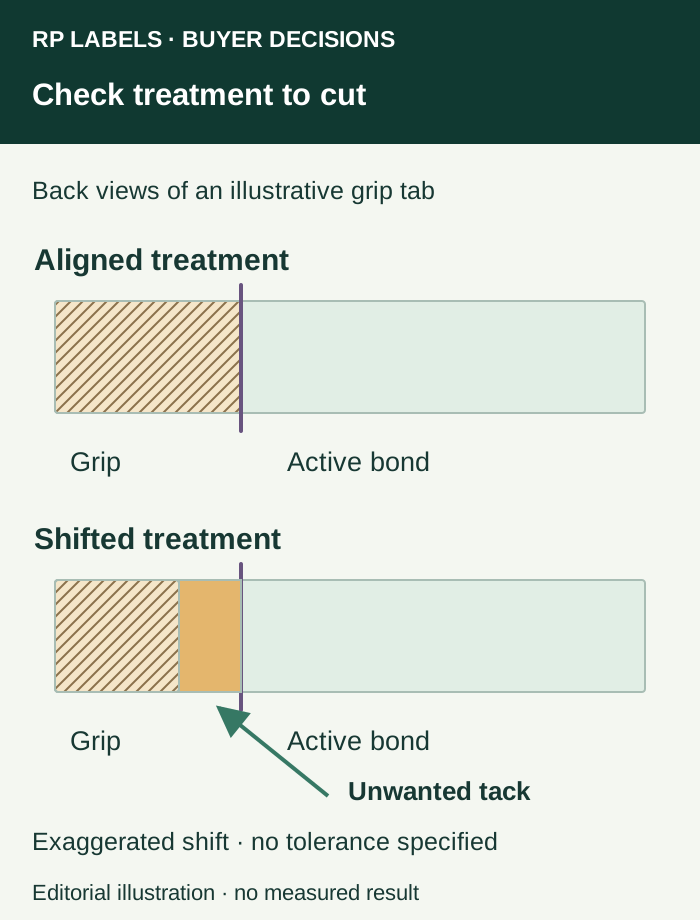
Ask who controls the registration between the cut and adhesive treatment. Obtain a project-specific proposed allowance and inspect the worst plausible position within it. If a small shift would put exposed adhesive under the grip tab or remove too much bond at the anchor, revise the layout before treating the nominal drawing as approved.
Review two boundaries on the physical sample
One boundary separates the tacky and non-tacky regions. The other is the cut edge or fold that the user encounters. They need to agree functionally on the finished specimen. A clean drawing cannot establish that relationship after conversion.
| Intended function | Sample observation | Reason to reopen the proposal |
|---|---|---|
| Easy grip tab | The user can find and lift the intended tab | Tack or placement defeats the grip |
| Flag anchor | The anchor stays on the intended container area | Loss of contact or a shifted treatment reduces holding |
| Folded flag | Mated panels align and exposed edges behave as intended | Unwanted tack, poor alignment or separation |
| Local dry edge | The defined edge meets the agreed handling requirement | The actual treatment or cut leaves an unintended sticky region |
The material supplier should provide applicable use and storage guidance. The buyer and packer should identify the relevant contact, temperature, handling and observation sequence. Record actual behavior after that sequence, including any unintended sticking to neighboring packs or tray surfaces. Sample results apply to the identified construction and conditions.
For a simple tab request, compare the selective proposal with a different cut or backing arrangement that answers the same task. A split backing helps remove the carrier during application. It leaves a different end state from a non-tacky area on the applied label. Choose by the required final behavior.
Put the functional map into the purchase record
Keep the returned map, material reference, treatment description, allowed alignment, sample identity and approval together. If the supplier changes the treatment route or construction, review which observations still apply. A substitute adhesive can change both the anchor and the intended low-tack region.
Ask the quotation to identify additional preparation, converting and sample scope, along with the available quantity and supply format. Obtain actual charges and availability for the project. Neither a drawing nor a process term establishes a standing service offer.
For small vial labels or supplement labels, send RP the front and back maps, actual container, functional requirement, application method and quantity per design. Ask whether a suitable selective construction or simpler alternative can be proposed. The map gives the production discussion a concrete starting point.