Sending Bottle or Vial Samples for Labels: Keep the Container Identity Attached
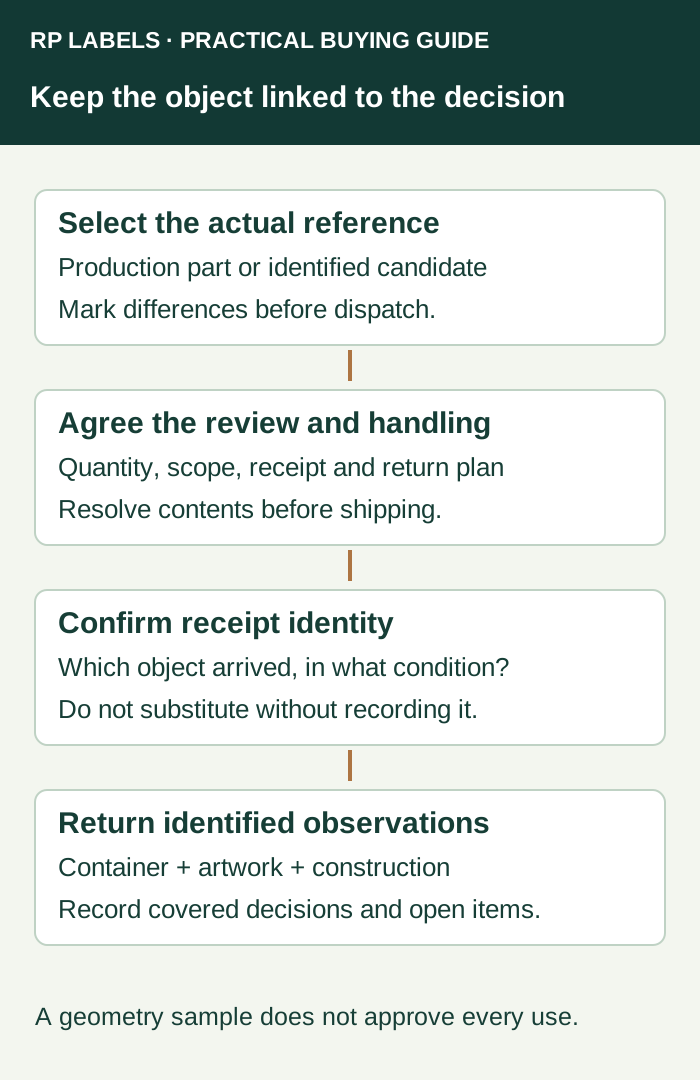
Sending an actual bottle can help a label converter review shape and a proposed application area. It helps much less if nobody can tell which production container it represents. Before dispatching samples, agree the receiving arrangements, the questions to review and the container reference that should appear on the returned evidence.
A nominal “10 mL vial” or “60-count bottle” is not a complete identity. Choose the actual proposed package from the intended supplier and retain its part number, drawing or other controlled reference. If the final production container is still undecided, say which candidate each sample represents.
Choose the sample around the open question
For a label-outline review, the converter needs the actual shape and usable wall area, with relevant closure or packaging parts if they affect clearance. For an adhesion question, the actual surface and its condition matter too. A visually similar bottle from a different material or surface treatment may answer the shape question while leaving adhesion unresolved.
Label & Litho's own preparation guide asks buyers to identify the container shape and material and expresses a preference for a physical container when reviewing fit and adhesive. That is its workflow, not an RP sample-service promise or a universal clearance allowance. Ask RP which physical reference is useful for the specific review you need.
The vial measurement guide and bottle-fit guide cover choosing dimensions. This handoff keeps the object used in that decision traceable after it leaves your desk.
Preserve the surface the supplier needs to assess
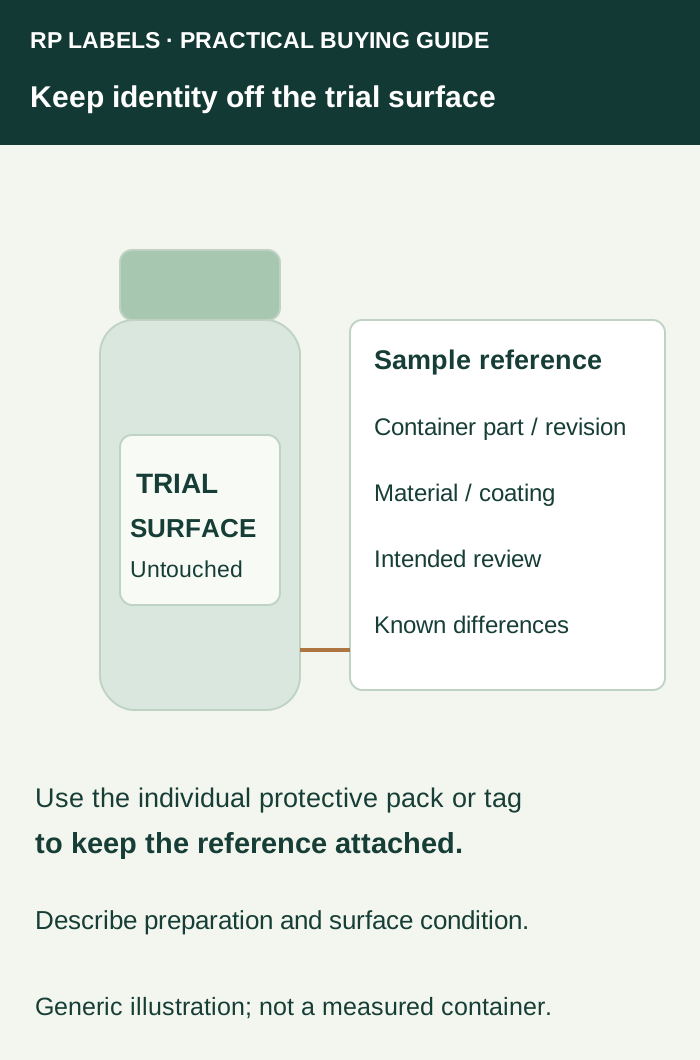
Do not place a sample-identification sticker, marker ink or protective tape across the intended label trial area. Put the identity on the individual protective pack or a suitable reference tag instead, and include photographs showing which object it identifies. The receiving team should be able to reconnect an unpacked sample to its record.
Describe the condition as supplied. A washed, polished or manually stripped bottle may differ from the production surface. If a cleaning or preparation step is intended in production, identify it so the reviewer knows whether it was applied to this sample. Do not quietly improve the sample and then claim it represents untouched production stock.
If several container candidates are sent, give each a distinct reference. Record material, supplier part, color or coating, drawing revision where available, and any relevant difference from the final production item. Ask the receiving team to keep those identities separate during review.
Agree the quantity, handling and return plan first
Ask how many containers the proposed review needs and whether any will be used destructively or retained as references. A single irreplaceable show sample may be unsuitable for an assessment involving repeated application and removal. A larger shipment of unneeded bottles is not automatically better evidence.
Confirm the recipient, address, project reference and expected handoff before shipping. For a geometry review, ask whether empty, unused containers are sufficient. Do not send formula, research material or other contents as part of a label inquiry unless the receiver and carrier have explicitly agreed the appropriate contents and handling. Identify any such difference in the review scope rather than presenting an empty container as proof of a filled-use condition.
Agree whether samples will be returned, retained or disposed of, and any charges or limits associated with that arrangement. An outgoing tracking number does not establish a return service or permission to consume the only master reference.
Use a worked pair to catch the wrong substitution
Imagine a fictional buyer choosing between Bottle A, the proposed production container, and Bottle B, an available display sample. They look alike in the catalogue, but B has a different surface coating. If only B reaches the converter, a successful layout demonstration may be useful while adhesion to A remains open.
Record “B used for preliminary geometry only; production surface A not yet supplied” in the returned review. Then decide whether to send A or obtain another agreed evidence route. Replacing the reference name with “approved bottle” would hide the very difference the sample was supposed to clarify.
If A arrives damaged or its identity cannot be resolved, have the supplier report that before testing or redesigning around it. Keep receipt condition and later review observations separate. A new sample should retain a new reference where its relationship to the previous one matters.
Connect the result to the production order
Ask the returned drawing, proof or observation to identify the container, artwork and label construction it represents, and any conditions deliberately omitted. Use the approval-coverage guide to keep a fit decision from becoming an assumed adhesion or color approval.
Before the order is released, confirm that the production container matches that reference or review the stated change. Prepare an RP inquiry with container photos, part or drawing reference, proposed dimensions, quantities and the unresolved label question. Ask which samples and receiving arrangements can be agreed for your vial or supplement-bottle label project.