Tapered Bottle Labels: Tie the Curved Dieline to the Bottle
The curved outline finally fits the trial bottle. Then purchasing finds another container with the same nominal capacity. Before calling the dieline finished, make sure the approval identifies the bottle it actually fits.
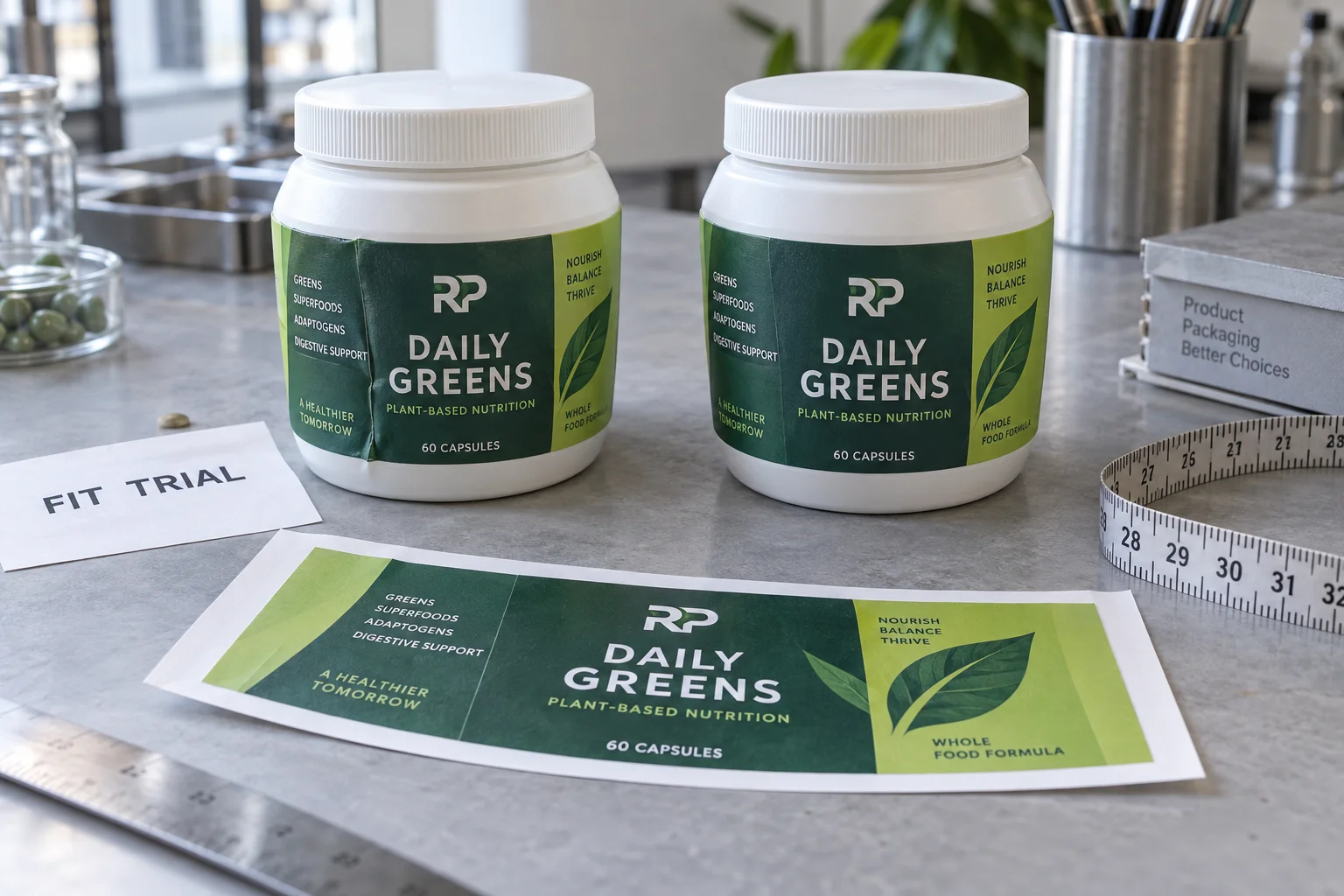
If the bottle gets wider or narrower across the label area, measure both boundaries before choosing a wrap. A curved dieline, a smaller front-and-back format or a different decoration route may be appropriate. Stronger adhesive cannot make a flat rectangle acquire the geometry of a full conical wrap.
My first question would not be which glue to upgrade. I would ask for the actual container. A catalogue picture makes a slight taper easy to miss, particularly on an opaque supplement jar with a broad shoulder. By the time the designer notices the climbing seam, the label size may already be locked into several artworks.
Do not let the successful fit photo lose its bottle reference
A close-up of a smooth wrap can circulate long after everyone forgets which sample was used. Name the bottle supplier and item reference, mark the upper and lower label boundaries, and photograph the whole identified container as well as the seam. Keep that record with the trial outline revision. A nice-looking crop is not a reusable dieline specification.
The worked release record separates the measured container, the proposed cut outline and the applied position. They belong together but they are not the same value. Changing the height or moving the label up the taper can change the needed geometry even when the bottle itself has not changed. Ask the converter to identify which dimensions and position the outline assumes.
If a replacement arrives, compare it at those marked boundaries before moving all the artwork files across. If the container profile or application position differs, hold the inherited fit approval and make a revised trial. Do not decide from a matching capacity description. Nor should a rectangular paper mockup be silently substituted for the curved outline that was actually reviewed.
A narrower front panel may be the more flexible choice for a launch still comparing bottles. A dedicated curved wrap may be worth controlling when the range uses a settled container and application process. The choice should remain open until the required copy, visible front and repeat application can all be supported; the most extensive wrap does not automatically win.
Use the handoff sheet to give the designer the accepted outline revision and the application owner the same sample reference. Check one complete artwork on the bottle before adapting the rest of the range. Send RP the physical container or drawing, boundary measurements, planned position, quantity per design and the latest trial reference. A change to any of those inputs should be visible before somebody reuses the successful photograph as a new approval.
Download the worked example CSV · Open the working CSV · Read the field guide. The entries are planning examples, not completed results.
Check the label zone, not the cap diameter
Mark the proposed top and bottom edges of the label on the container. Measure at those two positions and record the usable height between them. A cap measurement or the maximum width across the shoulder does not describe the area where the label must sit.
For tapered jars, measure the usable label wall at the height where the label will sit; do not use the widest or narrowest diameter alone. For squeeze tubes, measure the usable flat or slightly curved panel in the application area and allow for the tube changing shape when filled or squeezed. A physical fit check is recommended before mass production.
A straight conical section is one case. A bottle with a bulging wall, recessed panel, ribs or a compound curve is another. Do not use a simple taper template as though it covers all of them. Send a physical container or a dimensioned drawing when the profile is not clear.
OnlineLabels' tapered-label tool uses measurements at both boundaries along with height and wrap coverage, and recommends a full-size paper fit check. That is useful geometry guidance, not an endorsement of a particular adhesive for your bottle. Tapered-label measurement reference.
A small diameter difference becomes a visible length difference
Take an illustrative straight-sided taper measuring 60 mm in outside diameter at the upper label boundary and 56 mm at the lower boundary. The corresponding circumferences are about 188.5 mm and 175.9 mm. That is roughly 12.6 mm difference around a full turn, calculated as pi multiplied by the 4 mm diameter difference.
Those figures explain the mismatch; they do not supply a finished dieline. Wrap coverage, seam arrangement, label height and the actual container profile still need to be resolved. A rectangle has equal top and bottom lengths. The two bottle boundaries in this example do not.
For a true conical surface, a developed wrap follows an annular-sector geometry: curved boundaries, rather than simply a rectangle or straight-edged trapezoid. Leave the production dieline to a converter who can check it against your container and application method.
Three workable routes, with three different compromises
| Route | Why consider it? | What to resolve |
|---|---|---|
| Custom curved wrap label | Retains a broad connected design area | Container geometry, dieline, application and artwork layout |
| Smaller front and back labels | Limits how much taper each label spans | Available copy space and alignment between panels |
| Shrink sleeve or another decoration system | May suit greater coverage or more complex shapes | Equipment, container compatibility, artwork distortion and cost |
A smaller label is a legitimate option, not automatically a budget compromise. OnlineLabels discusses limited-coverage labels as one way to reduce the impact of taper. But reducing area only works if the approved product information still fits. Do not solve a wrinkle by making required copy unreadable. Tapered-container fitting options.
Do the paper trial, then the material trial
Print the proposed outline at actual size, check that the print software has not scaled it, and fit it at the intended position. Examine both boundaries, the seam and the relationship to the shoulder and base. Mark the trial revision so photographs of different attempts do not become interchangeable approvals.
Paper is an inexpensive geometry check, not a substitute for the final construction. The next trial should use the proposed face material, adhesive and finish on the actual container. Look at edge behaviour and visual alignment, then test the intended handling and application process under agreed conditions.
Ask the applicator supplier whether the container and format suit the available machine. A die that fits the bottle by hand does not prove that a straight-bottle setup will apply it consistently at production speed. If manual application is the intended route, agree on a repeatable positioning method rather than judging one carefully prepared sample.
Artwork needs to be reviewed on the bottle
Keep text, codes and key brand features inside the approved safe areas. Check how information reads after wrapping, rather than judging only the flat file. A logo that looks centred in the artwork may not occupy the intended visual front after application.
Send the designer the approved dieline revision before adapting the rest of the range. Changes to curvature can affect several panels at once. For barcodes, include the finished package in the verification and scanning review; a successful flat-label scan is not the whole assessment.
What to send for a custom quote
Provide the container sample or drawing, upper and lower label-boundary measurements, intended height, wrap coverage, quantity per artwork and application method. Include the desired material and finish, or ask the supplier to recommend a construction for the trial. Quote the fit-development work separately if necessary.
Can RP's round-bottle calculator make the curved dieline?
No. The label quote planner estimates dimensions for a straight cylindrical body. Use it only within that scope. A tapered or compound-curved container needs a separate fit review.
Will stronger adhesive remove the wrinkle?
Not if the main problem is geometric mismatch. Establish the outline and position first, then assess adhesion on the actual surface.
Do all tapered containers need a full curved wrap?
No. A smaller label or another decoration route may meet the brief. Compare the space for approved information, production method and repeat-order cost before deciding.
Bring the decision into your print brief
Use the identified references and open items in the worked record when discussing your custom print project. Include the actual package, artwork revision, quantity per design and the conditions explained above; leave unknown inputs marked for confirmation. Review the relevant custom-label service, then send the project details to RP Labels.
Related buying decisions
- Supplement Bottle Label Size: Release the Dieline Against the Actual Bottle
- Shrink Sleeves vs Pressure-Sensitive Labels: Confirm the Packer
- Supplement Bottle Label Problems: Wrinkles, Bubbles and Edge Lift
Sources and scope
Reviewed October 25, 2026. Primary supplier or official reference supports the identified production concept. Procurement comparisons and worksheets are editorial guidance. Conditional examples are not customer records, completed tests, regulatory approval or universal acceptance standards. Confirm the actual proposed construction and process with the responsible supplier and buyer. Demand layer: competitor and process pages linked here, including Avery, HERMA or OnlineLabels where cited, illustrate buyer language and process topics only. They do not supply RP minimum quantities, lead times, prices, certifications or materials. Authority layer: an RP number is backed only by a factory datasheet, a signed quote or proforma, confirmed product data, or a fact kept on the About page. The March 2026 proforma there is one production-run example, not a standing offer. RP shipping and planning pages describe what to confirm on a quote. Worked figures on this page are fictional unless an authority source is named for them.