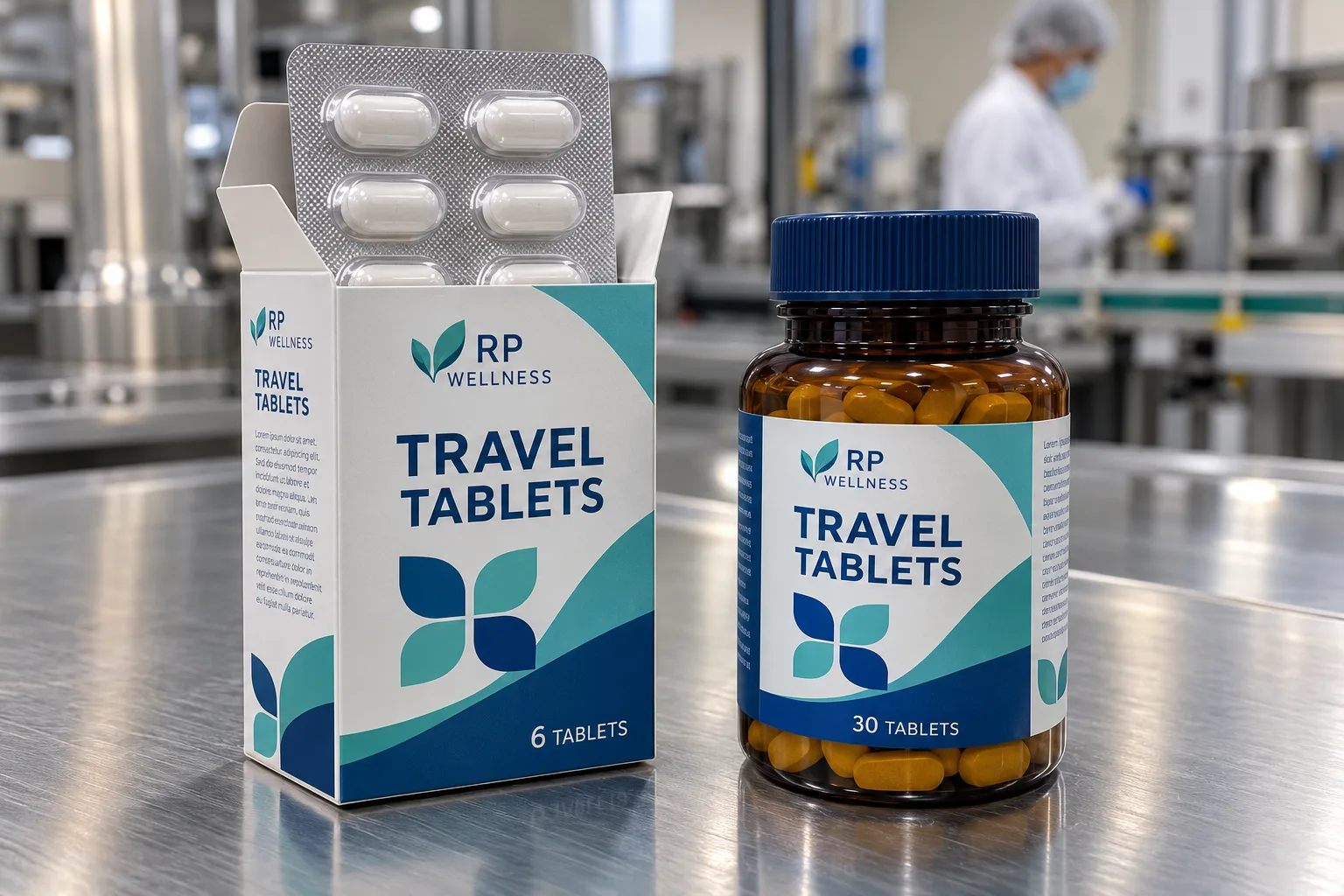
The product team wants one design family for a blister carton and a bottle. That is a sensible brand request. It is not a reason to send the same label file to two production lines. One surface is a flat folding carton; the other wraps a curved, sometimes tapered container. Their print areas, required information and handling points differ.
The RP Wellness packages in the image are fictional AI-generated concepts. Their visible typography is not approved dietary supplement labeling. For a commercial package, the brand's regulatory reviewer must check the final copy against the destination market.
Define the sale unit before allocating copy
Ask whether consumers buy the blister card inside a carton, the bottle, or both as separately sold items. Write down the count and pack configuration for each. If the blister is always inside a retail carton, the carton has a different information role from a stand-alone bottle. The FDA Dietary Supplement Labeling Guide describes core labeling statements and panel concepts for the US. Its details are not a substitute for product-specific legal review, especially when the pack format changes.
Do not cram bottle copy onto a tiny blister card without checking applicable exemptions and multiunit conditions. The FDA's small and multiunit package guidance is a starting reference. Whether a particular package qualifies is a question for the brand's regulatory team, not for a label printer to guess.
Measure the real surfaces, not the marketing render
For the carton, obtain the flat dieline with fold, glue, tuck and sealing zones marked. For the bottle, measure the straight wall and the usable wrap width on the actual container. The bottle sizing guide helps keep text clear of shoulders and base curves. Do not assume a rectangular carton panel and a wrap label can share one type size. A comfortable headline on a box can become cramped near a bottle seam.
If the brand wants the same visual identity, maintain a master style guide: colors, typography, original icon set and image treatment. Then issue separate controlled artworks for carton, blister-related print and bottle. Record the approved copy for each component. This avoids the common mistake of updating a caution or address on the carton but leaving the bottle version behind.
Set lot and date positions around the packing line
Agree whether lot and date are preprinted, overprinted during packing or added by a separate label. Leave an accessible area for the actual coder. Ask the packer about carton orientation in the line, bottle label application direction and how the operator checks the final code. A proof that looks complete on screen may place the variable field under a carton flap or on the bottle overlap.
For a blister carton, test the assembled and closed box, not just the flat blank. For the bottle, test a labelled filled sample with the intended cap. Verify that the same product identity and quantity appear consistently across every consumer-facing component. If each format has a different count, it may need a distinct approved version and product identifier.
Build the handoff around two proofs
Send the carton dieline, bottle samples, market, regulatory-approved copy, pack count, material finish, coder requirements, expected quantity and application method. Request two proofs, each marked with a version and corresponding physical package. The packaging checklist can keep artwork owners and reviewers aligned.
I would approve the shared brand system once, but never skip the format-specific proof. The extra check is small compared with a warehouse holding two beautiful, incompatible rolls.
Sources and scope
Reviewed October 17, 2026. The primary references below support the cited technical or regulatory points. The illustrated buying scenarios are editorial guidance, not RP production records, certifications, legal approvals or universal acceptance standards.