Blanket Orders for Supplement Labels: Compare What Gets Printed Now
Before placing a blanket order for supplement labels, ask which quantities will be printed now, which can be released later and what happens to any balance if the artwork changes. A series of delivery dates tells you when boxes might arrive. It leaves the print commitment, storage responsibility and payment dates to be agreed separately.
A recurring buyer may have predictable demand for one bottle label and uncertain demand for another. Compare the supply arrangement by SKU and revision. A stable design can justify a larger commitment, while a planned formula, pack count or copy change can favor smaller production runs even when their quoted unit price is higher.
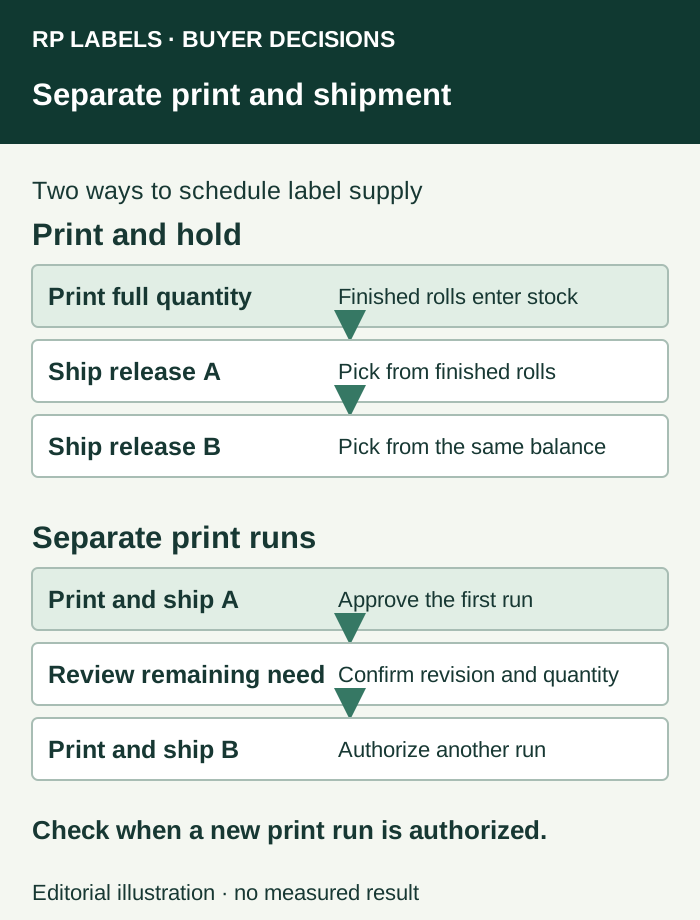
Ask what “release” means in the quote
In a print-and-hold offer, the supplier makes an identified quantity and holds finished rolls for later shipment. In a replenishment offer, the supplier may schedule further production when stock crosses an agreed trigger. In a separate-run arrangement, each order authorizes a defined print quantity and has its own production schedule. Ask whether a release initiates picking, new manufacture or both.
NADCO describes one example where the total order is printed upfront, stored and delivered in releases. Resource Label Group describes make-and-hold and min/max replenishment as distinct programs. Both are examples of those suppliers' arrangements. Use them to identify the choices and obtain project-specific terms from the supplier actually quoting. NADCO blanket order FAQ, Resource Label Group inventory program examples.
| Arrangement | Can make sense when | Ask the quote to show |
|---|---|---|
| Print and hold finished rolls | Approved copy and use rate are relatively stable | Committed quantity, stock location, release terms and final balance |
| Replenish within an agreed range | Use varies and the supplier can confirm replenishment responsibilities | Trigger, production lead time, minimum batch and authority to pause |
| Order separate print runs | Artwork, pack size or SKU demand may change before later runs | Per-run minimum, repeat setup, proof scope and available dates |
The reorder-point guide helps decide when to buy more. This comparison decides who holds the stock and when print work is authorized. If all rolls are already made and the decision is only which packer receives each one, use the multi-packer allocation guide.
Separate the purchase commitment from the stock balance
Ask for a record per SKU and artwork revision. Track the quantity committed, the quantity actually printed, the quantity eligible to ship, the quantity already released and any balance on hold. Obtain the date and basis of the supplier's stock count. A printed balance can include rolls that are allocated elsewhere, under inspection or no longer approved for the upcoming run.
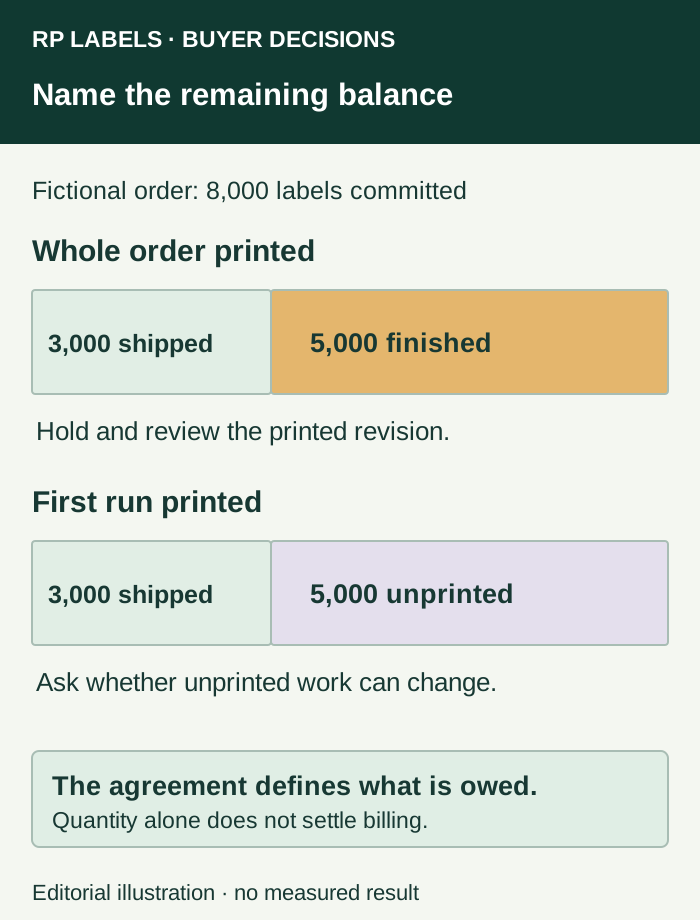
Consider an invented order for 8,000 labels on revision A. If all 8,000 have been printed and 3,000 shipped, 5,000 finished labels remain, assuming no adjustments. If 3,000 have been printed and shipped and the other 5,000 are only an open production commitment, there are no finished rolls to pick for the next release. The same undelivered quantity calls for a different response if revision B is introduced. Neither example determines what the buyer owes. That comes from the actual agreement.
Agree the change and release procedure before signing
- Name the current approved SKU, artwork revision and roll specification. Confirm which party can authorize each print run or shipment.
- Ask for the printed balance and any scheduled work that has not started. Include stock held at the supplier and rolls already delivered to the packer.
- If the revision changes, ask the responsible owner which quantities must be held, whether unprinted work may be amended and who can approve a revised release. Keep obsolete stock out of the eligible balance unless the applicable reviewer explicitly approves its use.
- Confirm how the written agreement treats remaining stock, storage term, billing, pickup, freight and any authorized disposal. Keep pending terms open instead of assuming a shipment schedule includes them.
- For each release, record the purchase reference, SKU, revision, roll quantity, destination, required arrival window and the supplier's confirmation. Ask for an updated balance after shipment.
If usage slows or copy approval is uncertain, compare a smaller firm run and a later production review with the larger commitment. If the design is stable, compare the delivered cost over the entire proposed schedule, including each release's actual charges and the treatment of any residual balance. Obtain written terms for the actual project. The delivered-quote comparison can help organize those figures.
Prepare one request the supplier can price
For custom supplement labels, send RP your SKU and release schedule, including approved revisions, expected quantities per period, destination and which quantities are firm. Ask for a separate description of production timing, available delivery options and what would happen to unfinished or finished balances after a revision. Keep standard one-time printing as a comparison when storage or release service is unavailable or unconfirmed.