The first bottle mockup usually has a large logo, a leaf motif and a color that will catch an eye on a crowded shelf. Then the copy owner asks where the product identity and contents count will go. I would answer that before approving the foil, not after the design has absorbed the last usable line on the front panel.
For a U.S. dietary supplement, front-of-pack is not simply brand space. The FDA's general labeling guide places the statement of identity and net quantity of contents on the principal display panel. The brand and a qualified regulatory reviewer remain responsible for final compliance. RP's role is to print the approved custom label accurately, not to certify the product's legal status.
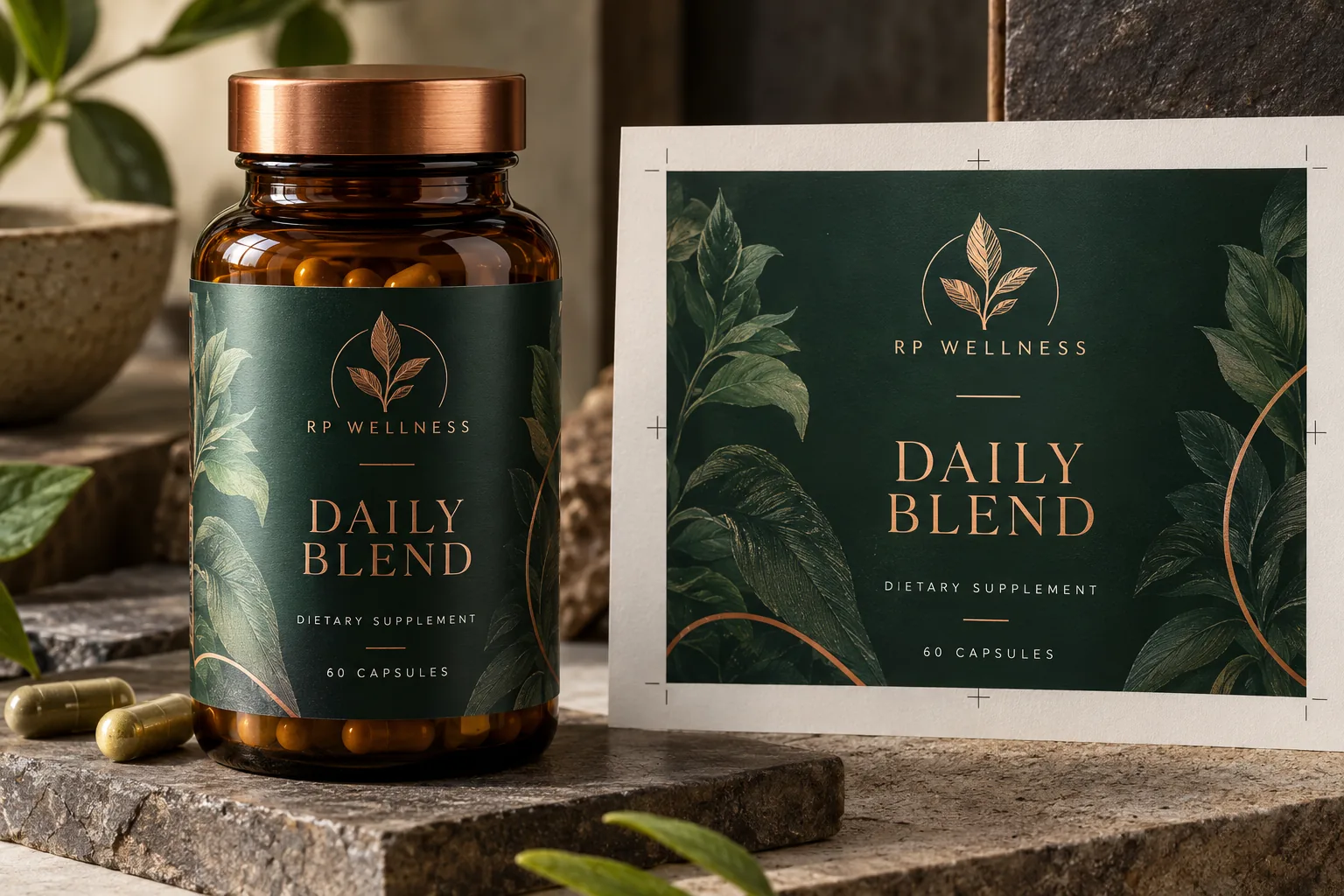
Separate the brand name from the product identity
“RP Wellness” can be the brand in a fictional mockup; it does not, by itself, tell a buyer what the product is. FDA's identity-statement guidance says the dietary-supplement identity belongs on the principal display panel and should be prominent relative to other front-panel matter. A buyer should therefore give the designer the final approved identity text before asking for a family of front labels.
For multiple SKUs, line up the longest approved identity in the design system. If the short name fits on the first flavor but a long name wraps awkwardly on the next one, the template is not stable. Decide where the product name can grow, and protect it from decorative circles, metallic accents or a logo that only works at one bottle size. The front-panel proof should be reviewed at actual size on a real bottle, not only on a flat monitor.
Reserve the net quantity as a distinct line
The FDA's net-quantity chapter describes placement as a distinct item in the bottom 30 percent of the principal display panel, generally parallel to the base, with a stated small-panel exception. It also explains that the permitted type size depends on the calculated display-panel area. The photographer's preferred crop or the designer's visual center is not the governing measurement.
Ask the brand owner whether the declaration is by count, weight, measure or a combination, and what wording its reviewer has approved. Do not improvise “60 capsules” because the sample bottle happens to contain that count. On a bottle with a curved or indented lower section, mark the real visible panel and measure the area correctly. If the net contents change from one SKU to another, the artwork and, potentially, the GTIN decision must change too.
What I would review on the physical proof
Rotate the bottle on the table the way a shopper or packer will handle it. Can the identity and quantity be read without hunting for the seam? Are they still visible when the cap is on and when the bottle sits behind a shelf lip? Does any metallic or patterned background weaken contrast? Check an actual-size print in normal light and confirm that the final container has the same diameter and straight-wall height as the proof bottle.
Keep required copy and promotional claims in separate review tracks. A marketing line may need legal review, but it should not displace information the brand has already determined is required. If the available front area is genuinely too small, reconsider the bottle or the label footprint. Shrinking every line is not a considered layout decision. Yesterday's Supplement Facts dieline guide treats the adjacent information panel; this guide is specifically about the front.
Brief the printer with approved facts
Send the exact bottle, market of sale, approved front-panel text, net-quantity declaration, target finish and all planned SKU variants. Note whether the product also uses a carton with an alternate display panel. The image above is an AI-generated design concept with fictional copy and cannot be taken as a compliant label. A custom supplement-label quote becomes more useful when the buyer provides final approved wording and a measured physical container together.
Sources and scope
Reviewed October 1, 2026. Primary FDA, GS1, HERMA and Avery Dennison references support the identified technical points. Buying scenarios and inspection checklists are editorial guidance, not RP production records, certification, legal approval or universal acceptance standards.