Custom Logo Hologram Stickers: Approve the Small-Size Mark
The logo looks impressive across a large presentation slide. On the small sticker that fits the carton, the brand name becomes the least noticeable part. Settle what has to remain recognizable before asking the printer to preserve every decorative line.
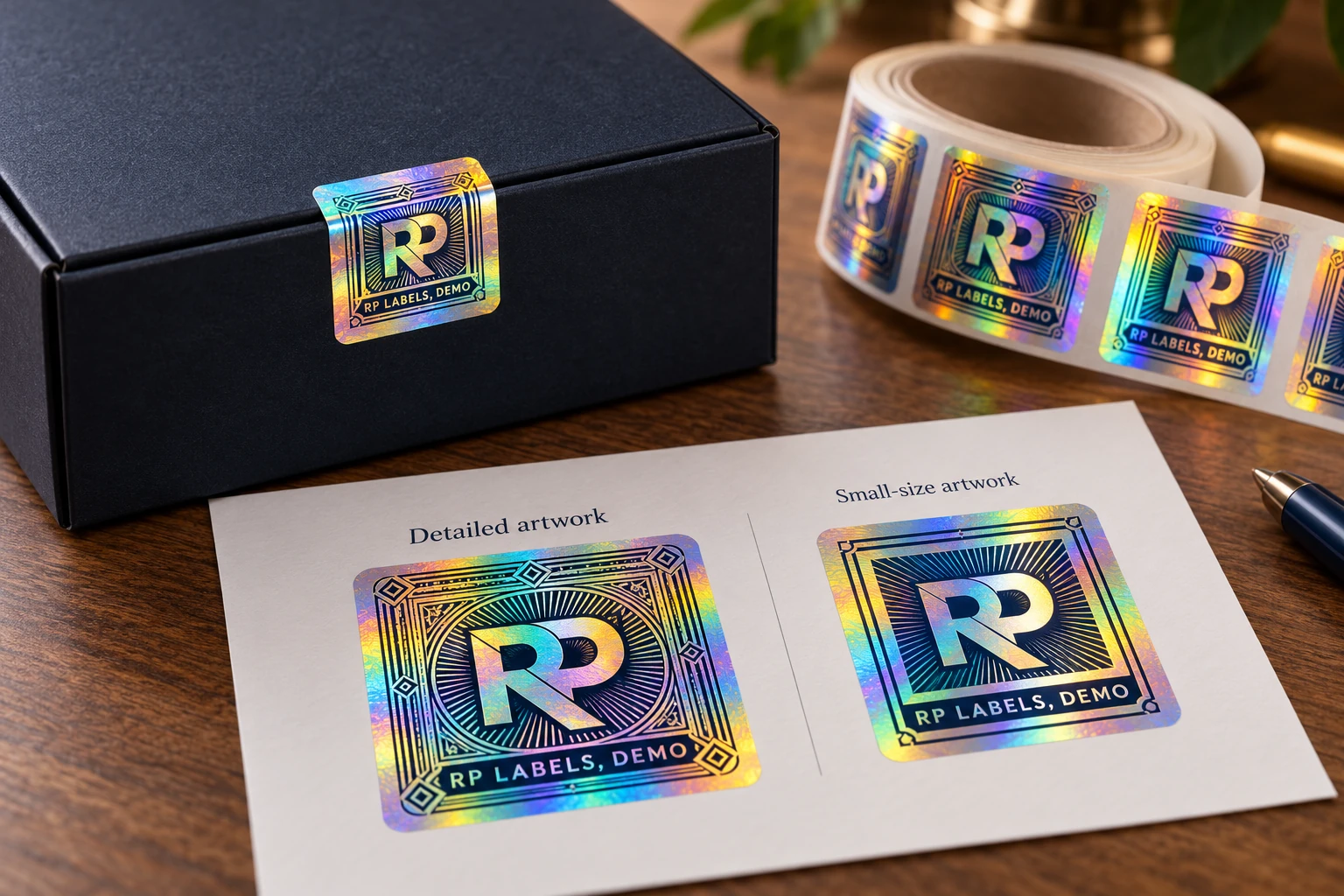
Small hologram stickers are often treated as a last-minute decoration. In practice, they are more effective when they act as a deliberate brand marker: on a bottle cap, box corner, outer carton, certificate, insert or sealed pouch. The package tells you what the sticker needs to do, which in turn decides its best shape and size.
Make a small-size master instead of shrinking the brand file blindly
Start by asking the brand owner which element carries recognition: the symbol, the wordmark or both. Keep that decision separate from the optical decoration around it. A complex border may be attractive at a larger size while contributing little on the intended sticker. Removing it can protect the recognizable mark without making the project less deliberate.
Prepare two identified proofs on the same proposed shape and size: the full-detail artwork and a simplified small-size version. Keep the essential brand proportions controlled. Review the actual printed or optical proposal on the intended package under ordinary light and through a few useful viewing angles. An enlarged digital rendering can check placement; it cannot reproduce the complete reflective appearance.
Ask the supplier to state whether the logo is a surface imprint over a stock pattern, another printed treatment or part of a proposed custom optical image. A simplified print proof does not approve an optical origination, and a physical stock pattern does not establish that your logo has been embedded in it. Record the sample and scope actually offered rather than selecting the most impressive meaning of 'custom'.
A bold monogram may win for a small cap marker, while a longer brand name may justify a larger rectangle on the carton. An existing pattern with a readable imprint can be sufficient for a visual branding brief. If the buyer requires a controlled optical feature, keep that separate specification and acceptance process open. This article's recognition review does not establish authentication or tamper evidence.
Use the small-size artwork sheet to identify retained, simplified and omitted elements and who approved each change. If the mark cannot remain recognizable in the available space, change the size, placement or brief rather than approving an unreadable miniature. Send RP the vector brand file where available, package photo, intended dimensions, essential elements, quantity and required customization scope. The next proof should answer which mark the buyer will actually recognize.
Download the worked example CSV · Open the working CSV · Read the field guide. The entries are planning examples, not completed results.
Start with the real package surface
A tiny round mark may fit a jar lid or cap. A narrow strip can work across a box edge. A custom die-cut shape can carry a distinctive logo on a flat carton or pouch. Before choosing a design, identify the available area, whether the surface is curved or textured, and whether the sticker will be handled repeatedly.
| Round logo sticker | A focused brand mark for lids, caps, jars and compact product panels. |
|---|---|
| Custom shape | Useful when the silhouette itself is part of the brand, provided fine edges remain practical at final size. |
| Holographic strip | Works across box corners, sleeve edges and long narrow package areas. |
| Logo plus code field | Possible when the code is kept on a calm high-contrast panel rather than buried in the effect. |
Simplify logo details for the final sticker size
Intricate line art, very small lettering and low-contrast elements can lose definition on a compact reflective sticker. Preserve the logo elements that make the mark recognizable: the wordmark, symbol, outline or a simple pattern. A proof is the right place to decide whether a detail should be enlarged, removed or moved to another part of the package.
Custom logo hologram checklist
- Best available logo artwork, ideally vector when available
- Photo or dimensions of the application surface
- Preferred shape, approximate size and quantity
- Whether the sticker is a brand accent, closure seal or packaging marker
- Any text, serial field or QR code that must remain readable
- Roll or sheet format and machine requirements if applicable
Choose a finish for the brand, not just the photograph
Holographic material looks different as the pack moves under real light. A full rainbow effect can be bold and playful; a more controlled pattern can feel refined. Check the proof for the way it supports the logo, and avoid using a reflective background for information that must be read quickly.
Use one approved proof as the reorder reference
Turn your logo into a usable hologram sticker
Send your logo, packaging photo, target size and quantity. We can help choose a custom shape and prepare a practical proof before production.
Chat on WhatsAppKeep the approval objects distinct
The source logo, the small-size adaptation and the offered physical sample should each have a reference. A brand owner may approve simplification of a border without approving a change to the monogram. The printer may confirm a printable line without confirming that the intended viewer recognizes the brand. Write those decisions separately so one signature does not inherit a larger meaning.
When more than one size is ordered, check the actual-size version for each cut rather than assuming the larger approval covers every reduction. Keep the selected artwork and physical sample references with the reorder brief. If the optical treatment changes, review the affected mark again. Consistency means controlling the decision that matters, rather than freezing every decorative detail regardless of its final size.
Bring the decision into your print brief
Use the identified references and open items in the worked record when discussing your custom print project. Include the actual package, artwork revision, quantity per design and the conditions explained above; leave unknown inputs marked for confirmation. Review the relevant custom-label service, then send the project details to RP Labels.
Related buying decisions
- Custom vs Stock Hologram Labels: What Are You Paying For?
- Custom Hologram Master: 2D/3D vs Dot Matrix
- Hologram Microtext and Guilloche: Give Inspectors an Accepted Reference
Sources and scope
Reviewed October 25, 2026. Primary supplier or official reference supports the identified production concept. Procurement comparisons and worksheets are editorial guidance. Conditional examples are not customer records, completed tests, regulatory approval or universal acceptance standards. Confirm the actual proposed construction and process with the responsible supplier and buyer.