Digital vs Flexographic Vial Labels: Compare the Whole Order
A lower repeat price can make a flexographic quote look settled. Then one design changes before the next order. Before choosing a print process, ask which parts of that attractive price depended on keeping the artwork unchanged.
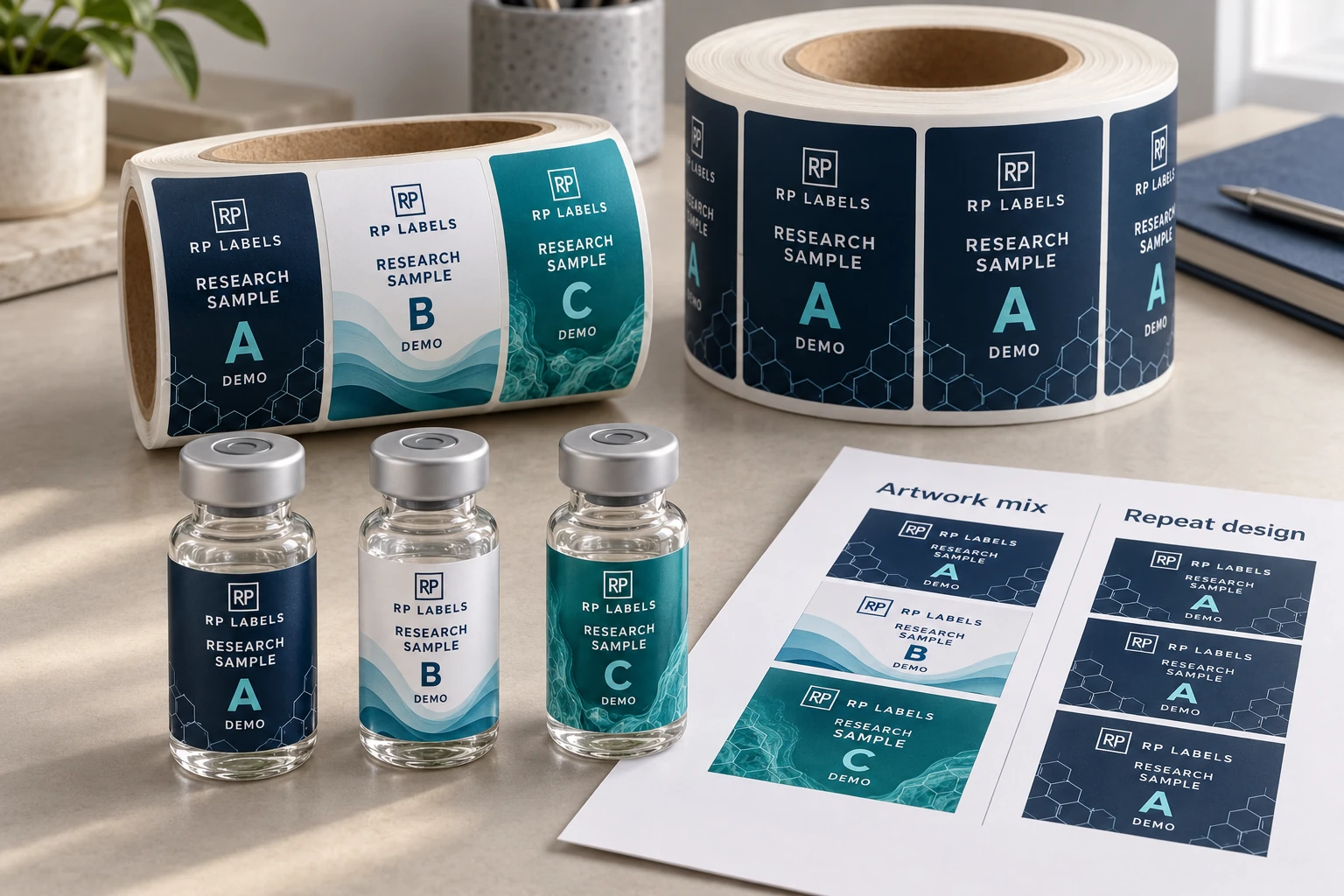
The short answer: digital printing usually suits short runs, multiple SKUs and changing data because it avoids conventional plates and limits setup. Flexographic printing becomes more economical when one stable design repeats at larger volume and the setup cost can be spread across the run. There is no honest universal crossover quantity.
Ask for three versions of the quote before choosing the press
Imagine a range with three approved artworks and an uncertain reorder. The first quote spreads setup across the launch. The second looks better on a repeat, but the buyer does not yet know which designs will stay. I would keep the forecast and the order being approved in separate columns. A hoped-for reorder is not a purchase order that can carry today's setup cost.
Ask each supplier to price the same three situations: the first run, an unchanged repeat of the same quantity mix, and a repeat in which one identified artwork changes. Keep material, white layer, finish, cut size, pieces per design, usable count and finished roll format constant wherever possible. If a supplier proposes a different construction, show it as an alternative rather than quietly treating the prices as equivalent.
For every situation, separate setup, printing, finishing, variable-data work and roll packing in the way the supplier actually quotes them. Ask which charges recur and which tooling can be reused. The point is not to demand an artificial cost breakdown that the supplier cannot provide. It is to obtain a written total and a clear list of its conditions, exclusions and validity.
The decision can then change without anyone being wrong. A stable repeat design may justify flexo preparation. A small range still revising individual files may favor digital flexibility. A specialty effect may make a hybrid or separate finishing route worth comparing. None of those options deserves a universal crossover quantity copied from another printer's job.
Use the scenario worksheet to attach each total to an artwork revision and delivery format. Leave unquoted charges marked for clarification, not zero. If only the unchanged-repeat case favors one route, ask whether your approved forecast supports that case before committing to it. Send RP the SKU quantities, revision state, proposed construction and required roll format so the comparison starts with the same job.
Download the worked example CSV · Open the working CSV · Read the field guide. The entries are planning examples, not completed results.
Count artworks before counting labels
A digital press can move between approved files without making a new printing plate for each color separation. That gives it an advantage when a peptide range uses many dosage strengths, color bands or regional versions in modest quantities.
Flexo has more preparation: plates, mounting, ink setup and press waste before stable production begins. Once the job is running, however, a long repeat order can use that setup efficiently. A buyer with one design and a reliable forecast has a different cost path from a launch brand still changing names and codes.
The finishing route can erase a simple press comparison
Printing is only one part of a roll label. Lamination or varnish, white ink, die cutting, matrix removal, slitting and rewinding still have to happen. A digital job may avoid plates but require a separate finishing pass. A flexo line may complete several steps inline.
Buying rule: compare total setup, finishing, SKU changes and expected reorders. Do not choose a process from cost per printed label alone.
Color should be approved by result, not reputation
Digital printing can reproduce detailed images and switch artwork efficiently. Flexo can run strong spot colors and stable long production when plates, anilox, ink and press conditions are controlled. Neither process is automatically more accurate in every factory.
For a brand family, define the real priority. If a dark navy must match cartons and future runs, provide a physical color target and discuss spot color. If each SKU changes frequently and small variations are acceptable, a managed digital CMYK build may be more practical.
Clear film and white ink need a separate conversation
Both processes can work with white and clear films, but opacity, screen texture and the order of white and color layers can look different. Metallic or holographic materials add another variable. Ask for a sample on the intended construction instead of approving from a paper color chart.
Variable data strongly favors a digital workflow
When every label carries a unique QR code, serial or changing text, digital production can integrate that variation without a new plate for each value. The data file, code validation and duplicate control then become part of the job. A printed code is not useful merely because it looks square.
Do not change processes silently on a repeat order
If a launch run begins digitally and later moves to flexo, approve a transition sample. Screening, white ink, color density and finish can shift even when the artwork file is identical. Keep one physical standard and record the material, adhesive, finish and press route used for the approved batch.
Printing-method brief
- Total quantity and quantity per artwork
- Number of SKUs, languages and dosage variants
- Expected reorder frequency and forecast stability
- Critical spot colors or acceptable CMYK targets
- White, clear, metallic or holographic facestock
- Lamination, varnish and die-cut requirements
- Static, batch-level or unit-level variable data
- Roll core, unwind, diameter and finished-roll count
Bring the decision into your print brief
Use the identified references and open items in the worked record when discussing your custom print project. Include the actual package, artwork revision, quantity per design and the conditions explained above; leave unknown inputs marked for confirmation. Review the relevant custom-label service, then send the project details to RP Labels.
Related buying decisions
- Small Batch Peptide Labels: How to Start at a quantity confirmed on the quote Without Making the Packaging Look Cheap
- Label Plate and Die Charges: What Carries Over to Your Next Order?
- Vial Label Color Matching: Choose a Physical Master for the Reorder
Sources and scope
Reviewed October 25, 2026. Primary supplier or official reference supports the identified production concept. Procurement comparisons and worksheets are editorial guidance. Conditional examples are not customer records, completed tests, regulatory approval or universal acceptance standards. Confirm the actual proposed construction and process with the responsible supplier and buyer.