Repeated QR Scans on Security Labels: Write the Review Response Before Printing
A customer scans a pack twice. A warehouse may also have scanned it before dispatch. A copied identifier can create repeated activity too. Those possibilities do not lead to the same conclusion. Before ordering unique QR labels, decide what the visitor sees and who reviews the cases the system cannot explain.
The customer has the pack in hand and wants reassurance. The service team has an event log and may not yet know why the code appeared before. I would write the uncertain response before the confident one. A useful review route protects the customer relationship while the responsible team checks what the signal actually supports.
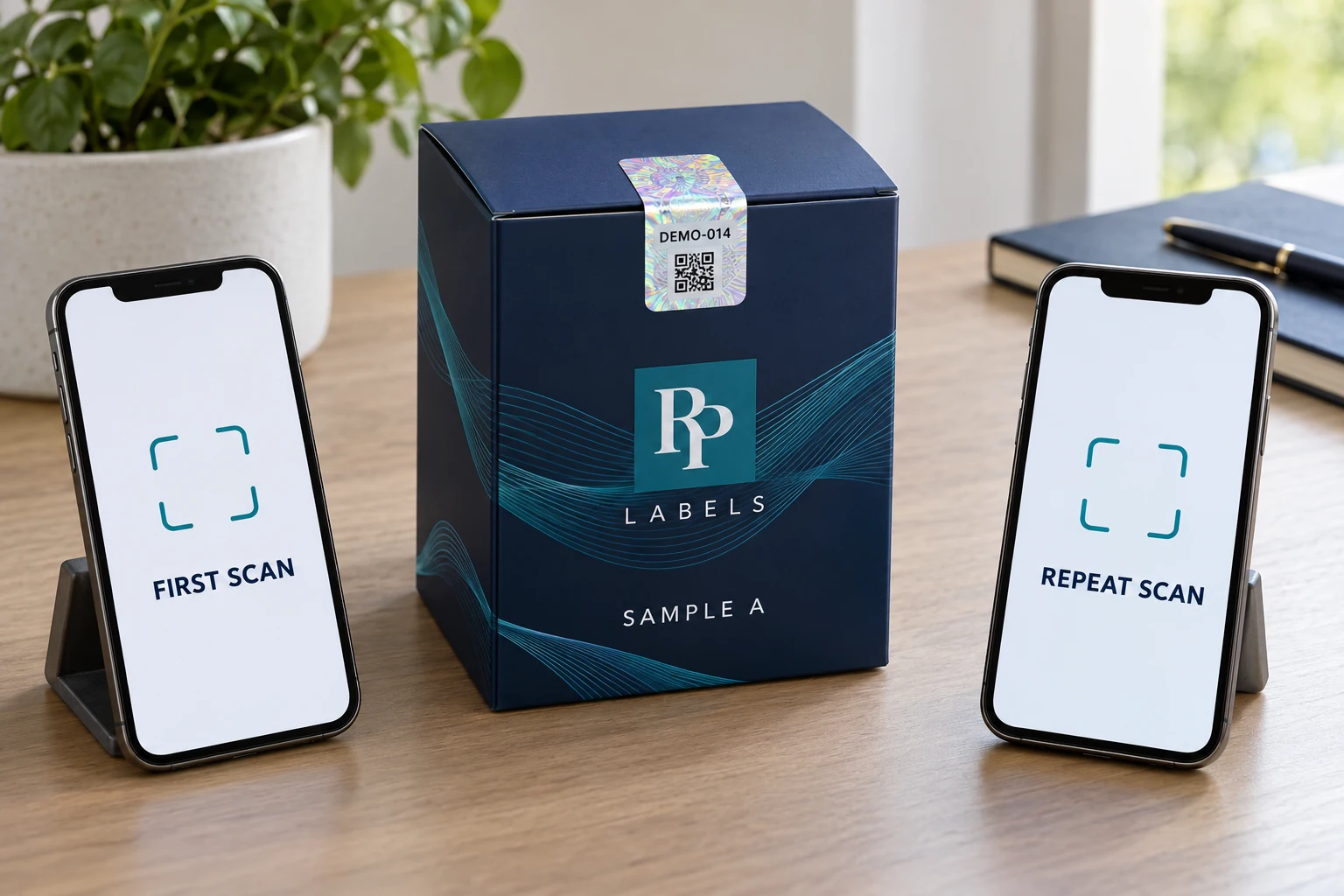
AI-generated packaging illustration. Fictional RP samples show the proposed decision; no physical test or customer order is documented.
Rehearse the response with dummy identifiers
Have the system owner create a test environment or controlled demonstration record. Use dummy identifiers supplied for that purpose; never expose live concealed values in a public example. Ask the customer-service owner to read the proposed first-scan, repeat-scan and unavailable-service messages as a buyer would. The wording should state what is actually known.
The worked response matrix includes a legitimate repeat visit and an unexplained repeated event. Both can say that the identifier has been seen before, but only the latter may need a review route under the brand's chosen rules. Neither row declares a product fake. The responsible security provider must determine which signals support stronger conclusions. Printing a unique code does not supply that analysis.
Test the handoff as well as the screen. Who receives the case, what identifier can the buyer share, and what useful fallback exists if the destination cannot respond? Avoid exposing another customer's activity or sensitive location information. The brand's service and privacy owners should approve the applicable data handling.
A static information QR can be enough when the task is simply to open a product page. A unit-specific verification program adds data and operational obligations. Buy that complexity only if someone owns it beyond the print run. For the physical label, keep the code data, readable identifier and approved artwork linked in the supplied file.
Send RP Labels the demonstration schema, intended code format, label size and the print-only scope needed. Keep the system provider's release separate. The label is ready for its role only when the printed example reaches the intended record and the response owner has approved what happens next.
Define the identifier separately from the visit
A serial identifies a specific label or pack when the system is designed to manage it. A scan is an observation about that identifier at a time and place. GS1 explains the distinction between serialization and unique identification. Its digital-signatures standard notes that barcode data can be copied and that conflicting observations may indicate cloned instances. “May” matters: a duplicate scan by itself is not proof of fraud.
Choose whether the public code is static per SKU, unique per pack, or paired with a concealed factor. If a brand wants a true security claim, ask a competent security provider to design the backend and threat model. Do not call an ordinary QR link counterfeit-proof. A visible unique code can still be photographed. The static versus unique guide explains the printing tradeoff; here the decision is how the system responds after printing.
Write three outcomes before approving artwork
Document who receives alerts and how a genuine customer can report a problem. If the web service is unavailable, the page should offer a useful fallback rather than a dead link. The brand also needs to decide retention periods, privacy notices and access permissions. GS1's 2D barcode implementation guidance flags web-security and privacy considerations when QR codes lead consumers online.
Make the printed roll match the data file
For variable printing, provide a controlled source file with one identifier per expected label, rules for duplicates and rejected impressions, and the intended URL pattern. Decide whether replacement labels may reuse an ID. Preserve a record of produced, rejected and shipped ranges. If the converter cannot reconcile the physical rolls with the data file, the website may register scans for codes that were never released or fail to recognize legitimately shipped packs.
Check a physical sample from the actual holographic material with the intended phones and scanners. Reflective foil can change camera contrast; keep the QR area and quiet zone readable. Test the first and last labels of a sample roll and compare their serials against the supplied data. The scan-contrast guide focuses on that print detail.
What belongs in a purchasing brief
List carton or product surface, label size, holographic effect, number of unique identifiers, print file owner, website owner, duplicate-scan screen owner, and the person who approves the response wording. Keep printing and software quotes separate. A lower per-label price is not a complete security-system price, and a beautifully printed code does not supply a database.
When you request a custom holographic QR-label quote, send the artwork, code format, sample destination and the desired physical verification method. The brand should be able to answer what the second scan says before the first production roll is released.
Sources and scope
Reviewed September 30, 2026. Primary FDA, GS1 and label-material references support the identified technical points. Buying scenarios and inspection checklists are editorial guidance, not RP production records, certification, legal approval or universal acceptance standards.
- GS1: digital signatures, copied barcodes and conflicting observations - GS1: serialization and unique identification - GS1: retail 2D barcode implementation and web-security considerations
Worked duplicate scan triage record
The rows below are hypothetical planning examples. Empty observation or commercial fields must be completed from the actual project; no sample has been tested for this article. Use the worked CSV and blank worksheet with the field guide. Keep the example references separate from production records.
| test case | dummy identifier | event context | customer message scope | review route | response owner | observed result |
|---|---|---|---|---|---|---|
| Legitimate repeat | DEMO-014 | Same owner revisits | State prior activity without fraud verdict | Help route if needed | Service owner | |
| Unexplained repeat pattern | DEMO-015 | Context not established | State need for review | Brand-defined investigation route | Security and service owners |
Bring this decision into the print inquiry
Contact RP Labels with the completed duplicate scan triage record, the actual packaging reference, approved artwork and quantity per design. State which fields remain unresolved so the print specification and any relevant sample scope can be discussed against the same decision.
Related buying guidance: 3D Holographic Labels; Static versus unique QR codes; QR destination ownership; Serial-number reconciliation.